
The morning was relaxed, have breakfast and get ready to meet my fixer. Heydar is my contact point to take care of handling my motorbike. This includes going through all the customs procedures, transporting the bike to different places and finally uncrating the bike. The kick-off for this process was signing a POA (power of attorney). To do this, we met at the ASAN building; I had to take a taxi in front of the hotel that seemed to have circulated in Britain a loooong time ago and hasn’t seen a service in a long time. Add a 75 year old driver who needed my phone to find the place and it turns into a little adventure.
I met Heydar at the entrance of building and learned something about Azerbaijani efficiency. The building contains all king of administrative public services, including notarisations. After having passed an entrance desk, we had to wait for our number to show up at one of the many desks with modern displays. When it was my turn, the prepared document was printed and I had to pay 17 EUR at the friendly cashier who outed himself as a supporter of Bayern München. Another clerk read out loud the document, translating into English. After I agreed, I was asked to enter the office of the notary who seemed to be, in contrast to his female clerks, of the grumpy kind. After reading, he countersigned and the job was done. The whole procedure too probably around 20 min, very impressive indeed. With this document, Heydar can do all the necessary actions in my name without me being involved the whole time.
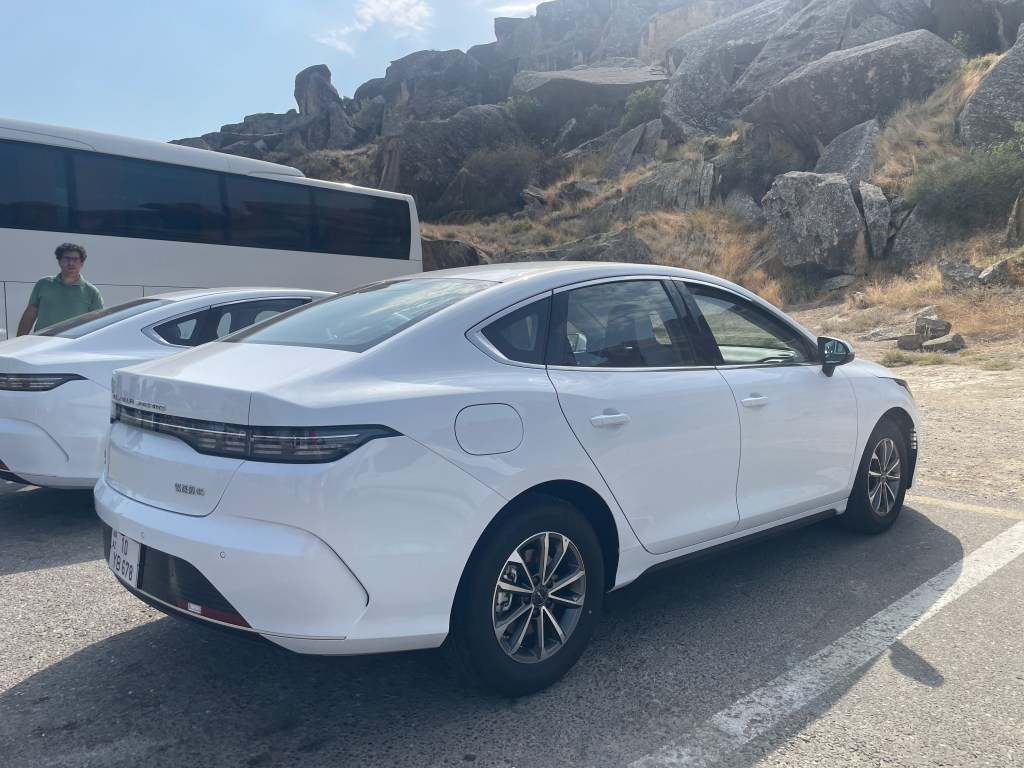
As the friendly taxi grandpa had waited, I took another squeaky and rattling taxi ride back. There, I prepared my excursion of today; I picked my car and drove one hour south of Baku. The glitz of the capital changed to the arid, dry country that surrounds it. The traffic in Baku is super compliant with speed limit, an extremely high number of cameras and police officers are a clear warning. Even on the highway with a speed limit of 90 km/h, cameras are a permanent companion. I finally came to terms with the Chinese car and figured out how the cruise control works, an important feature here.
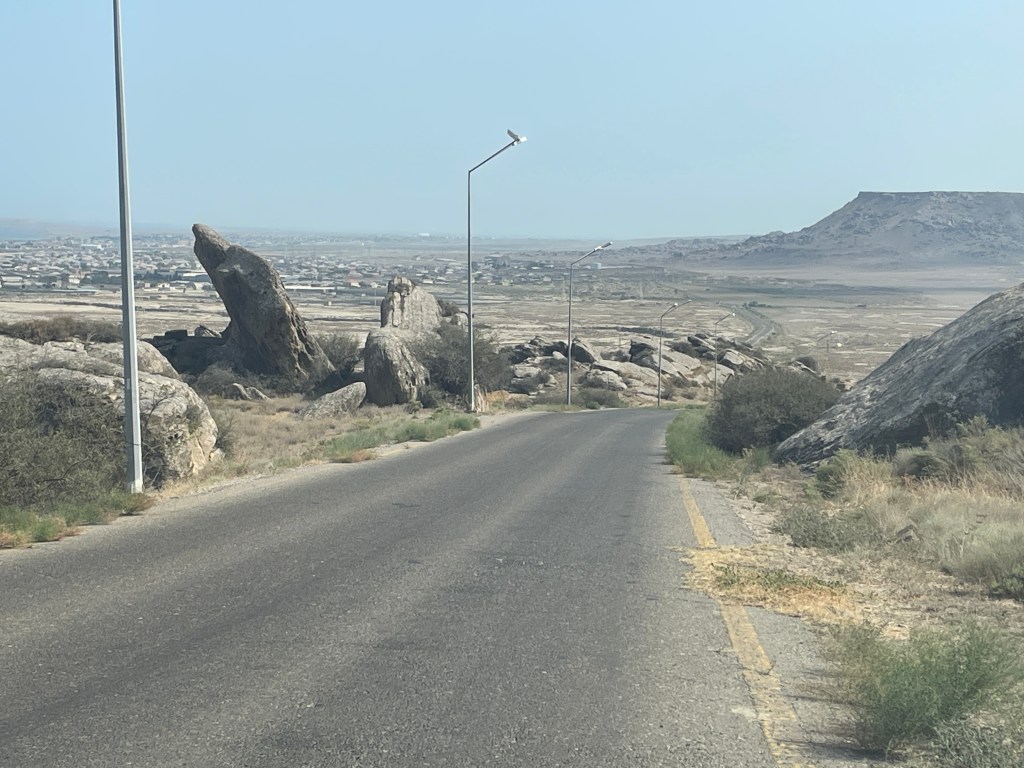
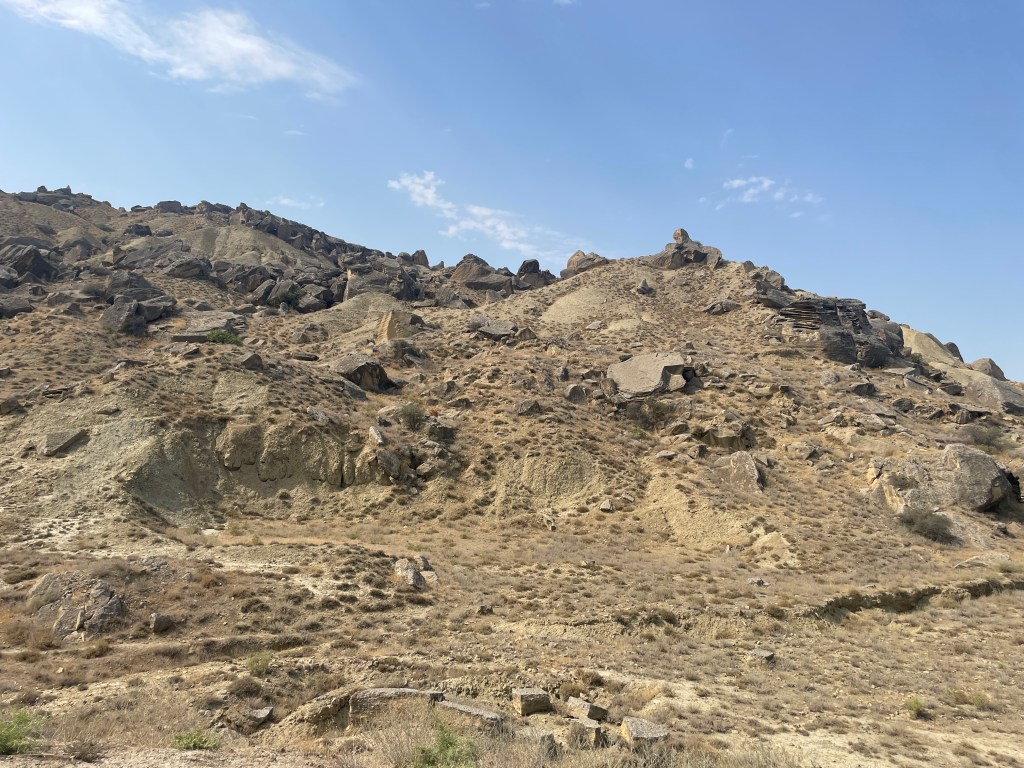
At the town of Qobustan, I took a turn and drove towards the area of two sights: the UNESCO-listed petroglyghs and the area of mud volcanos. When I neared the site, drivers tried to wave me down. As usual, I ignored them and stopped at a police control. The officer explained that the museum was open, the small mud volcano area was closed and the large area required a guide and a rough ride. Aha. So this was the plan of the drivers. Well, I remember a trip to Romania in 1994 when I had to endure a half-day detour because my colleague, a geologist, needed to see the mud volcanos there; however, the experience was more than underwhelming.
So quickly I decided against the mud volcanos, anyway I was not so keen to wander around for an extended time in the burning afternoon sun. So I told the officer I would visit only the museum and the petroglyphs, no guide needed. First I visited a little, but very modern museum explaining the settlements in the area. This area had been populated for hundreds of thousands of years. For the last 20.000 years, petroglyphs had been carved into the rocks and caves in the areas. The museum explains the circumstances and conditions when the many rock carvings were created.
Another 2 km up the hill was another parking where an itinerary started that led along many carvings with explanations. Carvings had the best chance of remaining when they were protected from the environment a bit.
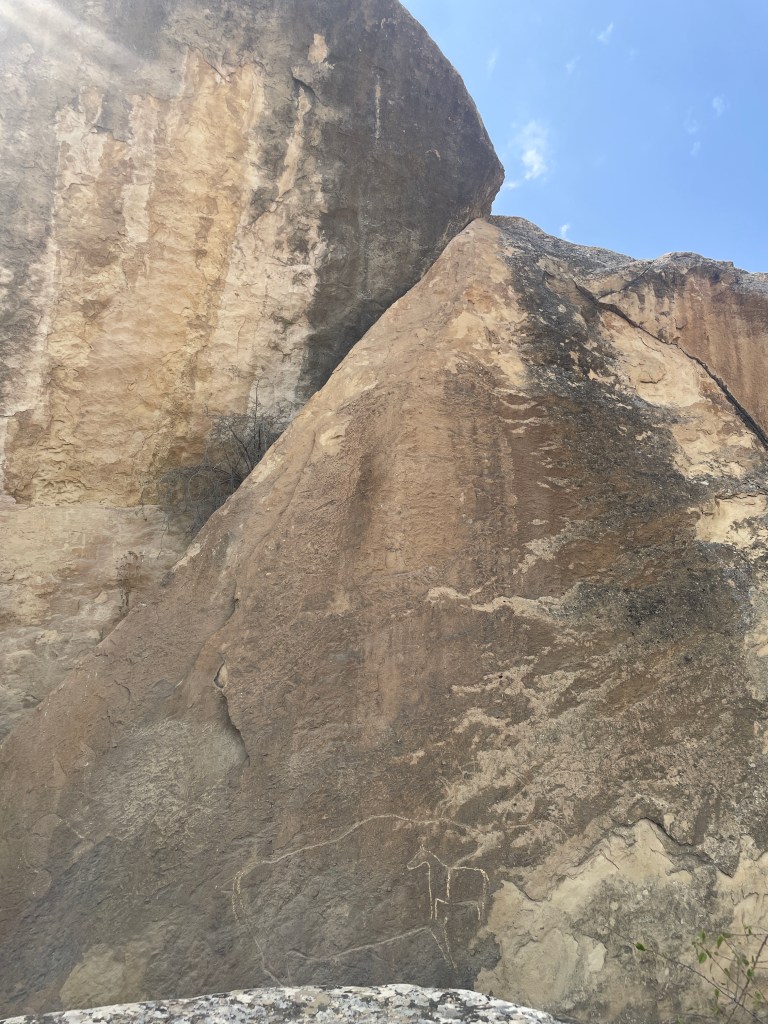


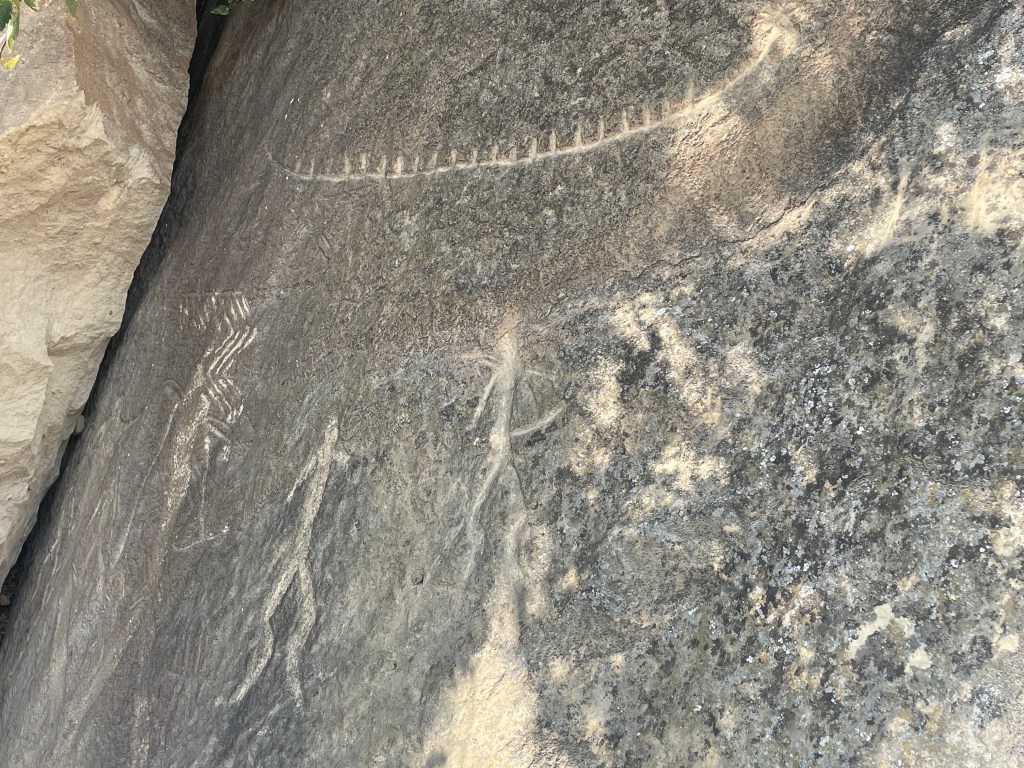
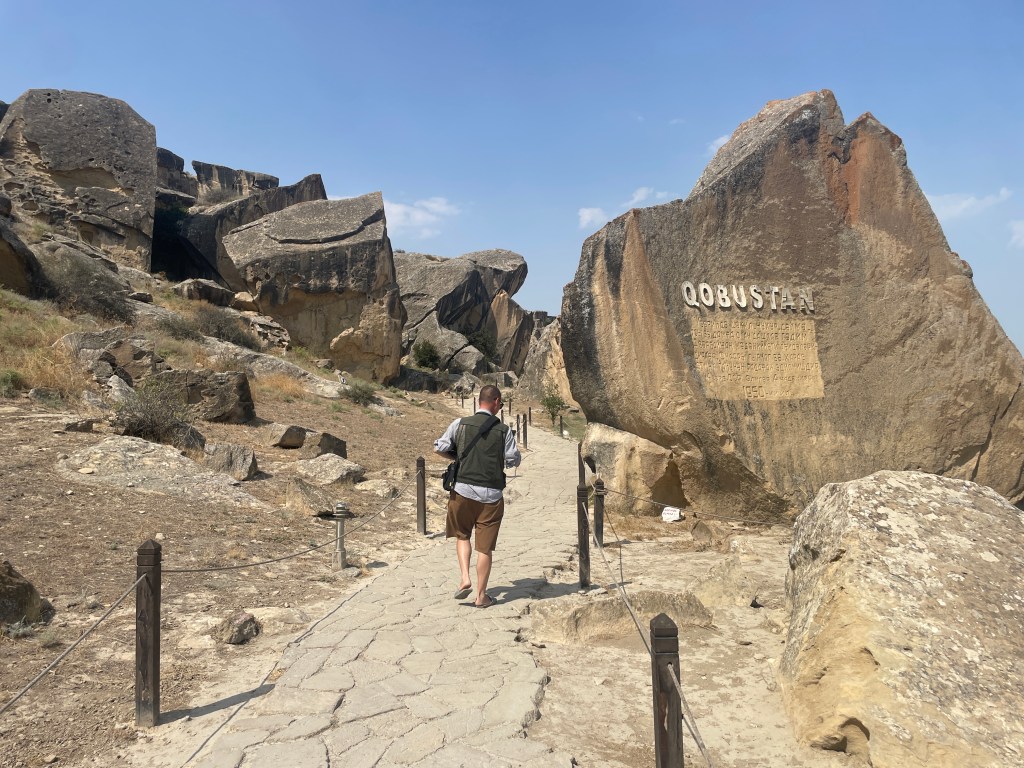
The carvings are very abundant and were engraved over thousands of years. Interestingly, some of the petroglyphs of men and boats reminded me of similar rock carvings I had seen in Northern Norway and in the centre of Sweden; the shapes of animals reminded me of the caves of Lascaux in Vézère, France. This place is a kind of prehistorical Louvre. Although the shapes are minimalistic, the artistry is impressive in many carvings.
The Gobustan Rock Art Cultural Landscape is a historic site in Azerbaijan, comprising a large collection of petroglyphs that reflect the flora, fauna, hunting practices, social structures, and cultural expressions of human societies from prehistoric to medieval times. These engravings provide detailed depictions of anthropomorphic figures, such as lance-bearers and ritualistic dance scenes, as well as various animal species, bullfighting events, camel caravans, and celestial symbols such as the sun and other stars. Estimated to date back approximately 5,000 to 20,000 years, the rock art offers insight into the spiritual life and daily activities of early human populations in the region.
From Wikipedia
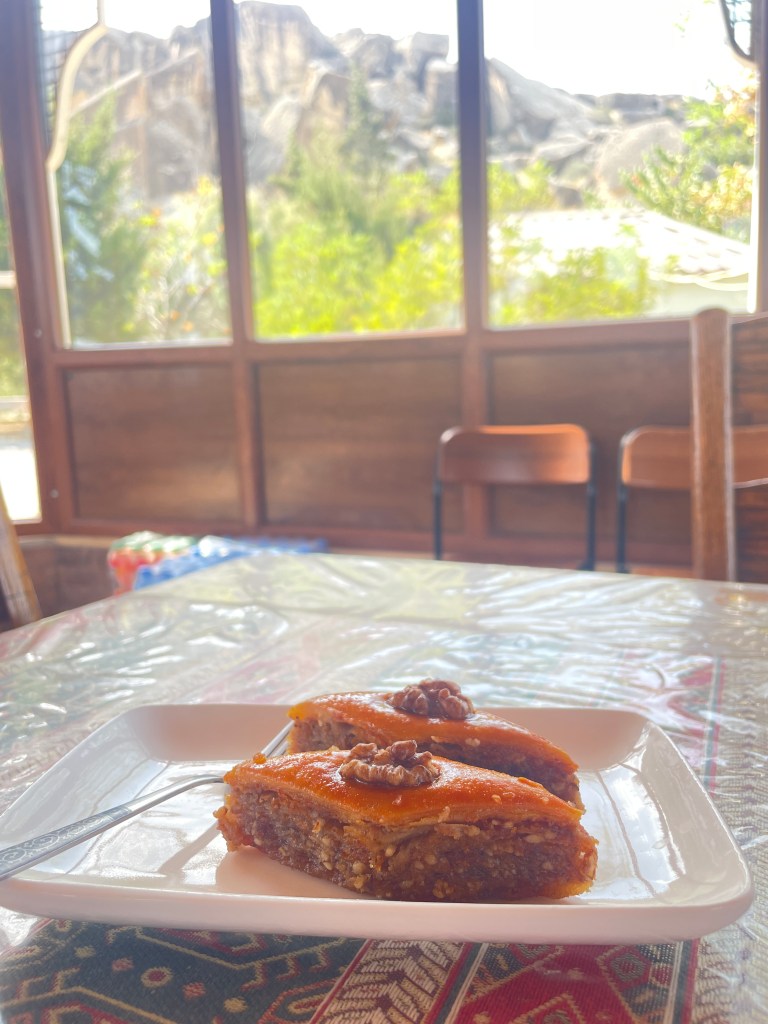
I enjoyed the shadow of the rocks where I could. At the end of the walk, a little café with air condition was very welcome to cool down. I ordered some local pakhlava that was very tasty. I returned to the car and headed back to Baku.
When I reached the outskirts, I made a detour to the Motomondo shop, located in a large car selling terrain (Auto Merkezi). I had dared to smuggle a small bottle of chain lubricant in my luggage but did not dare to send motor oil. The shipper had refused to keep it in the panniers. So I needed to get some motorbike oil, with an old bike like the XBR with a wet clutch, modern car oils with their many additives result in a slipping clutch. I entered the showroom with many motorbikes and uttered my wish to purchase some motor oil of the more viscose kind. I obtained two litres and continued to chat with the owner. This conversation took a longer turn when Sahir, the owner invited for some tea. For an hour, we discussed motorbike topics, he even knew the Iron Butt Association! The conversation was in English, but he also involved his girlfriend who was talking in Russian. This shows the multilingualism of Baku, where locals speak many languages. A pleasant, unexpected intermezzo.
I returned to the hotel and had to try out the quite well-equipped fitness room. After a good sweat and some huffing and puffing, I had a shower and prepared myself for a walk to the centre where I would visit the Dolma Restaurant, a folkloristic restaurant with good traditional food. Many tourists, but this is to be expected. I ordered some delicious fried eggplant salad and a lamb sajd, all delicious. After a walk through the calm, but beautiful pedestrian street, I returned to the hotel.


It seems that the motorbike clearance moves faster than expected, tomorrow I’ll know more.


Leave a Reply