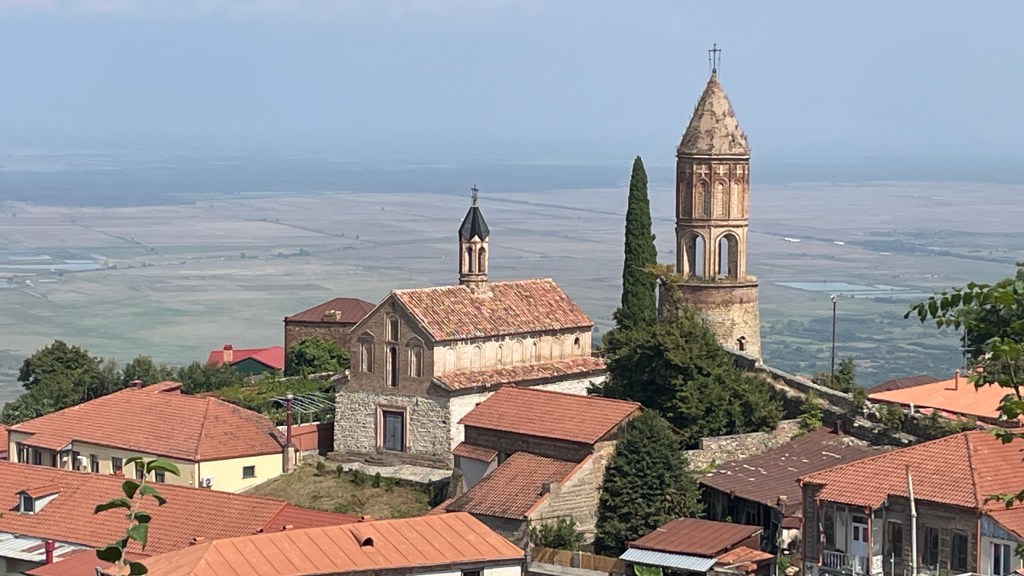
The morning could only start later. It was not because the night before, I had carelessly ordered a double Macallan whisky, not knowing that a single shot is 50 ml! So that makes five drams in one go. Nice.
No, I was fine, but the breakfast would only be served at 8 p.m. But what a huge buffet it was! I packed my stuff and only at 9:40 I left the plush resort by the huge front porch, with a chugging and rattling XBR…
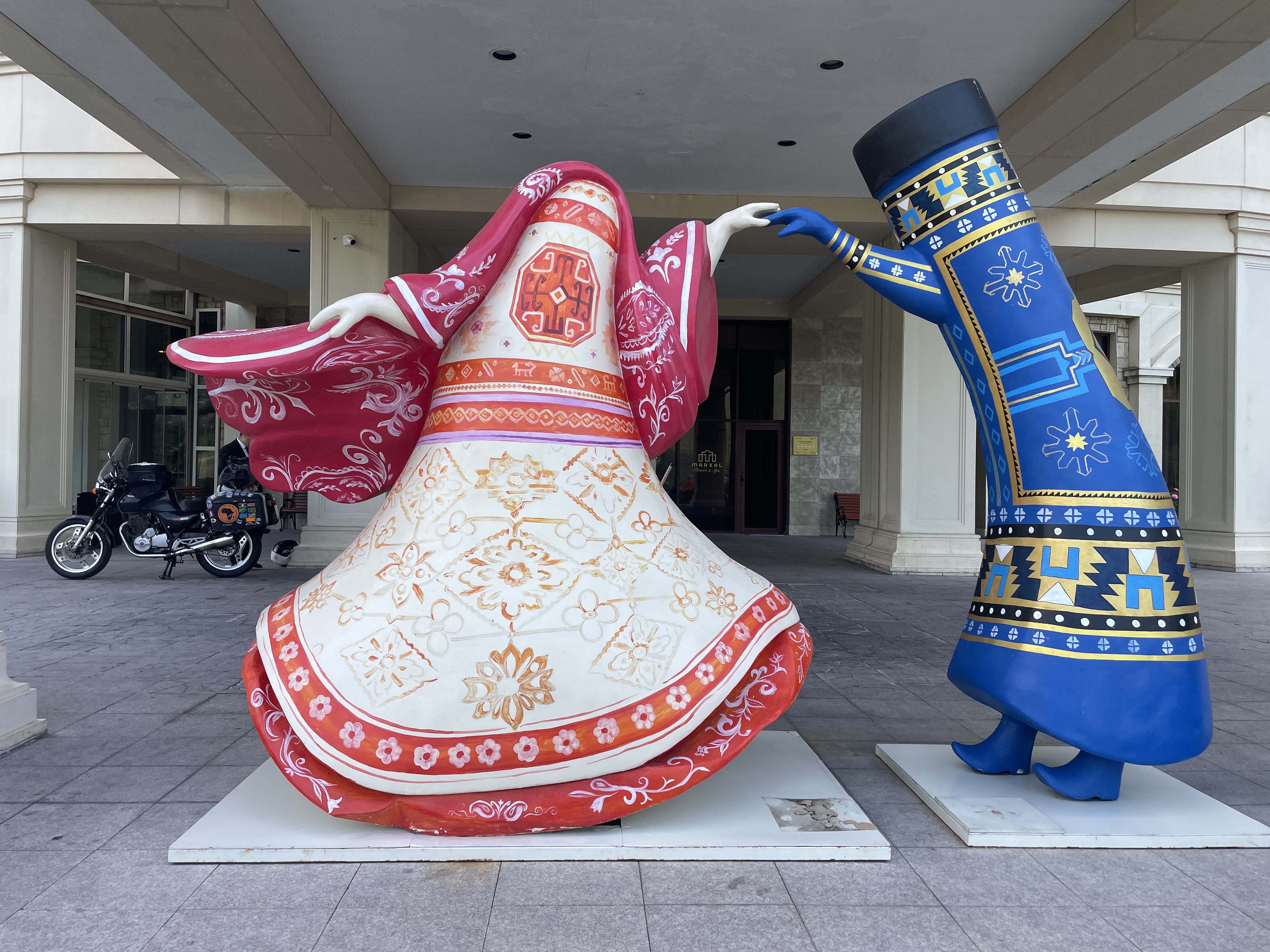
I followed the road to the northwest, along the mountain range. The road was excellent as yesterday until….it wasn‘t. What had happened? The next 30 km were of the ‚at least it‘s not raining‘ kind, potholes, bumps, tarmac patchwork. Horrible. The maximum possible speed was 50 a 60 km/h with maximum concentration. At least the trees next to the road were nice.
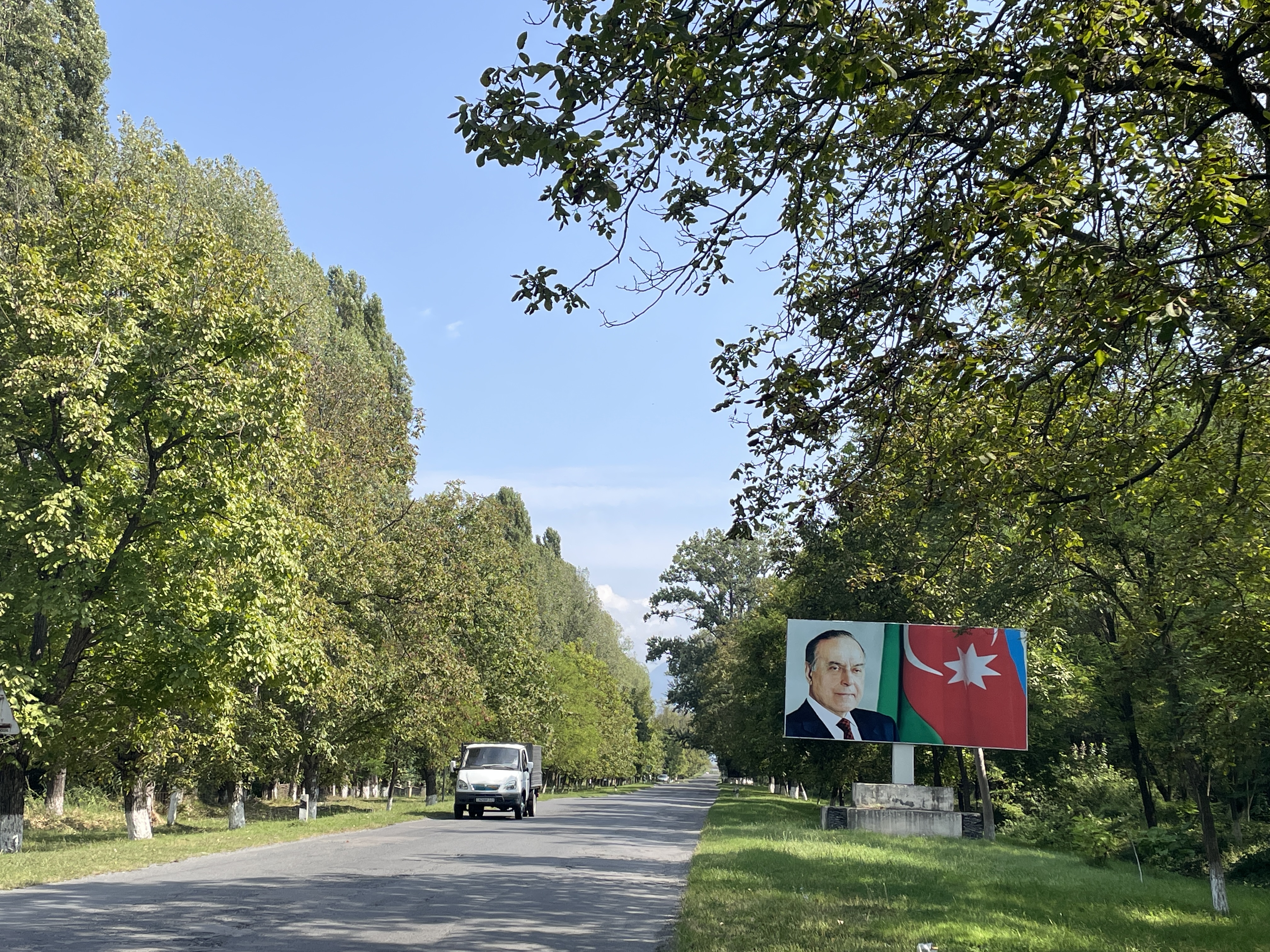
And then suddenly in Zaqatala, the nice tarmac was back. I filled up and topped up the oil… an acceptable oil consumption considering the high temperatures.
Slowly the temperature started to rise again and after another 50 km I reached the border area. Since the last town there was no traffic. Remember, the land border is only open for trucks and exiting tourists.
Passport control at the entrance to the compound. At the control station: passport bike registration. Handed to a clerk in an office. Waiting. Patience. Then to another officer in another office. Visa. Patience. Open the panniers. Ok. Leave to the exit of the compound. Show passport and ticket to leave. Good. Ride on the bridge in nomansland.
The letters state just ‚Georgia‘ without the usual ‚welcome to‘. This was meant as a warning. Georgia is somewhat rougher than gentle Azerbaijan. As Emily Lush puts it in her fantastic travel blog:
Travellers have been conditioned to expect instant warmth or overt friendliness. In reality, everyday interactions in Georgia tend to be more reserved – people rarely smile or make small talk with strangers, which can be misinterpreted as unfriendliness.
This is most noticeable in the service industry, where norms are very different from what you might be used to. Interactions are typically direct and task-focused, with little emphasis on performative friendliness or cultivating rapport. If these are your first points of contact, it’s easy to come away with the wrong impression – even though this reservedness (sometimes borderline hostility!) is usually nothing personal.
Well, the treatment at the Georgian border was exactly like that. Very formal and demanding. Passport. Bike registration. Mandatory travel insurance. Hotel booking. How much money? Show me! Finally, everything was inserted in the system and I could go.
I started the XBR and rolled 10 metres. Stop! Customs control! What? Open panniers. Open everything! I had to show and open everything. Panniers, tank bag, bags, jacket. Everything was stripped by three people. And only one had a proper uniform. With stoic patience, I complied, but assembled and fixed everything with extra slowness. If you give me a hard time, I make you wait.
Finally they were done without cracking a hint of a smile. At the money exchange right after the border I changed my remaining manat to lari.
The first kilometers in Georgia seemes if somebody had flipped a switch and teleported me back 25 years. It was clear that Georgia is not a rich oil country like Azerbaijan, but the difference was striking. The feel was a bit post-sowjet, abandoned houses, old Ladas, some shabbyness. It turned out that this was probably a matter of remoteness from the capital, because with less distance feom Tiblisi, the situation improved. However, after the first day, Georgia seems to be ‚rougher‘ and less sophisticated than Azerbaijan. Somehow more ancient and traditional. With a lot more of Soviet heritage.
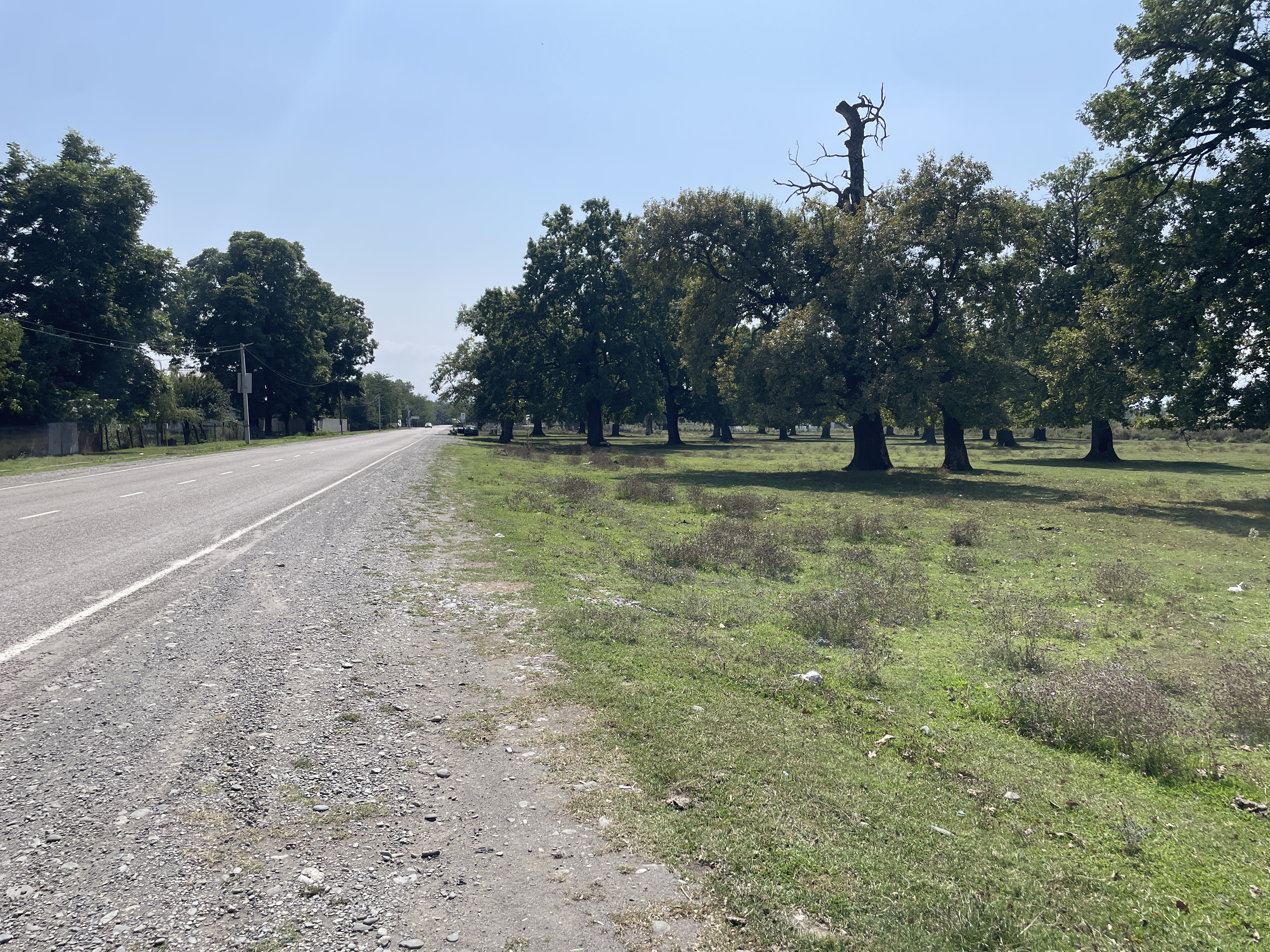
My destination was Sighnaghi, probably the most touristic place in this part of the country, in the ‚Toscana of Georgia‘. Whoa. That‘s a big claim. Let‘s see. But first I have to find it.
I am using old-fashioned paper maps to give me a rough idea where I am and a fall-back solution should the GPS not work. The sat nav has some basic information about the road network, but not always up to date and the hierarchy of roads is not very clear, it seems that every goat track might be eligible as well. So when I was searching the way up to Sighnaghi off the main road, I got confused. Was I on the right track? In a village, I had to stop and check Google Maps as a third option. This raised the attention of some men sitting in the shade, waiving in my direction. A guy in a car, looking like he could be a perfect hermit or orthodox priest with his long hair and beard, asked me with gestures if everything was alright. ‚Yeah‘, I signaled back, ‚I got to continue and then take a turn to the left‘. He stepped out of the car and handed me a small Georgian flag es a gift, all smiling. Oh, thank you. Next, another man showed up to shake my hand with both arms and crossing himself, giving me a symbolic ‚welcome‘. This was a nice balance to the experience at the border.
I found the twisted road up the mountain and after 6 km, I reached the town of Sighnaghi. The first view looked indeed similar to some sights in the Toscana, the village is towering on the top of a hill, overlooking a plain with many vineyards with the Greater Caucasus mountains in the background. Kakheti is Georgia’s biggest region by area, taking in the entire eastern part of the country. The landscape and climate varies dramatically from the high mountains of Tusheti in the north to the semi-desert landscapes of Udabno and Vashlovani in the south.
Georgia has more than 500 endemic grape varieties in total, many of which grow (or once grew) in fertile Kakheti. Today, it remains Georgia’s most productive wine region, responsible for around 70% of the nation’s annual harvest.
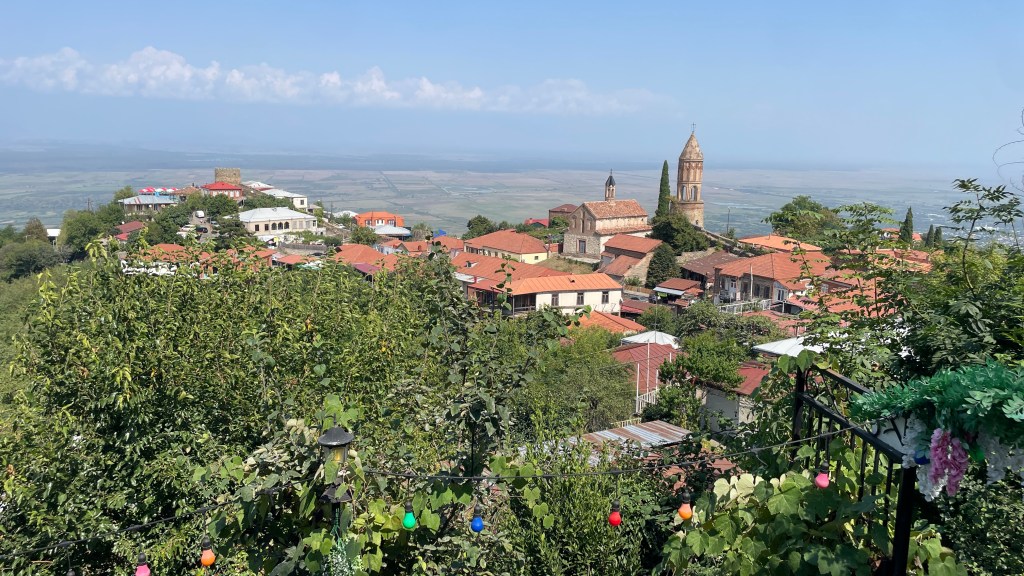
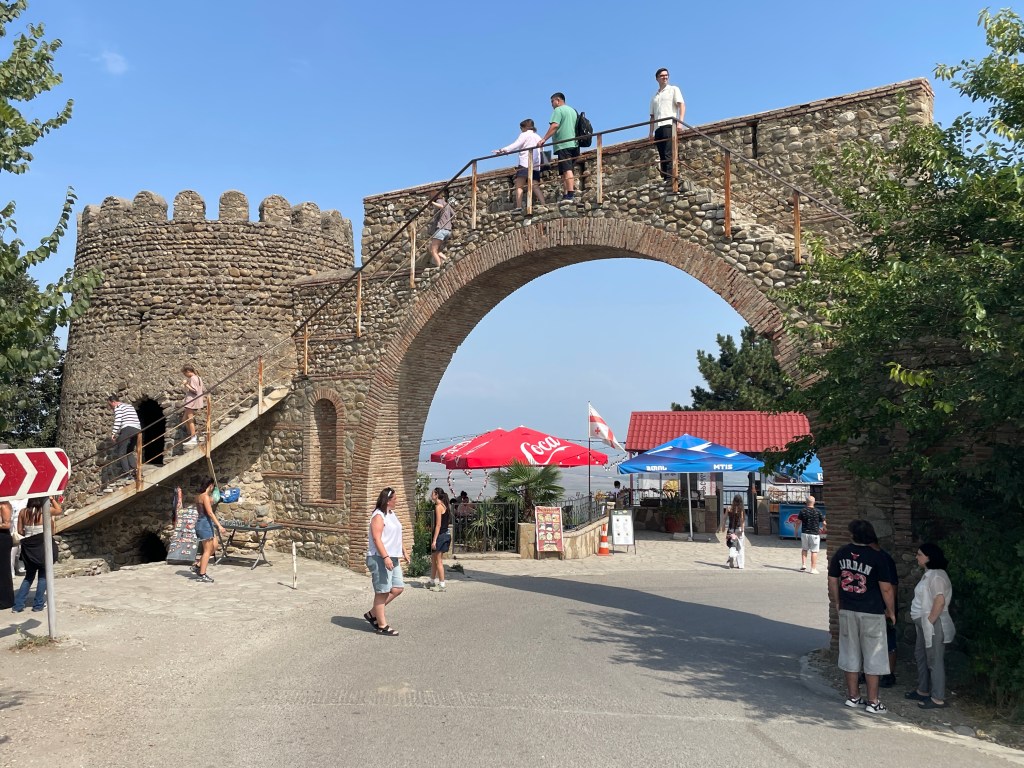
Sighnaghi is surrounded a large wall with some city gates. I rode down a street flanked by many souvenir shops with tourist junk until I reached a city gate. I parked the bike and anjoyed the view from the tower. The whole hill is flooded with terrace restaurants and cafés and I felt a bit peckish…hmmmm…what about a snack and some beverage?
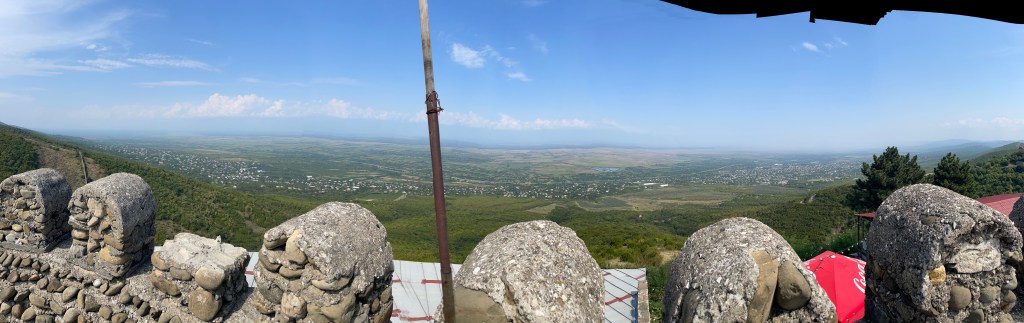
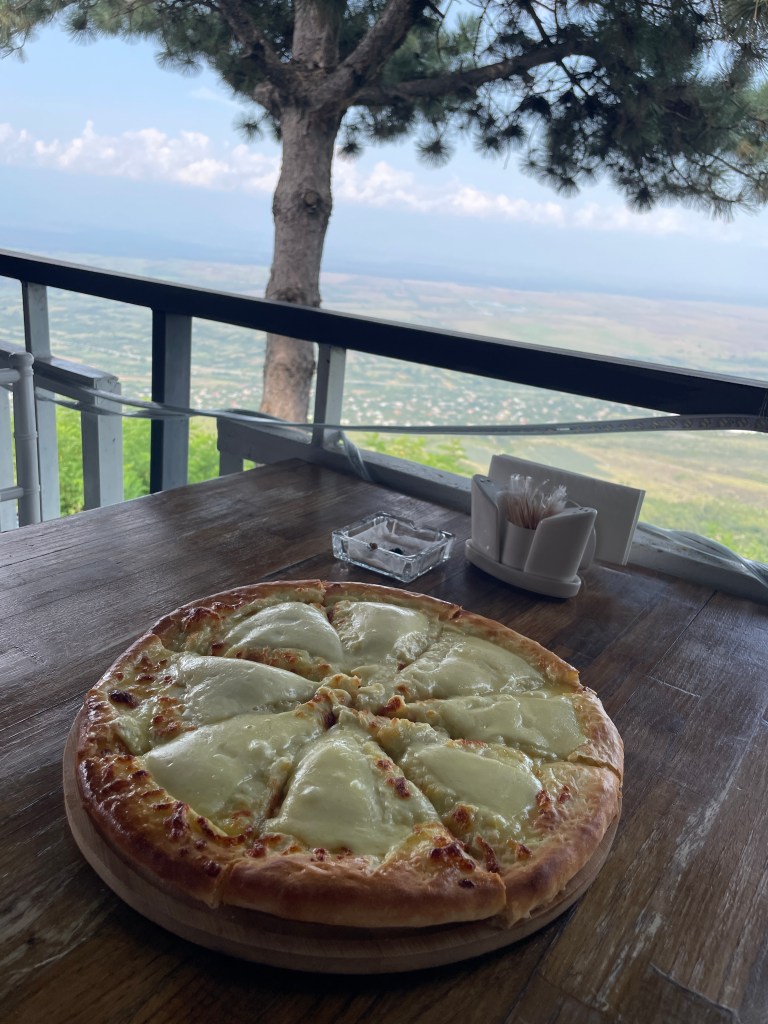
I chose one of the establishments and sat down at the edge with a nice view overlooking the plain. I rdered some water and a snack, I thought. Khachapuri, one of the Georgian pastries, I remembered. I ordered the ‘royal’ version. What arrived was a kind of fluffy pizza with a triple ration of cheese on top. Gulp! I did my best but had to leave half of it, it was simply too much.
I had planned to visit a winery in Telavi, the centre of Georgian wine making. It would mean one hour of detour, but I could afford to arrive a bit later at the hotel in Tiblisi. And then I checked the weather forecast. There was quite some humidity in the air and clouds were forming. The weather app predicted thunderstorms…and very soon. Ouch! This would mean I would have to ride in a thunderstorm later, maybe when it’s getting dark, on dodgy roads and suicidal drivers…so the sensible choice was to skip the detour to Telavi…what a pity! So this would mean to ride directly to Tiblisi, hoping to see as little rain as possible. I went to the centre of the village where I extracted some cash from an ATM. I was addressed by a Dutch tourist who had spotted the number plate.
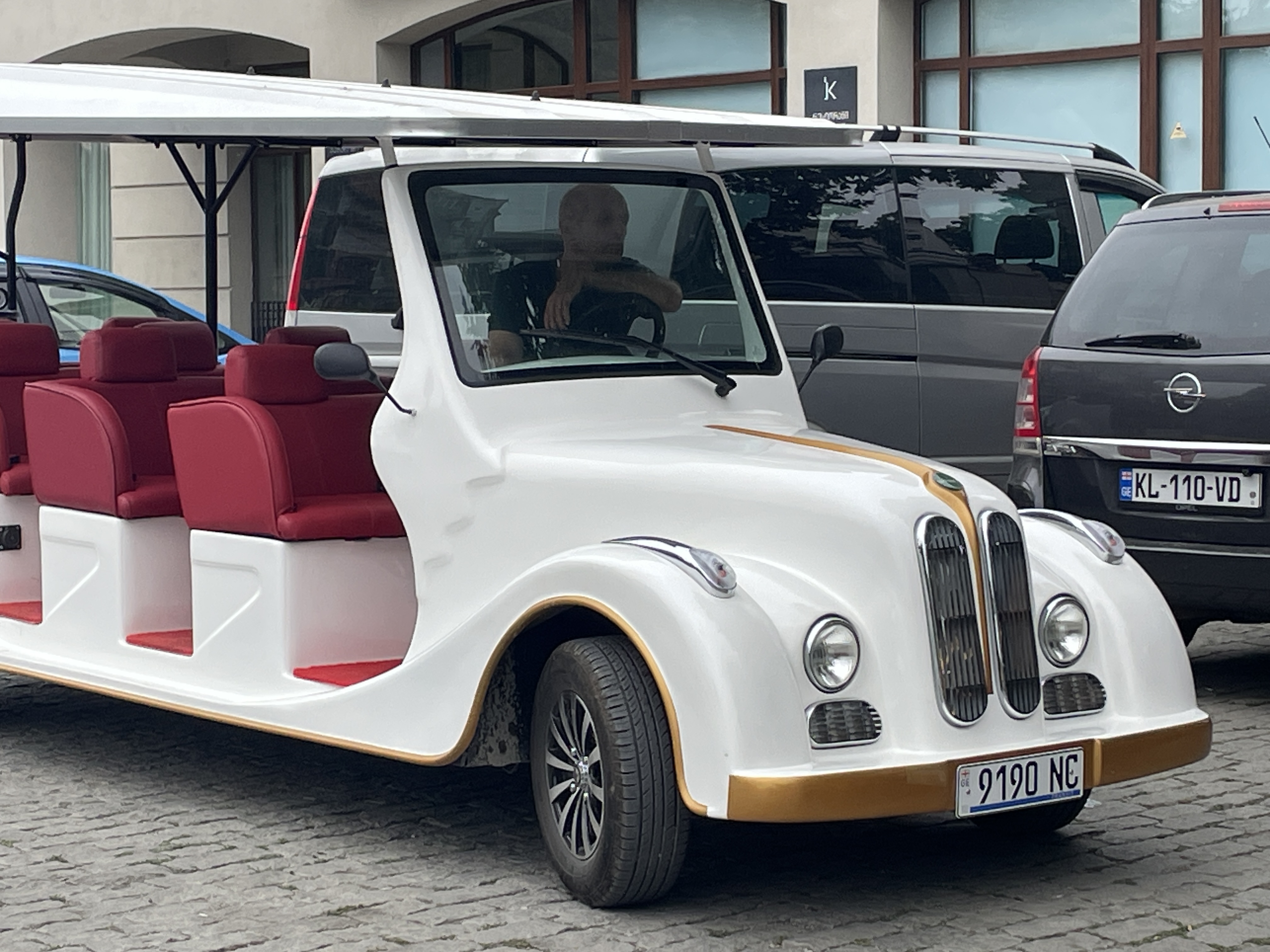
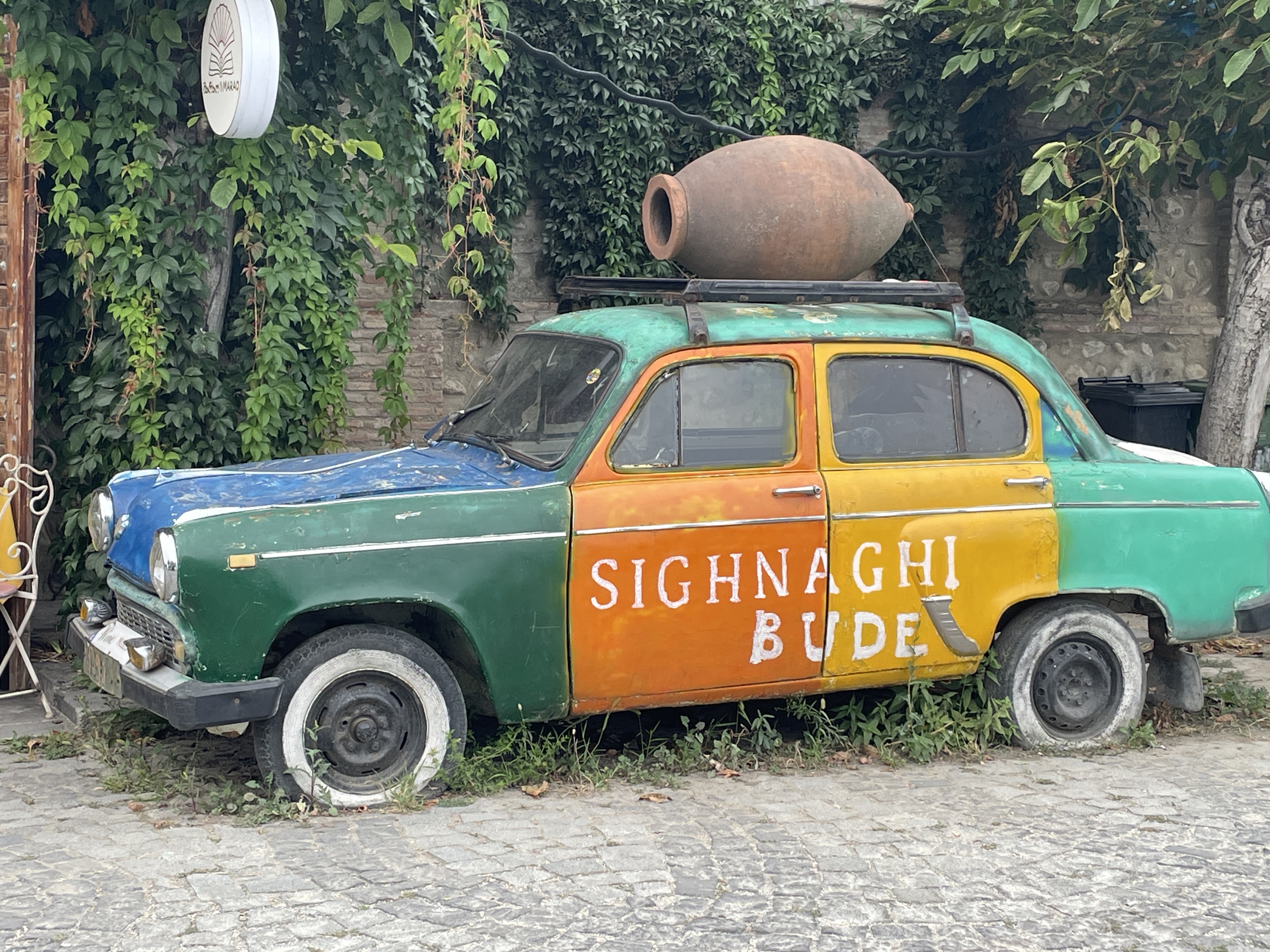
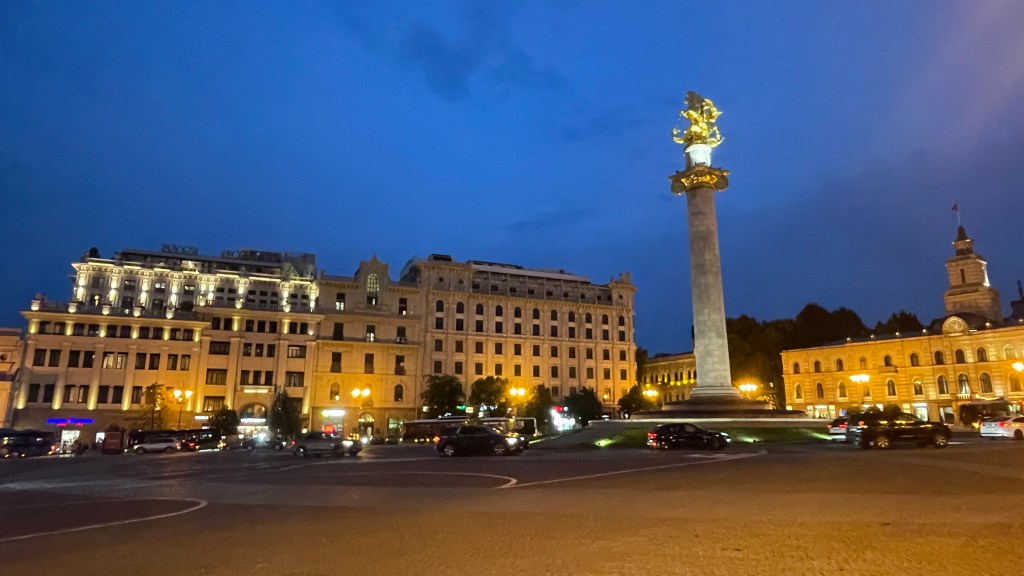
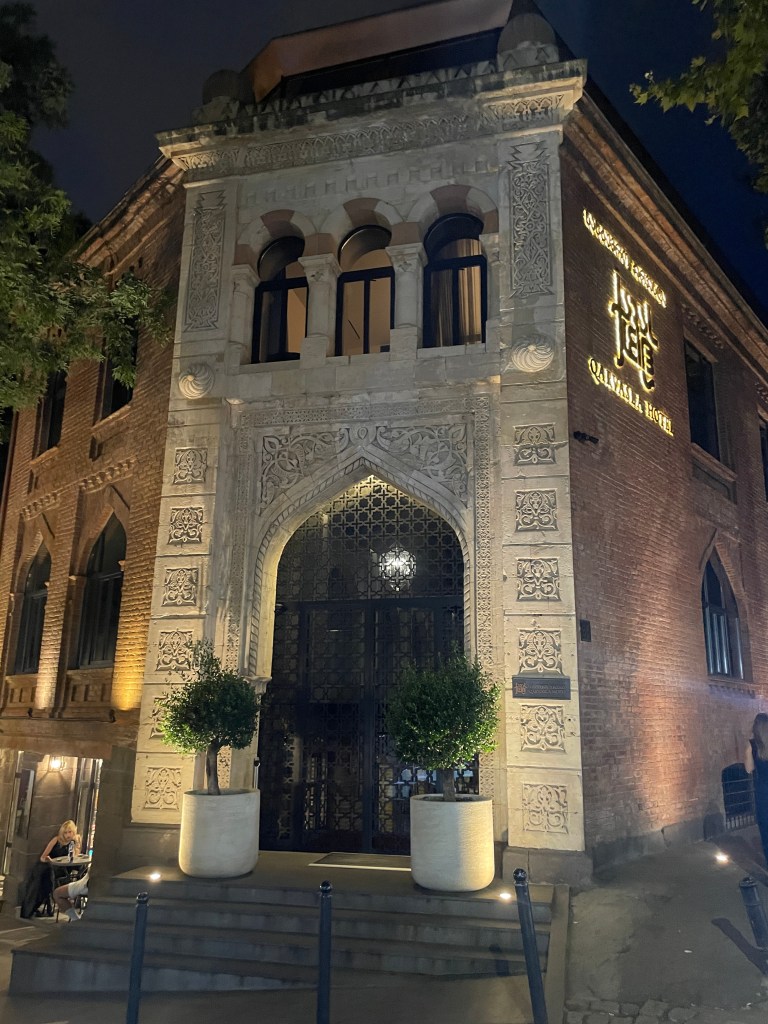
I left the Sighnaghi by the other side and when I stopped to check if I was on the ride course, a large Dodge with a couple stopped next to me. At first, I couldn’t understand the guy, after all I was wearing a helmet and earplugs. Then I deciphered it as French and exchanged a few words with the guy, actually we were blocking the road…The road was in good condition and at its end, it joined a large road to Tiblisi. It was cloudy first, but I could not spot any rain clouds. Quite the contrary, slowly the weather improved again until I was riding in sunshine again. @#&!/!!!! What the feck! Could I have done the detour? The expected two hour to Tiblisi were actually shorter as the new motorway was built which reduced the travel time considerably. So I arrived in Tiblisi in sunshine and filled up again. I found the hotel near Liberty Square which was not easy, it is hidden behind a gate (that’s why it is called The New Gate Hotel?). It is an ok hotel, very central, with a small parking and ok facilities an d with a very competitive price for such a location. What is a bit amusing is the classification…five stars are a bit ridiculous….let’s call it a solid three-star hotel, LOL.
After some refreshing in the cool room, I was ready to discover the Old Town of Tiblisi. First impressions: this is so different from Baku, the opposite in many ways. Streets were bustling with life and many tourists. Lots of small shops with street food, a lot of pastries, for example. And souvenir tat everywhere. Although the city is renovated everywhere, there are still many places in a bad state, many even dating back to the Soviet era. I was strolling through the streets, looking for a nice place to snack something, accompanied by some wine?
After having popped into my first Georgian Church where many came and went (head scarfs and scarfs to cover men’s shorts were provided at the entrance), I chose the Nino Meris Wine Bar as the place to spend the evening.I ordered a five wine tasting and a cheese platter. The wines were presented very knowledgeably by the shop lady.
From Widipedia:
Georgia is one of the oldest wine-producing countries in the world. The fertile valleys and protective slopes of the South Caucasus were home to grapevine cultivation and neolithic wine production (Georgian: ღვინო, ɣvino) for at least 8000 years. Due to millennia of winemaking and the prominent economic role it retains in Georgia to the present day, wine and viticulture are entwined with Georgia’s national identity.
I tasted one autochthonous grapes, but in different styles…white, amber and red…in European or traditional Georgian style…all quite good. The Georgian style has an ancient touch to it, like the people a bit rough on the edges. In the end I did get a glass of Chacha, the Georgia version of Grappa. The cheeses were special and some were quite salty.
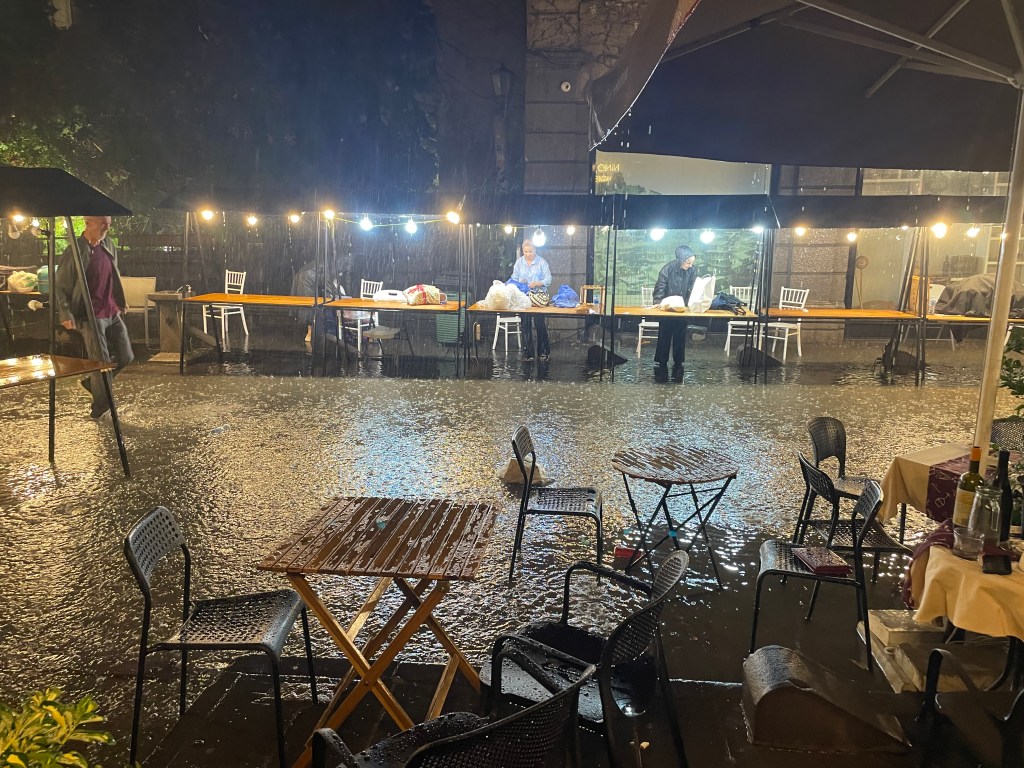
During my tasting, the sluices opened and a massive thunderstorm broke loose. Within minutes, the street was flooded and where I had been sitting some minutes ago on the terrace, water was deep as 40 cm. Well, if this is the rainfall to be expected, this is definitively not the stuff I would want to get caught in on the bike. Finally the rain stopped and I could return to my hotel.


Leave a Reply