When this event was announced end of 2023, I immediately enrolled for it. Although I had a very successful rallying year behind me – a gold medal, top twenty finish of the notorious Iron Butt Rally in the US and three rallies won in Europe, among them the first and probably last 12 Days Rally in Europe – I was very keen to ride this 6 day, multiday rally through some of my favourite riding area in Europe. I kept my opinion pretty to myself, but I had not been very happy how the 12 Day Rally had turned out. So I was chuffed to learn that another multiday rally would take place again so quickly. So far, my track record was quite positive after a rough start:
- European Tour 2014 (6 days), in the virtual first place, my gearbox atomised in Spain – DNF!
- European Tour 2016 (6 days) – 1st place
- Alpenbutt Rally 2017 (6 days) – DNS as I was the rally master 😁
- European Tour 2018 (3 days) – 1st place
- 12 Days Rally 2023 (12 days, obviously) – 1st place
Another reason to join this rally announced for 2025 was the fact that Gerhard Memmen-Krüger would be the rally master – a sign of quality, promising a high level event with many interesting places to visit.
Two days before the rally, I had a chat with Arjen, one of my strongest competitors. We talked about our preparations and casually, Arjen mentioned that he already had his route ready. I was flabbergasted – the route ready? But we would get the rally only the evening before the start to do our planning? It turned out that when a link to some test files were sent four weeks earlier, an ominous file with a strange file name was also present in that folder. I did not look at these example files, after 47 rallies I deemed it not necessary anymore how the data provided would look like – this was more for rookies. Well, this superfluous file in fact was a draft file of the rally book ready for printing. How it ended up there was a mystery, but I guess it was simply by mistake, typical copy/paste problems. Shit happens.
The real problem was that not everybody was aware – this disturbed the level playing field. A message to all would have been the right choice. I had almost no time to look at the file, a working day and my delayed preparations left no time no analyse the supposed rally book in detail. What I could deduce was, as expected, that the challenge would be to create a big loop through the three countries scoring as many combos of locations as possible, this seemed to be the centre of the rally. But there was no time to have a closer look, this would be a task for the regular planning after the riders meeting. What’s the opposite of ‘head start’? I guess a good answer could be ‘handicap’?
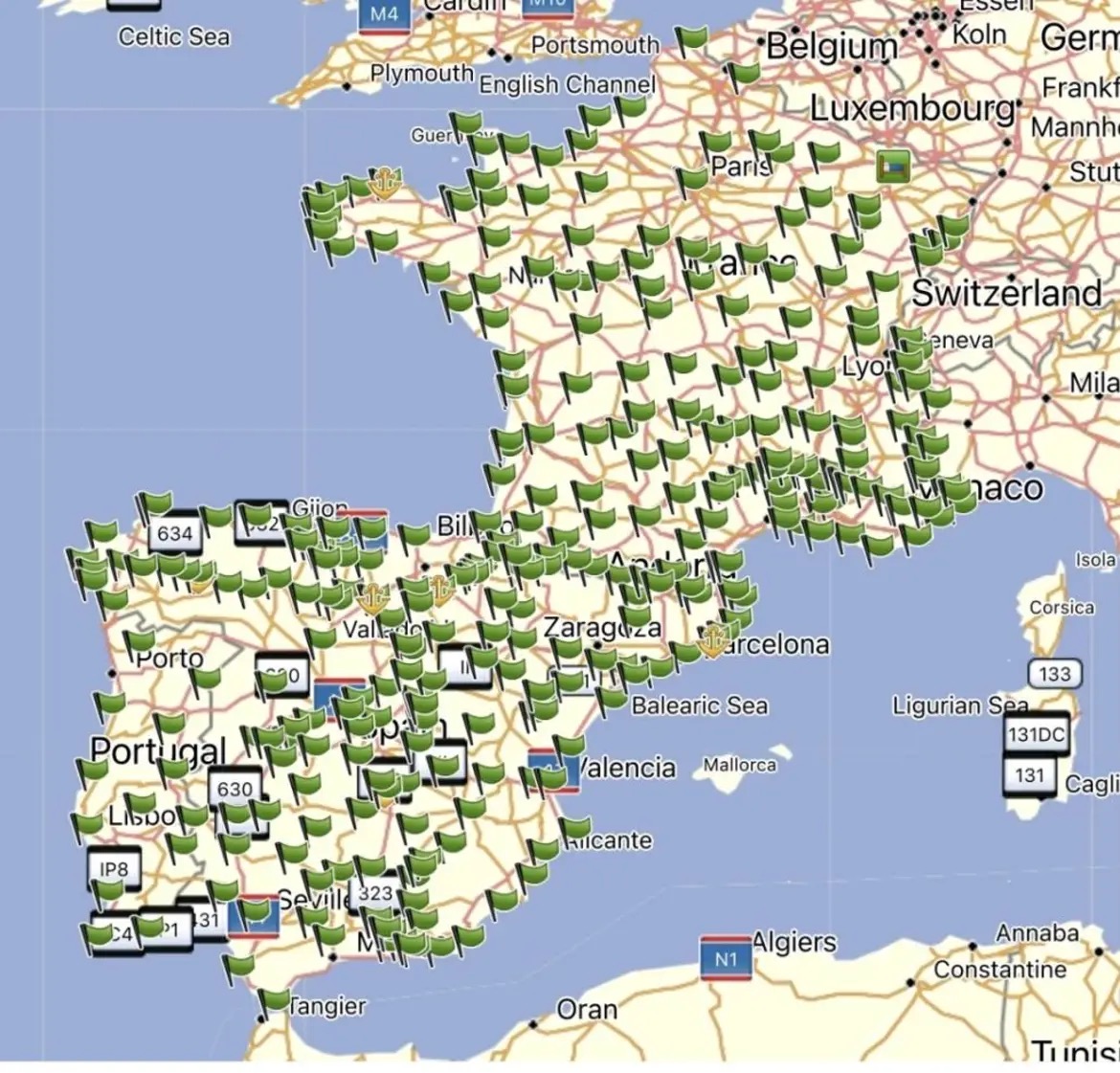
After more than 19 months of waiting, the riders gathered in a hotel in Metz in early August 2025. After the usual paperwork, we had the riders meeting where many details were revealed. After dinner, we received the rally books and….as expected, there were little changes to the leaked version. But anyway, it didn’t matter. Let’s see this with fresh eyes. My usual routine to transform the data into the appropriate format for my planning took longer than usual as the high number of points had introduced a formula error that haunted me for one hour until I could locate and correct the problem. When I finally had all the data in the right format, it appeared that my initial idea about the rally was correct: there were many points scattered over the three countries, there were the expected combos that seemed important and the basic challenge was to do a loop through Spain and especially Portugal, picking up as many combos and high value locations as possible. Unlike in other rallies, there were no alternatives, no “should I chose route A, B or C?”. It was really “how much can you bite off AND swallow?”
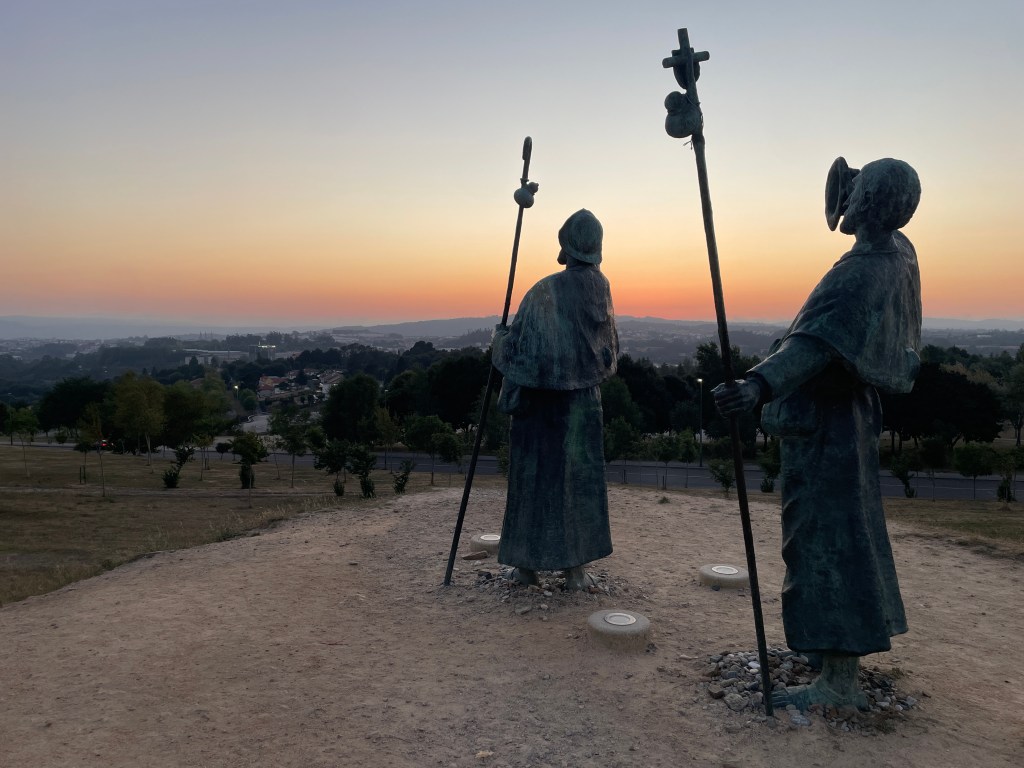
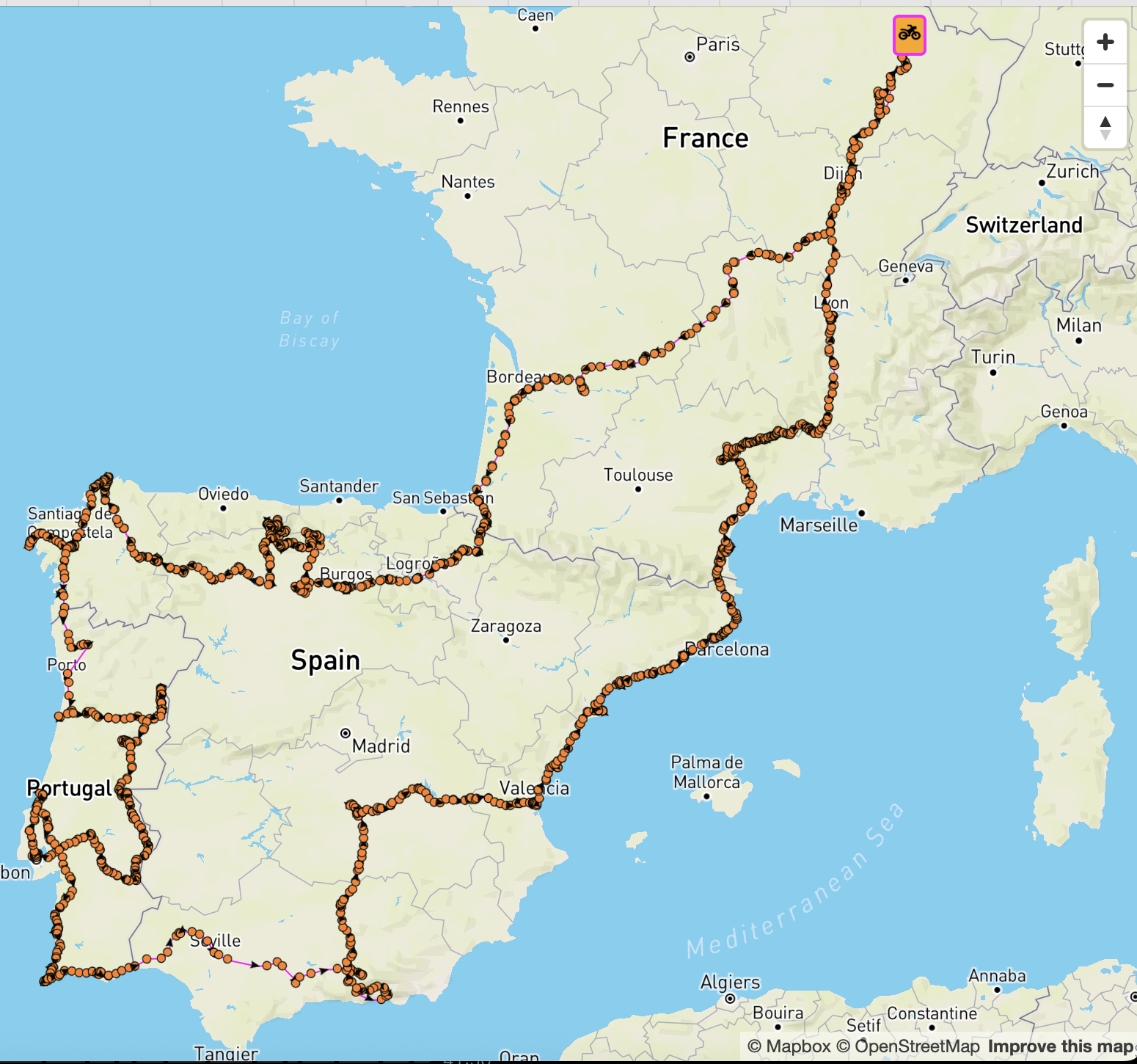
The highest combo with a additional points value of more than 38.000 pts was the ‘Pilgrims’ combo, riding along the Camino de Santiago starting at the northern end of the Pyrenees all along North-Western Spain to Santiago de Compostela and the coast in Finisterre. A massive challenge, as it consisted of 19 (!) individual bonus point locations, lined up like a pearl necklace. The rally master confirmed my guess that this resembled very much the “Pony Express Combo” in my first Iron Butt Rally 2013, challenging the riders to visit a lot of small points under time pressure without making a single mistake. This combo was a “must”, both the individual points of the locations and the extra combo points resulted in more than 60.000 points, too many if you wanted to get a good result. The problem with it was that, not by coincidence, some daylight bonus locations made the planning difficult, as they can only be visited at daylight. A critical point for day 1 was a daylight point south of Pamplona. If you would not bag this one in time, you would have to wait until the next morning, actually losing time, as the to-be-documented, mandatory rest break per night was five hours. As there was darkness from about 10 p.m. to 6 a.m., you would lose three hours, waiting for the sun to come up.
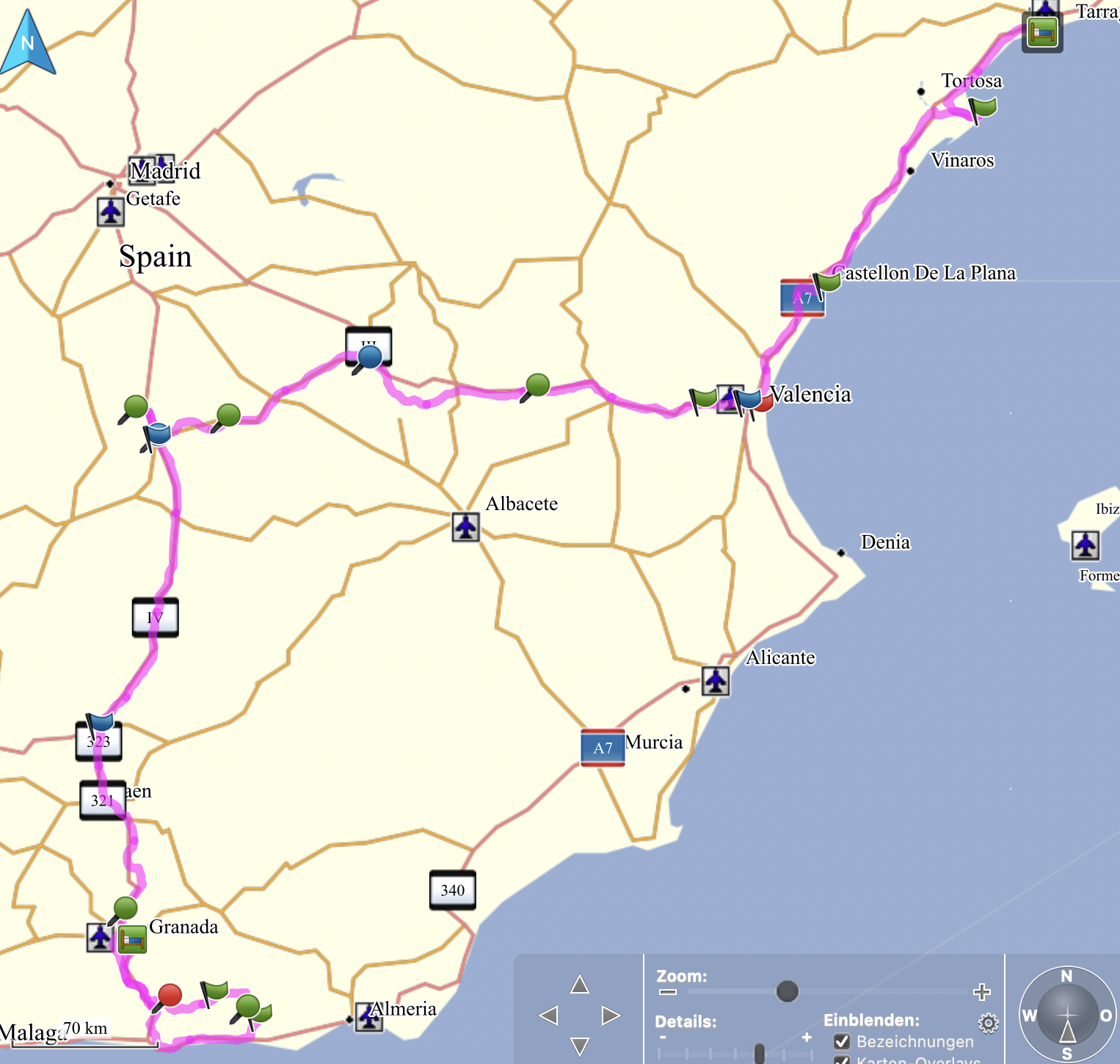
The challenge for day 1 was clear: get as quickly as possible to Pamplona! However, there was another twist: in order to be a finisher, riders had to visit at least five points out of a selection of locations. It appeared that two of the locations were more or less close to my route to the Spanish border, so I had to incorporate these two spots in my plan; other locations I had to leave literally left and right. The big prize for day 1 was to get to Pamplona at daylight and decide what to do there, depending on the time. I could stop for the night in Pamplona or continue, as the next locations were all-day, which means I could visit them also in the night and maybe plan a rest in Burgos: hotels should have a 24h reception, if possible, also a secure parking, and an open petrol station nearby to document the rest break. This can be best done in a larger city, so Pamplona or Burgos were first choice. For the rest of the rally, I would have to plan on a day-to-day basis at night. The basic idea was to get to Santiago, go down to Protugal and scoop up all high points before entering Spain for Sevilla and Granada. From there, it was direction finish with some possible detours, picking up more combos. In any case, this would be a 8000+ km ride, this seemed challenging, but doable.
Day 1 (Metz – Burgos)
The next morning, after breakfast, riders were ready for a “late” start at 8 a.m. This was the right time, after all there would still be 150 hours of rally time ahead of them, so there was no need for an early bird start. After many farewells, riders set off in perfect conditions and good mood. More than six days (actually 6.5 days) were ahead of them and all kind of experiences could be expected. Will the bike endure everything? Will the rider endure everything? Do I have a good plan? What mistakes will I possibly make? How hot will it get on the Iberian peninsula? What’s my back-up plan? Etc etc etc…These are possible questions that might haunt the leaving riders. I for my part, had a relatively simple task for day 1: Get to Pamplona before sunset and make small detours for three locations next to the road or in the case of Bergerac, a 20 km detour from the motorway. That’s it. Enough to focus on. Think about the coming days later in tonight’s planning session. Go!
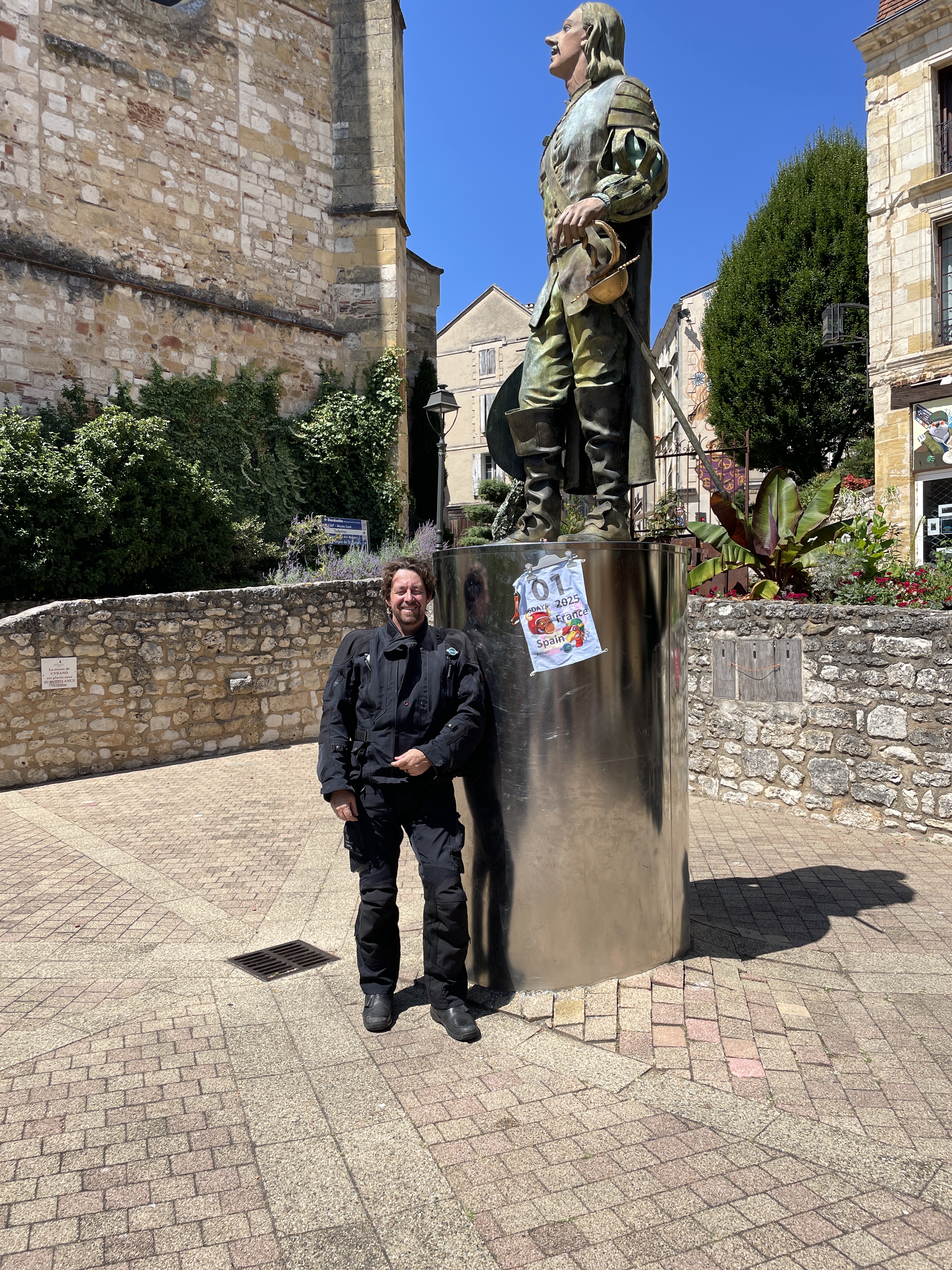
We rolled out of the parking lot and everybody headed for the motorways. As usual, I tried to get away from the pack as quickly as possible to go at my own pace. So this was a day for rolling on the French highway. Luckily, the BMW has a cruise control that would ease the need for constant speed. I took the motorway to the south towards Nancy and Dijon, picking up one location along the way, a memorial in the countryside on the top of a hill. Interestingly, the tablet suggested a bumpy road that saved a few minutes compared to the daily plan. I zig-zagged to the south-west, only interrupted by my second monument in Montceau-les-Mines. This was rather uncommon for rallies in Europe, riding for hours without a bonus point location. Four hours later, I left the motorway near Périgueux and rode towards Bergerac. This was the only larger detour from my route for day 1, but 4150 points were too many points to be left aside. It was quite hot now and I had to waddle to the statue of Cyrano de Bergerac to take a selfie.
I headed back to the motorways to pass Bordeaux and to ride through Les Landes towards the border with Spain. Next to Bayonne, after a quick 10 hour ride mostly on motorways, the rest of the day on secondary roads was about to start.
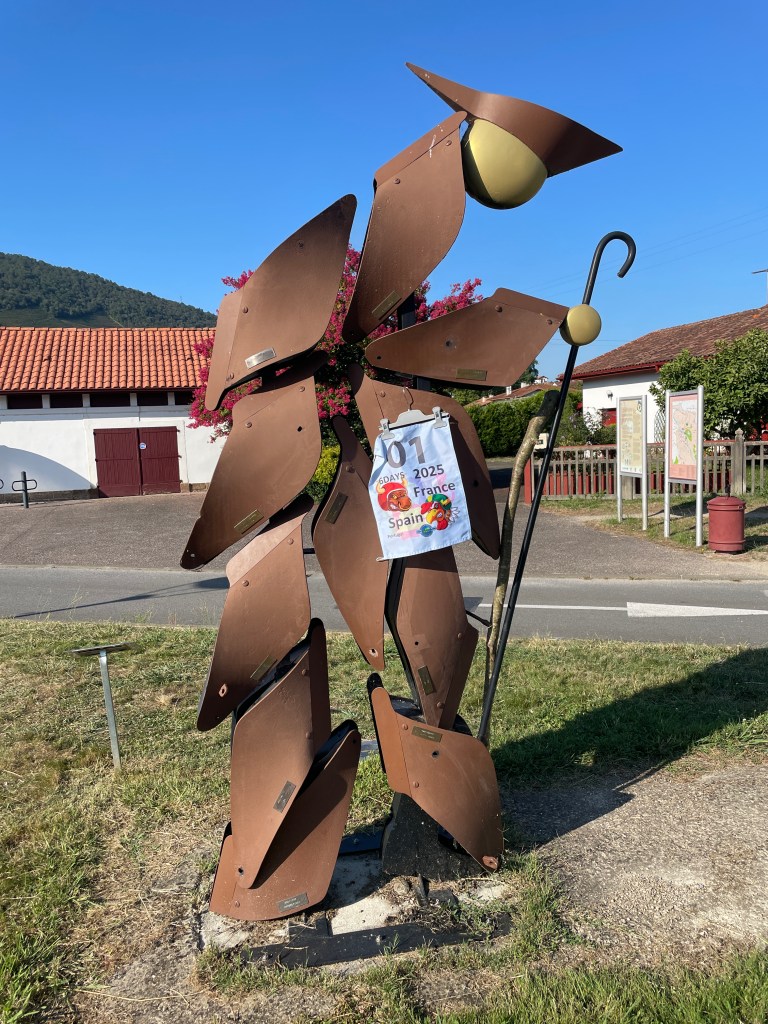
I enjoyed the ride through the hills and soon reached St. Jean-Pied-de-Port, the French pilgrim town where the main part of the Camino de Santiago starts. Also for me it was the start of the big Pilgrim Combo. When I took the picture of the metal pilgrim to the left and sent the picture by e-mail, I noticed a message from Arjen: “where are you? I am in Bergerac shortly”. What? I had thought the whole day that I was behind him, as I had done some detours. And now I was three hours ahead of him? This meant he couldn’t get to Pamplona at daylight? I was well on schedule, and this was only the first day, but this felt somewhat reassuring. Although there was still a loooong way ahead of us where many things could go wrong.
I started my ascent to the Pyrenees and crossed the border to Spain soon. I still have my lowered footpegs on the K1600 which makes riding more relaxed… until you ride some twisted roads. The footpegs very soon were throwing sparks! I needed to change my riding style and had to apply a “hanging-off” style. I spotted a flag on the GPS screen that I hadn’t expected. Was there a location I had overlooked? I stopped and had a closer look…yes, indeed there was! Next to the highest point, there was a church right next to the road. Well, this was an unexpected 1450 points, because the GPS had chosen a different route than the Basecamp software. When I look at my track now, I wonder why it differs so much from the plan, apparently the on-the-fly navigation wasn’t so bad as I was slightly ahead of my plan to get to Pamplona. I liked riding through the lush Basque Country, it is very different from Castilla to the south. I had enough time to enter a small supermarket in Aoiz at 19:30 (Sunday evening!) to get me water and some sandwiches that I could eat after having bagged that crucial daylight point south of Pamplona.
Soon after I entered Pamplona and was happy to encounter only some residual Sunday evening traffic. I parked the bike in a pedestrian zone and walked the last metres to a statue celebrating the famous bull run through the streets of Pamplona during the Fermin festival in July. Good! And now to the key point south of the city. I had 90 min to sunset and only 20 min to go. Brilliant! I could fill up petrol in the city, this would get me to wherever I would stop tonight. When I rode up the crest it dawned on me why this point was chosen as a daylight point: you had to enjoy the views! It was not only the location of the artwork against the background, but also the scenic panorama view that made me enjoy the views for some minutes while I was munching my dinner.


I had done it! My riding against the clock was successful which meant I did not loose some hours in Pamplona waiting for the sun to come up the next morning. After 1330 km and 12.5 h, I was only 24 min behind my very ambitious plan for today. I could ride on and visit a lot of places in the dark as there were no vital daylight points for the Pilgrims combo anymore today. The question was: where would I do my mandatory, documented rest break? There were two options: Logroño, the capital of the Rioja region or Burgos. I would reach Logroño in one hour before 10 p.m., meaning that after the five hour break, I had to start at 3 a.m. Not my preferred option, as I like to use the hours before midnight when I’m not yet tired and to have little riding in the dark in the morning when the brain still ask angrily why the hell I had to leave the bed so early in the morning. A riding time of more than two hours to Burgos seemed to be the better option. So I reserved a plush hotel not far from the centre and the last bonus point location; a petrol station for the electronic ticket to document the rest break was also near by. This went well!
The next stop was a pilgrim statue next to the road not far away, next to one of the many pilgrim hotels. As it was still before sunset, I could include a daylight bonus that was not part of the pilgrims combo. It was next to a wine museum and a monastery and I had to find the right spot. Finally I found it…it was a fountain, but not just a regular water fountain. It was a wine fountain! Publicly accessible!
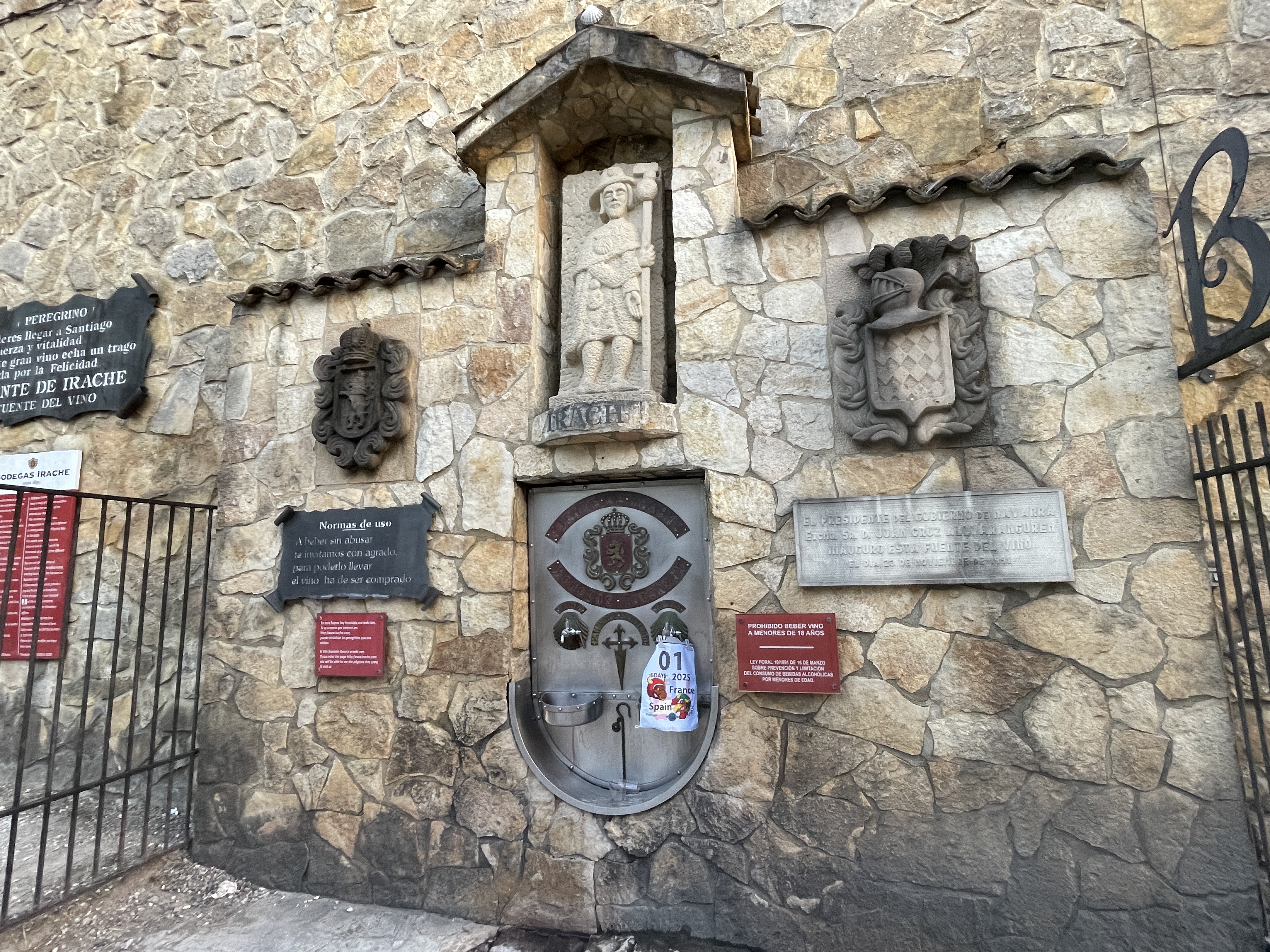
I had to try the wine, it was a young and fruity one, not bad actually. It is free to drink, but you should pay if you carry some away. Onwards! The next location was another pilgrim statue in the centre of Logroño in the last rays of daylight. So my choice was the right one.
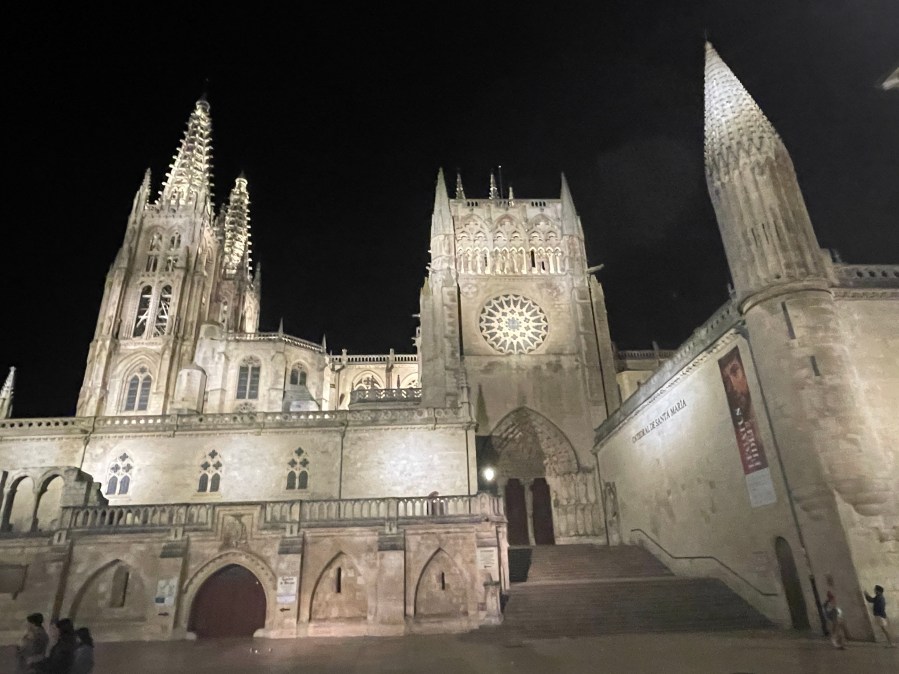
From now on my auxiliary lights would turn night into day. Half an hour later, I visited another pilgrim statue in the village of Santo Domingo de la Calzada. Right. Another hour more and I could start my rest break. Or so I thought. Exactly one hour later I parked my BMW in the centre of Burgos and walked across the Central Square to the sitting statue of a pilgrim, taking a touristic picture of the Cathedral of Burgos on my way bike to the bike.
The hotel was only a few metres away, but I had to get an electronic receipt first. Shouldn’t be a problem. I had spotted a petrol station only five minutes away, but apparently the card reader did not work. Argh. There was no other fuel station in the vicinity. Well, I could go for an ATM…and I found one, withdrew some money and got the ticket…I remembered an issue I had during the 12 Days Rally in Spain. Spanish ATMs don’t issue receipts with an address, but with numeric codes that identify the bank and the individual ATM. With the same codes on the start and end ticket, the same location of the tickets was demonstrated. That’s how it was accepted in 2023. Just to be on the safe side, I phoned the president and asked for confirmation which he did. Great, now to the hotel. When I was just to enter it, I received a phone call from the Michiel the president: the rally team had discussed and the rally master had insisted that an address was necessary. I was pretty miffed, I had to find another petrol station now! I found one at the other end of the city and got my ticket. I was quite angry, because I had lost 40 min, rules should not change from one rally to another and the word of the president is always the last resort. Well, I was finally in the hotel, but had to park the bike in another place in the street, unfortunately no hotel parking was available. After a well-needed shower, I sat down and planned my second day. This was tricky, as I wanted to do a detour to the Picos de Europa, a big combo in the famous mountainous region of Northern Spain. But before that, I had to pick up some more locations in the dark.
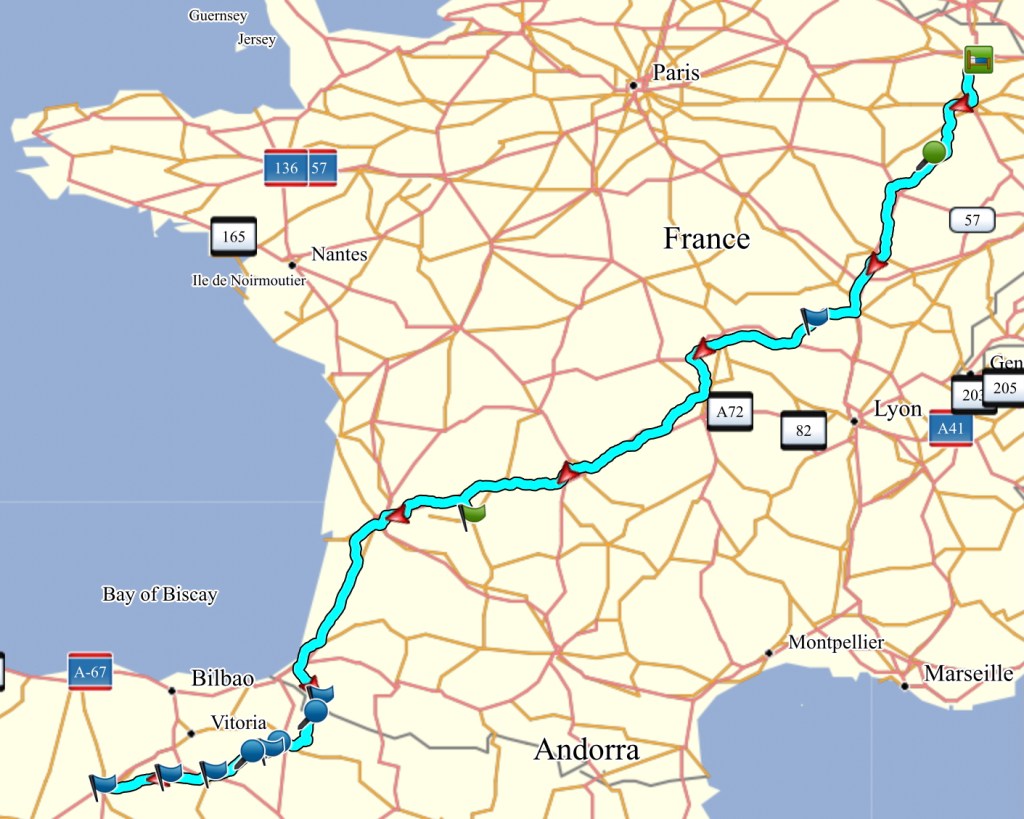
Despite the hiccup at the end, the first day went quite well: 1530 km in a bit more than 16 hours, a wild ride.
Day 2 (Burgos – Santiago de Compostela)
The alarm went off at 4:15 and my breakfast consisted in some cookies I carried as a reserve and some coffee from the capsule machine in the hotel room. After the tough day, I took it easy and managed to get the start ticket, vulgo the documentation of the first rest break, 14 min later, i.e. my rest break lasted 5 hours 14 min. In order to get the combo points for the rest breaks, all six breaks had to be documented properly, less than four properly documented breaks would result in disqualification. In the e-mail that contained the picture of the ticket, the correct code had to be used. It could be easy to mix up the 12 different codes in the week ahead, so I had to 100% focus when doing this, maybe in a tired state of mind. This explained the relaxed, but safe attitude.
The route for this day was not easy to plan as all of the Picos de Europa Combo points plus one extra high point were daylight points. Sunrise was only at 7:09 a.m. and the shortest route to the first location was less than an hour. Solution: in a zig-zag way, I included two locations of the Pilgrims combo before I would head north into the Picos. Nobody was on the road when my burning lights cut through the dark night. One pilgrim sculpture in Frómista and one pilgrim statue in Carrión de los Condes later I rode north to the famous mountain range. Slowly daylight disappeared and I began my ascent to the first Picos location up on a mountain, at the fountain of Chivo I took my picture and headed down again. In the small village of Brañosera I took a picture of a memorial that commemorates the first declaration of city rights in Spain in the year 824. I enjoyed the winding road in the early morning sun, stopped at the Mirador “Alto de la Varga” for a combo picture and rode along a barrier lake before turning northwest again. Up on the Collado de Llesba I had to park the bike and walk up to the bear monument as the rally master had introduced a new category “T” in the rally book: “touch” means that the rally flag has to actually touch the object, not just to be in the foreground. This meant I had to walk uphill and had to fix the flag somehow with stones as the wind was strong, despite the blue sky.
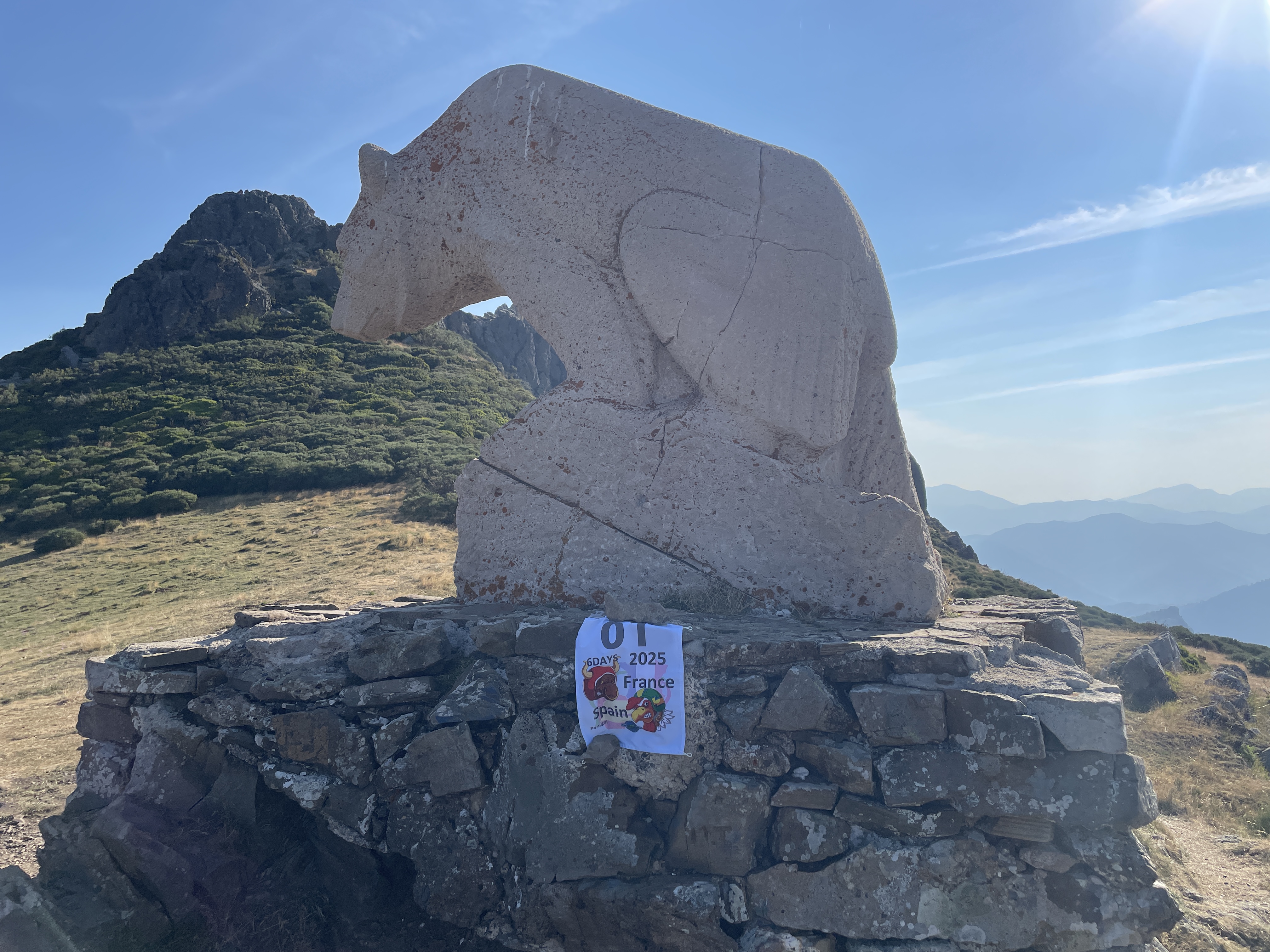
The panorama was scenic, but I had no time to lose: I had again a long day in front of me. I wanted to reach the end of the Camino and stay in a hotel in Santiago for the night AND do a detour to the Northern Galician coast. Quite a programme. The next location was not part of the combo, but a very high (5590 points!)’normal’ location in the heart of the National Park: Caín de Valdeón. Basically a cul-de-sac where the road got smaller and smaller, becoming a single track road. The scenery got impressive with towering rocky mountains left and right. The intense traffic stopped me from taking touristic pictures, so I rely on Google Maps:

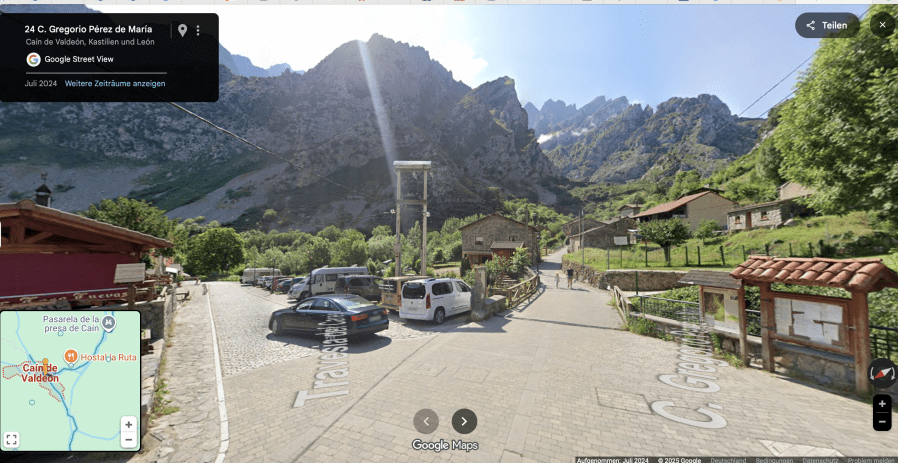
Traffic was slow now, after all it was middle of the touristic season and this was definitively a beautiful place. Finally I reached the end of the road, the little hamlet of Caín de Valdeón. It was surround on all sides by mountains and it was not easy to find the memorial stone immediately as the GPS signal was, understandably, weak.
I took my picture, enjoyed a quick look around and rode back on the small single track road, thinking for the n-tenth time “I should come back here one day”. Which I almost never do. At the end I turned left on the national road, heading back the same way I had come from, thinking that I was finally on my way south to the Castilian plains.
I counted the number of locations visited in the Picos….yes, I had stopped at five points…my plan also listed five codes….but I remembered that the Picos Combo consisted of five locations…and I added a sixth location…there was something wrong?! I stopped, pulled out my laptop from the top case and checked my route.
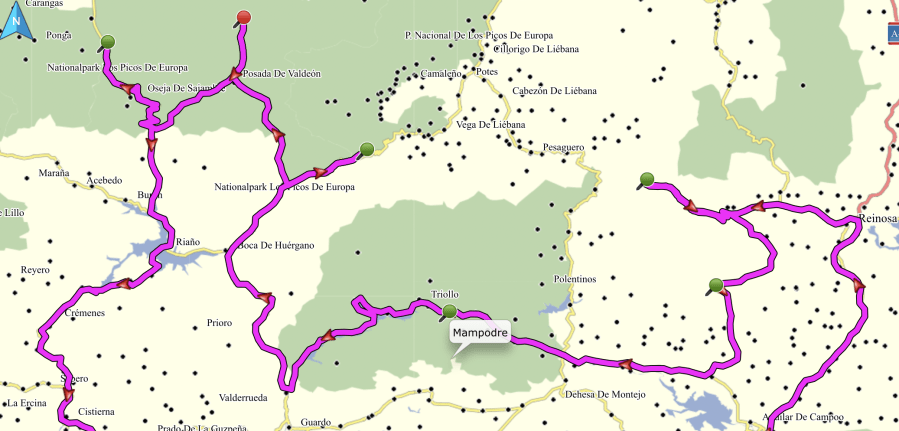
Indeed, I had missed one point when I transferred the points to be visited from Basecamp to my to-do list. &!%#1!!!! I had done the same error again as in the 12 Days Rally when I lost two combos because of one small transcription error. Even when finishing the planning at 1 a.m., I have to stay alert and do a double check after having established the list for the next/same day! I turned around, swearing and lamenting the lost time. At least I had spotted the mistake in due time. I went to another valley with a nice small road, applying the hanging-off technique, until I reached a large, actually gigantic memorial plate in a rock. Well done, now let’s head south!
In Riaño, next to a lake, I finally found a petrol station. My plan to have a little lunch break was hampered by the fact that there was no seating area, so I had to choke down a soggy sandwich of the poorer kind, to remove some clothing and to continue the ride. I left the mountains behind me and descended to the drought-stricken plains of Castilla-León. An hour later, I took a picture of a pilgrim statue in Sahagún. I started to sweat now….temperature rose to 35 degrees…welcome to Spain in August…who would have guessed that? I headed westwards to the capital León where I had to enter the city centre…there it had 37 degrees…cosy! I rode to a large square in front of the Convent of San Marcos. Where could I park the bike? Ah, there were some trees at the side of the square…
I enjoyed the shadow, grabbed my flag and rally book, but left the GPS on the bike, it seemed that the staue was inside the convent. However, the main entrance was not open or did not lead to a patio as I thought. Confused, I waddled back to the bike. I could feel the streams of sweat running down my skin. Where could I enter? Maybe to the side? I walked through the restaurant of the Parador Hotel restaurant….enviously watching the guests having a delicious lunch in the shade of nice trees…focus, mate, focus! No, there was no chance to get there…I walked back to the square and looked around. I used Google Maps to get an idea where the statue would be located. Is was in the centre of the square? Wait…there it was, facing the facade. A very tired pilgrim. I felt similar, combusting internally. I just wanted to get out of here and feel the wind in my face…and all other body parts as well.
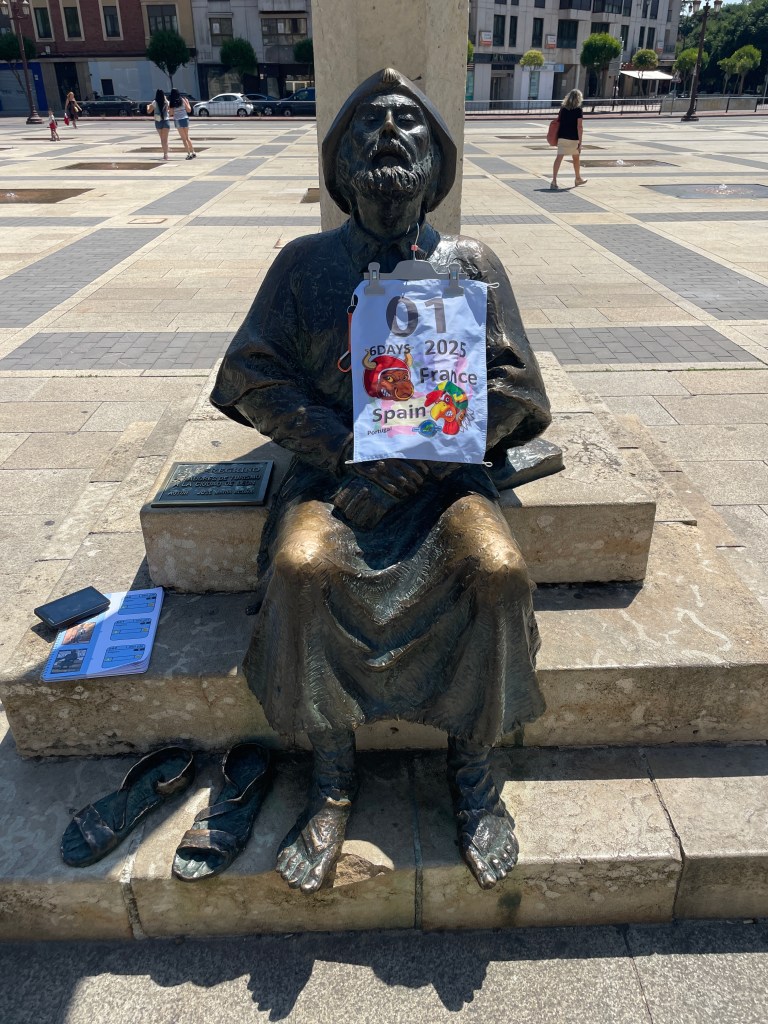
I photographed a pilgrim statue in Astorga, in Molinaseca and Pedrafita do Cebreiro. In Cebreiro, I met a resting female pilgrim, for a change. Later I turned onto some very narrow singletrack roads.
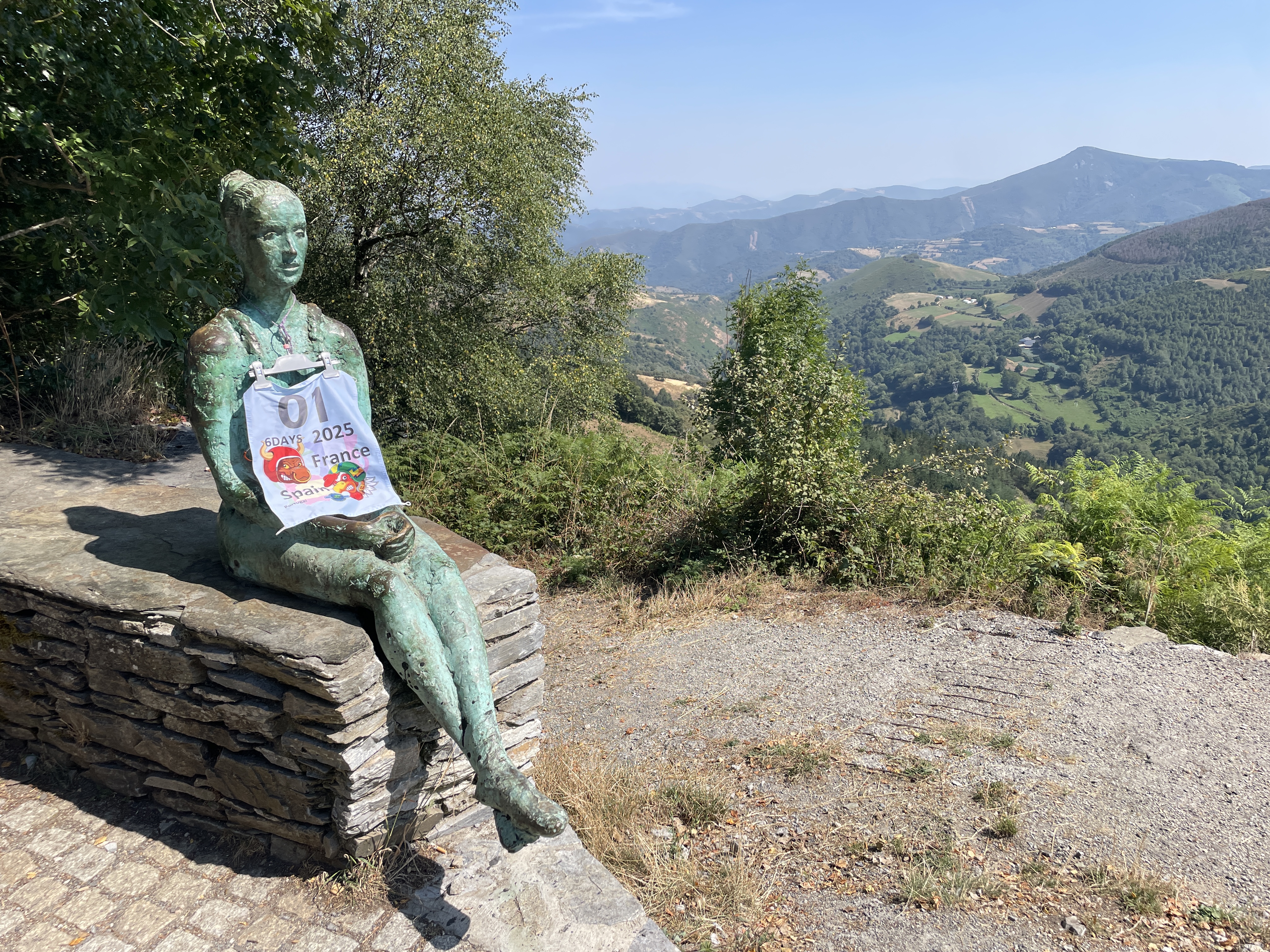
When I had passed the border to Galicia in my ascent, soaring temperatures dropped a bit and the landscape turned greener, what a relief. In a little, remote farm I found another pilgrim statue in the yard. The next rural locations were in O Alto do San Roque and Samos where I picked some more pilgrim statues. Next, I had to divert from the Pilgrims Combo again and had to ride to the Galician North coast. The closer I got, the lower the temperatures dropped. But first, I needed another petrol stop. This would be the last one before the rest break. But maybe I had waited too long? Suddenly it seemed that I ran out of options…would I find one on time? Ultimately, I spotted a station that came to my rescue. I thought it was time for a little snack as I hadn’t had a proper break that day and the day still would be long. When I was munching my sandwich, another rider was entering the petrol station. It was John Gann from Switzerland. This surprised me, but what I didn’t know at that point that he not opted for the pilgrims combo. We exchanged a few words before I headed for the high point location (11950 pts) that was worth all the detour. It was actually cool now, I was riding down to the coast. I could see my destination in the distance, this was a very scenic place.
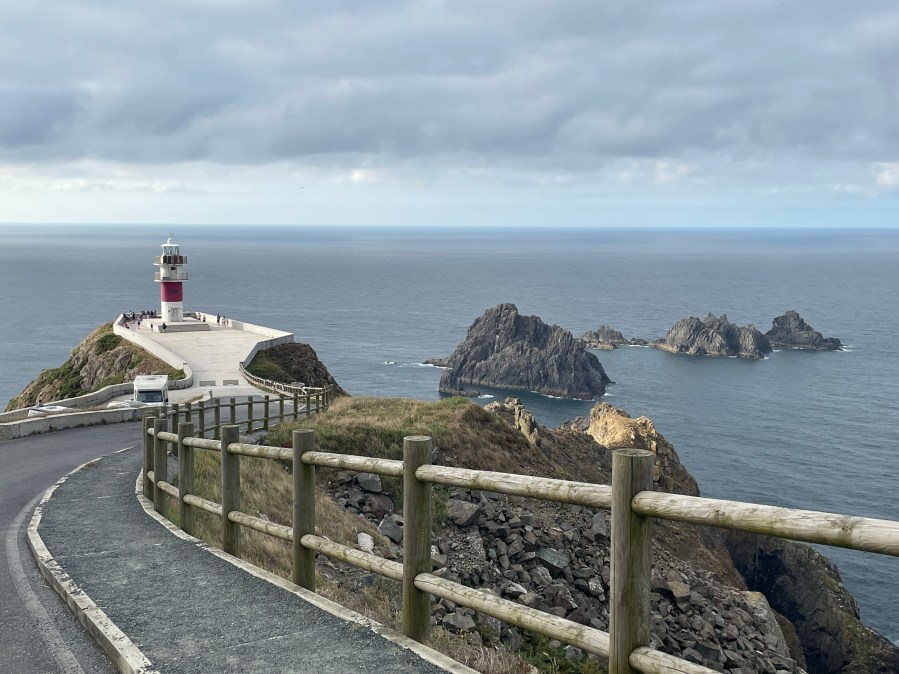
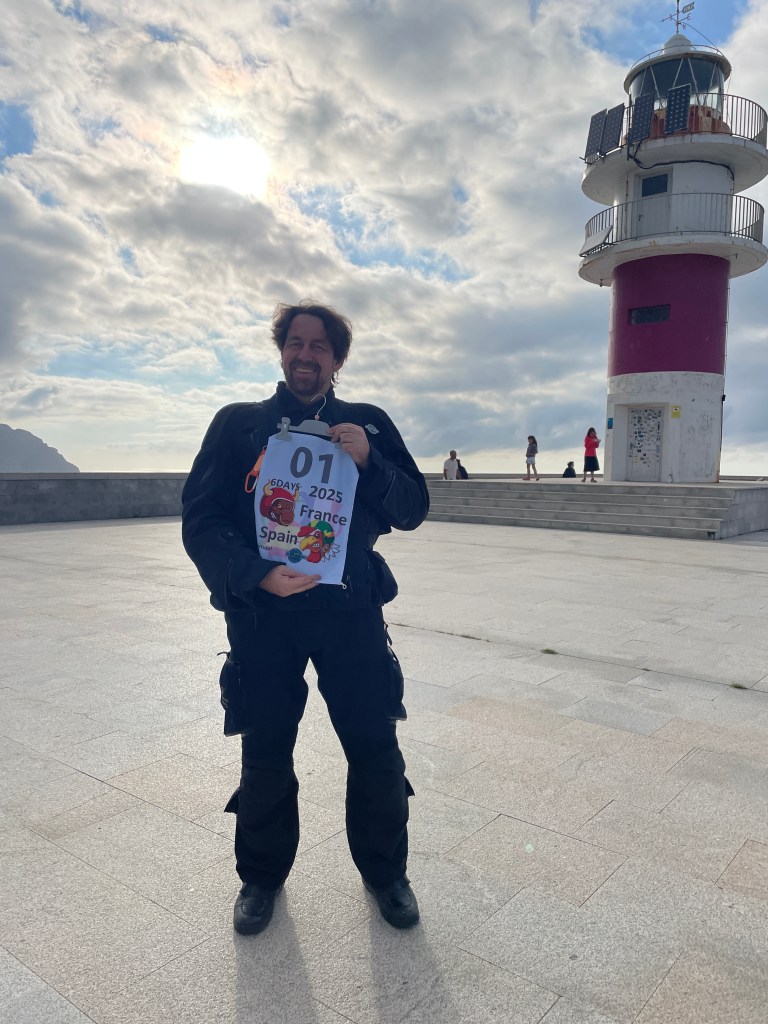
After my hiccup in the Picos, I was suspicious about my daily list and wanted to douple check with the rally book…indeed, this was a selfie location! Almost another error made! &!@%!£!!! I really needed to check every single location from now on, just as I did in the Iron Butt Rally 2023, too many miles/kilometers to loose many points. I asked some tourists to take a picture of me as the wind was too strong. And there was already John approaching, he had the same issue, so I took the picture for him. The next location was very close and also a quite high one (8650 pts) and I had to leave the coast and ascend to the mountain between the coasts. But when I arrived at the parking point, I was surrounded by a massive fog, visibility less than 5 metres. Whiteout! I had no idea what to do now? Where to go?
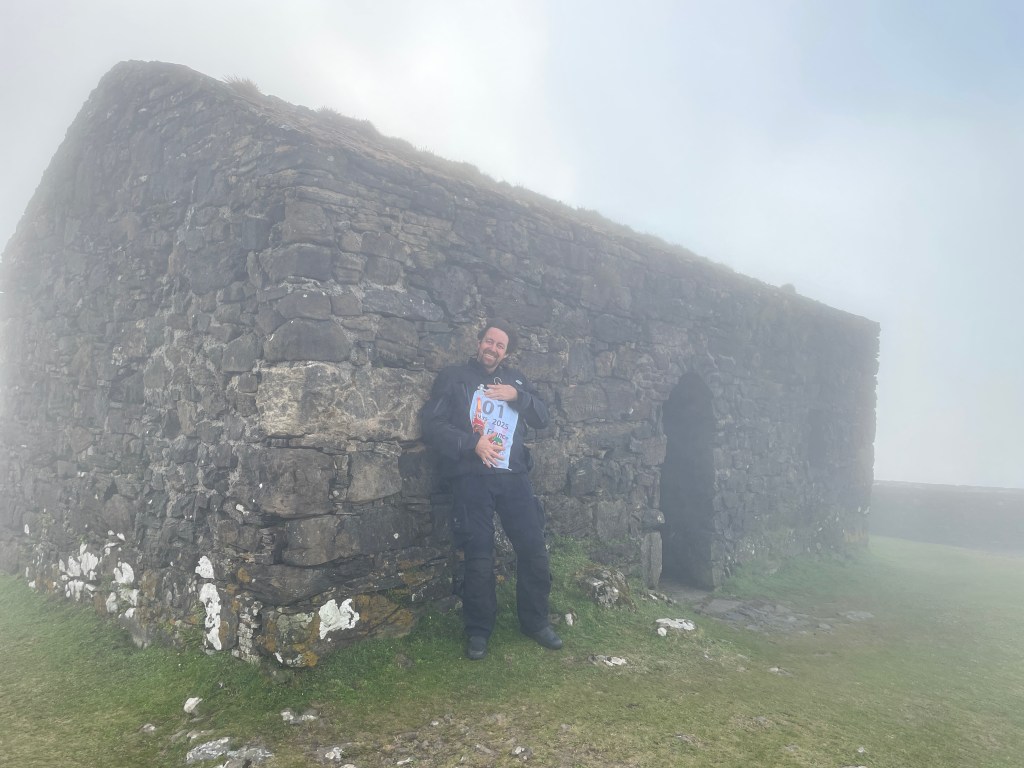
I had to pick the rally book…obviously, it was a stone hut…but where? The GPS was not a big help. When the fog was lifted a bit, I could see a path leading uphill….let’s try this. I stumbled upwards over stones in the fog…after a while, the fog lifted more and I could spot the stone building. The wind was so strong that I could not put the rally flag anywhere. And there was John again, so we did the mutual picture taking again.
The points were bagged today and I had to book a hotel in Santiago de Compostela…Found! The question was…would I still be able to ride to the Finisterre, the end of the Camino AND do the daylight location in Santiago? Or only next morning? But then it would still be dark…complicated….I had enough time while riding towards Santiago. My pondering was interrupted by the scenic views in the evening lights: I made a mental note that I will have to make a longer visit to Galicia. One day. No, really! I mean it!
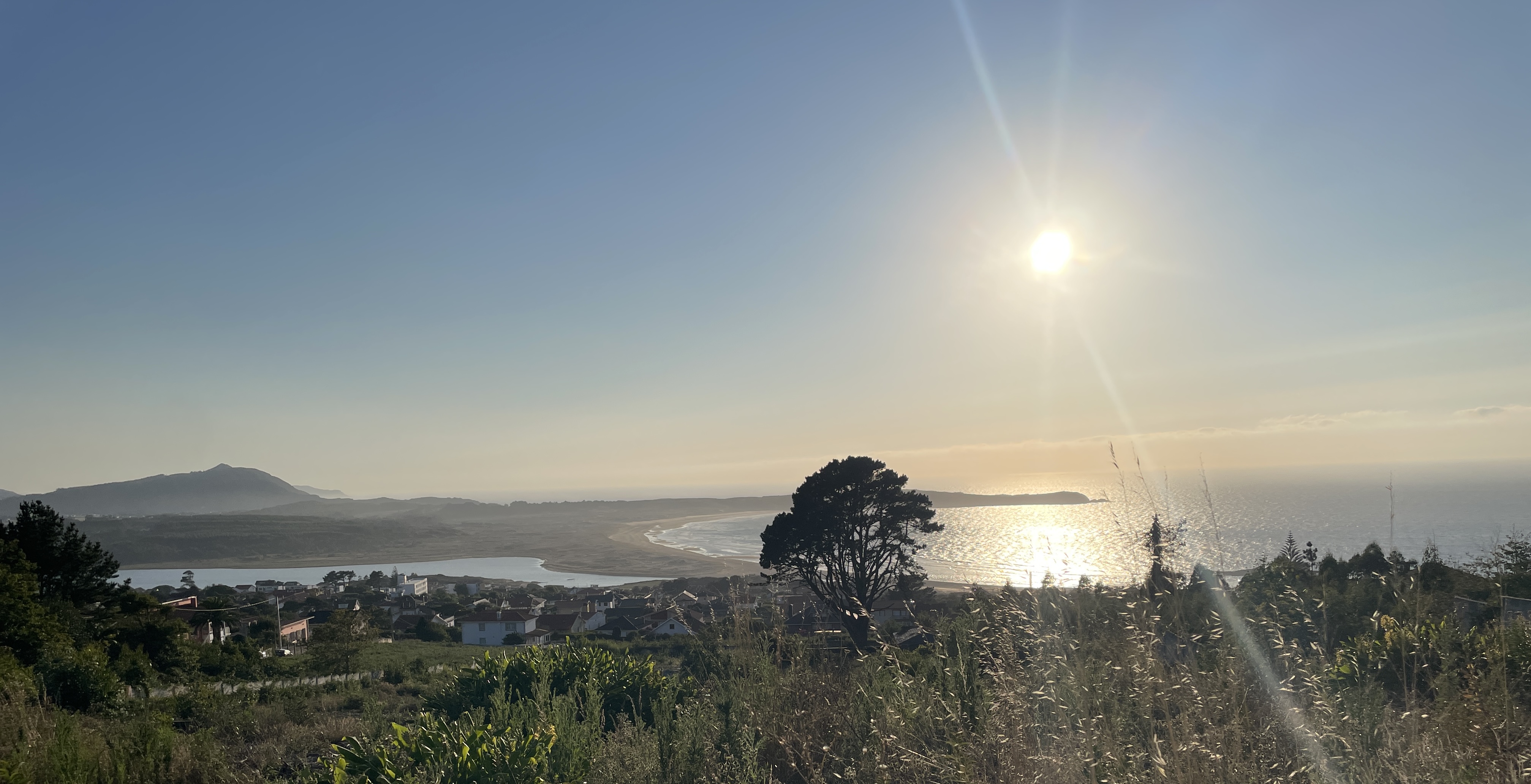
I decided that I had done enough today and was not keen on a night ride to the Westernmost point of the Iberian peninsula. I could still get the daylight point in Santiago, start my break, have maybe some dinner and ride to the West in the next morning. I had some issues finding the access to the pilgrim statue in Santiago, in the end I rode uphill off-road across a parc, which is quite daring with such a big bike. I found it, and in the last rays of daylight, I bagged this point that closed the shop for this day.

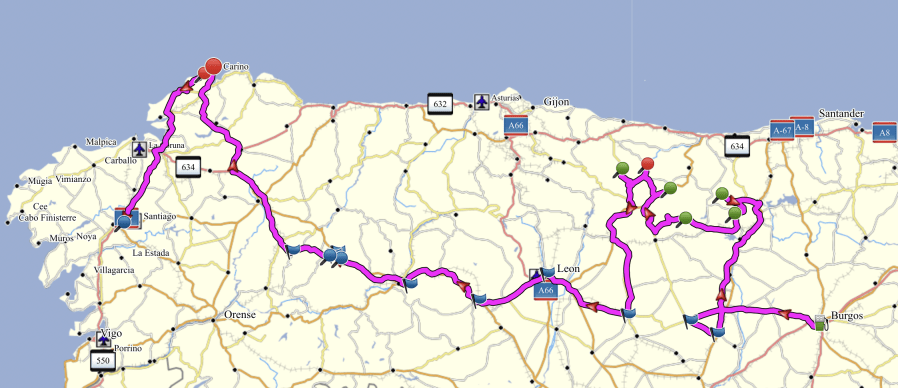
I started my rest break with the petrol station ticket that concluded the riding for the day. “Only” 1226 km in 17 h 10 min, seemingly a relaxed ride…NOT. Lots of bends, lots of secondary or single track roads, push, push, push.
I had purchased some food for breakfast and thought to look for a restaurant to have some dinner, after all it was just 22:15, quite a normal dinner time in Spain. I rode around in the quarter, but could not see anything that would provide a quick meal or would be appealing enough. Well, maybe I could get something in the hotel? When I arrived there, I parked the bike in front of it (no parking again) and went to the reception. I saw the restaurant/bar was full with people, so I asked if I still could get something to eat. Well, the restaurant closes at 22:30, but I could always have some snack. No problem. Oh, good. So I went back to the BMW, locked it properly, fetched my bags and went to the restaurant. “Can I have a table, please?” “Oh, I’m sorry, it’s 22:35, the kitchen closed right now.”. “But I can have a snack, can’t I?” “No, the kitchen is closed”. I learned the hard way that Galicia is different from the rest of Spain…no chance. I had stopped early for the break, and then this? Angrily, I went to my room, had a part of my breakfast as dinner, had a shower and planned the route for the next day, carefully double-checking my list for day 3.
Day 3 (Santiago de Compostela – Lisbon)
I had decided to indulge myself – I got up late and ended my rest break after 5 h 50 min – a luxury. Shortly after 4 a.m, I was on the road again. It was pitch dark and I was happy to have my 15.000 lumen Erica auxiliary lights that throw a cutting heap of photons on the road, turning night into day. There were some extra points to win if you would take a picture of the official “Camino de Santiago” sign. The previous days, I passed many of them, thinking that they were the wrong ones. Checking the rally book at night revealed that I had the wrong picture in my head! I passed many of the correct ones. I was hoping to find at least one more on my way to the end of the world, the point of Fisterra to the West. I was lucky in the end – I passed one after one hour, close to the cape, when I already had almost given up hope to still find one.
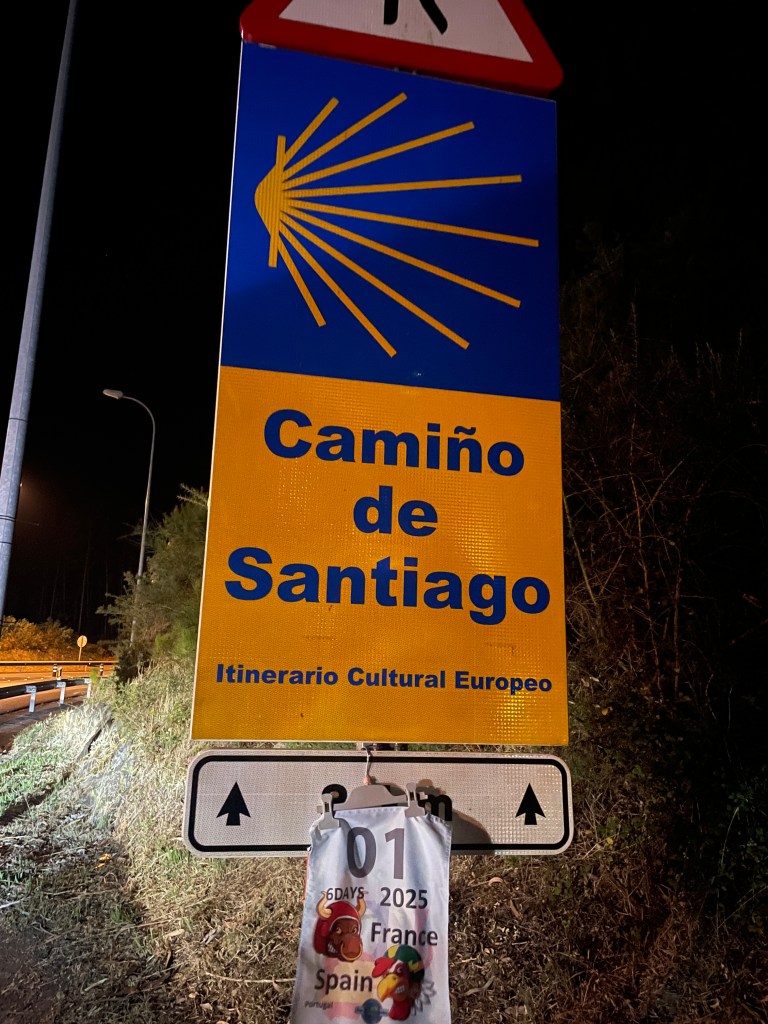
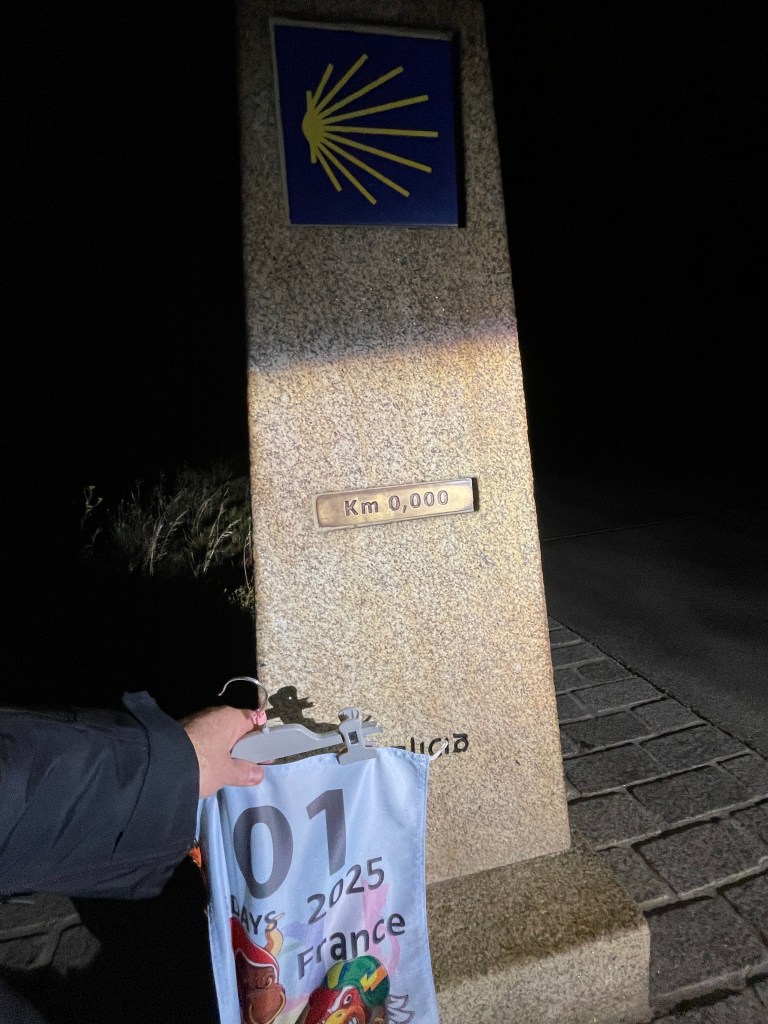
Finally I arrived a Fisterra, “the end of the world”. Close to the cape, there was the last pilgrim statue to be photographed. And then, I arrived at the lighthouse and at kilometer 0.0 of the Camino. Still pitch dark at 5:15 a.m., more than two hours before sunrise, I took the picture that should give me 39.000 extra points for the Pilgrim Combo, by far the highest chunk of points you could earn in this rally. Basically a must if you wanted to score well, leave alone winning the rally. Contently, I rode back the same road to Santiago. I considered it the better choice to have added this stint in the morning instead of the late evening. I entered the motorway and rode south to Vigo, where I had to take a picture of a church on the Monte da Guía at the break of dawn.
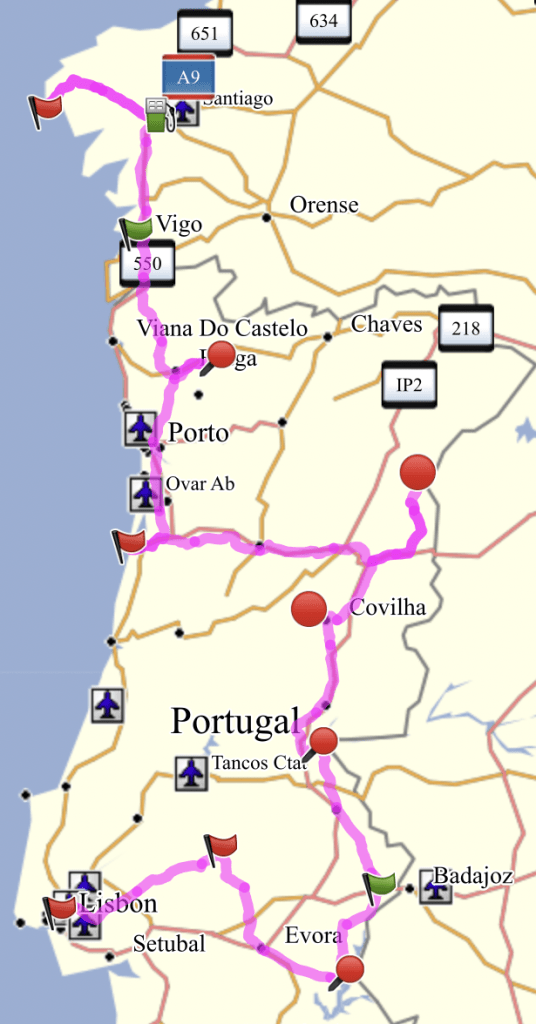
I was well in line with my ambitious (again!) plan when I crossed the border to Portugal at 7:35 a.m. The next two days would decide on the outcome of the rally. My underlying plan was to do the Pilgrim Combo as quickly as possible to be able to pick up ALL locations in Portugal. Yes, ALL. Each but one of them had a points value of 8500 pts, except three high value locations in the northeast, east and southwest, with 11500 and 16.000 pts. This was massive! Whatever your plan for the rally was, you had to do Portugal. All locations plus the Portugal Combo resulted in a total of more than 142.000 points! So it was clear to me that you had to collect all of them. The question was, in which order. This required a lot of zig-zagging.
Picture to the right: Tough nut to crack! How to combine all the points when
i) you enter from the northwest
ii) round pins are daylight only
iii) you want to exit in the southeast
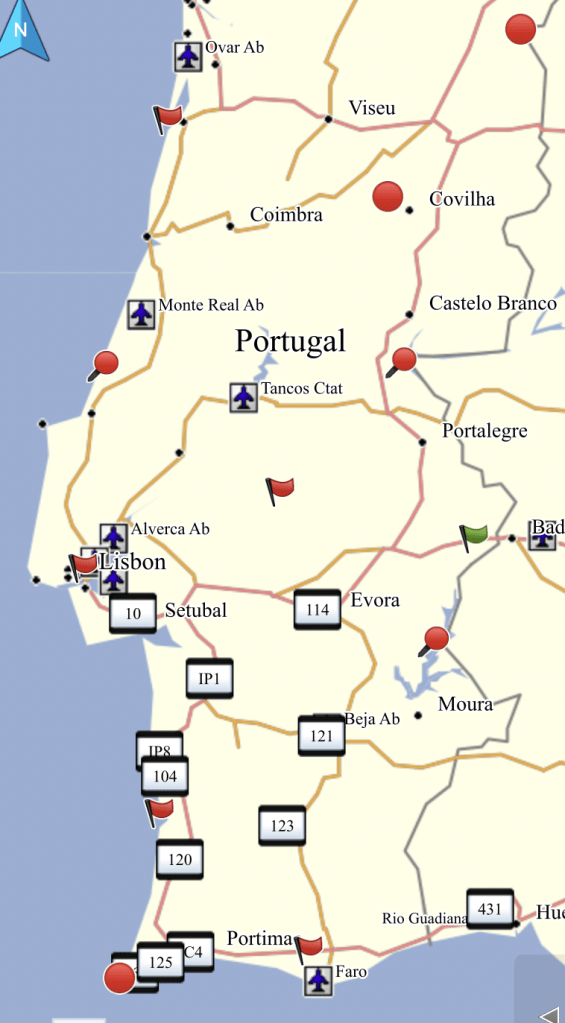
In whatever manner I wanted to connect the dots, there was no easy way to combine them in a straightforward way. The tricky point were the daylight locations. I couldn’t find a solution to visit them at the right time. I sensed that this was precisely what the rally master had in mind…During the whole day, I kept adapting my route on the fly until I came up with the solution: I had to use “brute force” tactics. In this context, it simply means to “go the extra mile”. In other words: “ride your socks off“. But the details were not clear to me yet, I needed to adapt depending on my progress during the day.

Step by step. Not far from the border, my first location led me uphill a long road from Braga to the east. And here you have the basic geography of Portugal: highest elevations in the east at the border with Spain, gradually descending to the coast in the west. It was a nice sunny morning, it was still cool. I had to park the bike on a parking, this seemed to be a touristic place: Capela de Nossa Senhora da Lapa. I walked upwards, following the GPS, between rocks and cork oaks. Finally I reached the highest point and took a picture of the chapel as required. I was the only one around so I could easily chip in a ‘bio break’ that was much needed. I had to go down the same road back to Braga to join the motorway again. In Porto I crossed the Douro, looking out for the famous Eiffel bridge that was too far away to be spotted.
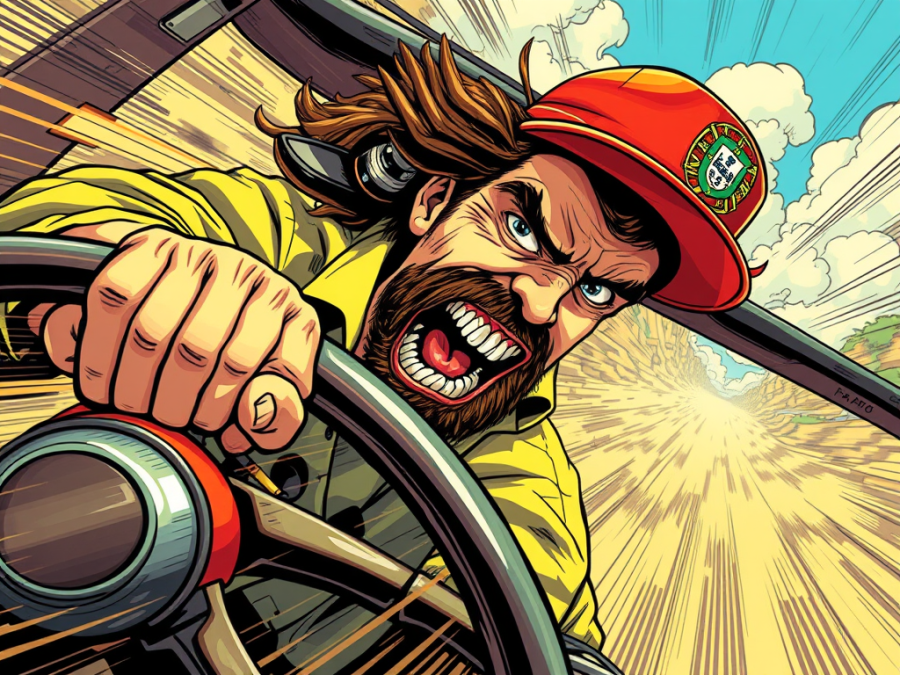
Gradually I was shaping my opinion about Portuguese drivers (call it prejudice, if you want): either totally insecure or thinking to be an incarnation of Ayrton Senna. You better watch out, as for the latter, reality does not match the self-assessment.
Picture to the right: Illustration picture. Colour may vary.
In Aveiro, I left the motorway and crossed the coastal village of Barra to take a picture of the Obelisco de Barra at the harbour. It is actually a huge sundial. Onwards! More of the zig-zag, my next location would be 2.5 hours away. I had to cross the whole country west to east, but before that, I needed to fill up. You want to approach the lesser populated areas of Portugal with full tanks, just in case. Anyway, at 11 a.m., I had done my first 600 km already.
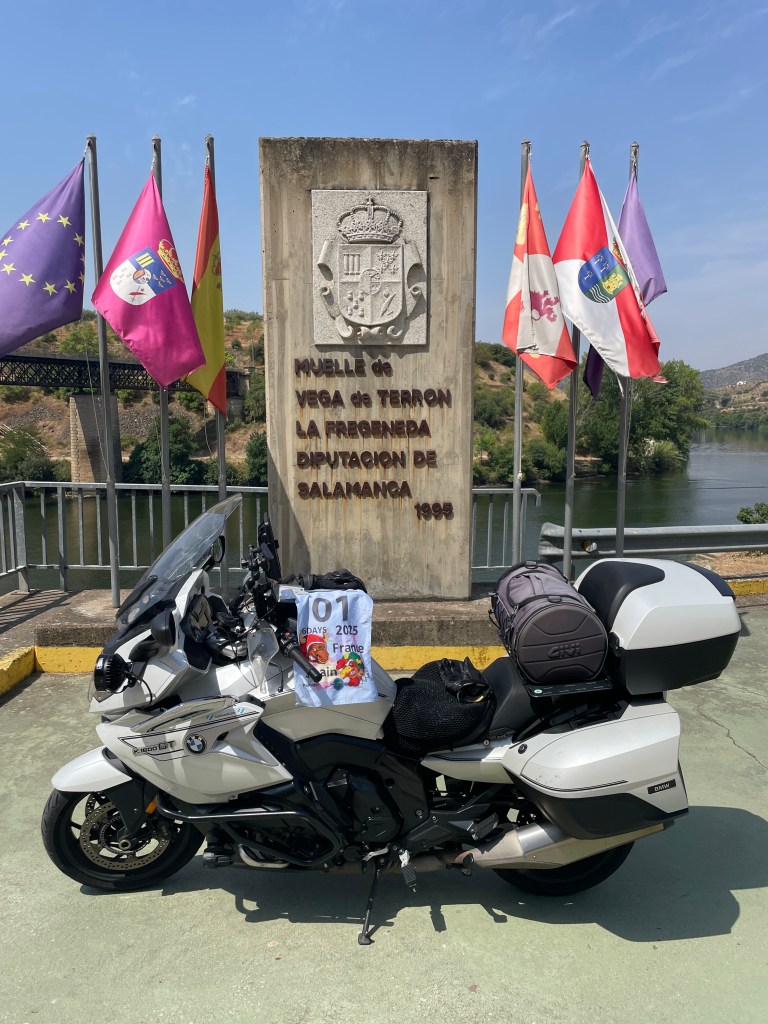
Before the Spanish border, I had to turn north again and ride through the rural landscape, no traffic and temperatures quickly rising towards 40 degrees. The ride was nice, good tarmac and a fluid road lay-out. I reached the location that worth a strong 11520 points and was confused. I crossed the border?? Yes, the bonus point location was situated on the other bank of a confluent of the Douro/Duero river that was about to converge with the Douro at the same location. I crossed a bridge and was in Spain! This time, the bike needed to be in the picture. My double-checking with the rally book should prevent any stupid errors from now on.
I had to ride 50 min back to the motorway, it was seriously hot now, approaching 41°. I took a turn to the south and recognised the motorway that I had ridden in 2022 on the way to the Ride to Eat, which was the some location I was now heading: the highest point of Portugal, the Torre station in the National Park Serra da Estrela (2000 m). A touch of Alps with nice views and scenic views over the land below. I wanted to get out of this heat and pushed the bike on the motorbike before exiting to the town at the bottom of the mountains, Covilhã. I encountered some traffic there, but was startled when suddenly the main warning light turned yellow. Huh? What was going on? I noticed that the coolant temperature was very high in the display. Gulp! I was going on the motorway and now I was trapped in traffic in the town, going uphill at 40° with little cooling wind and the ventilator turning desperately.
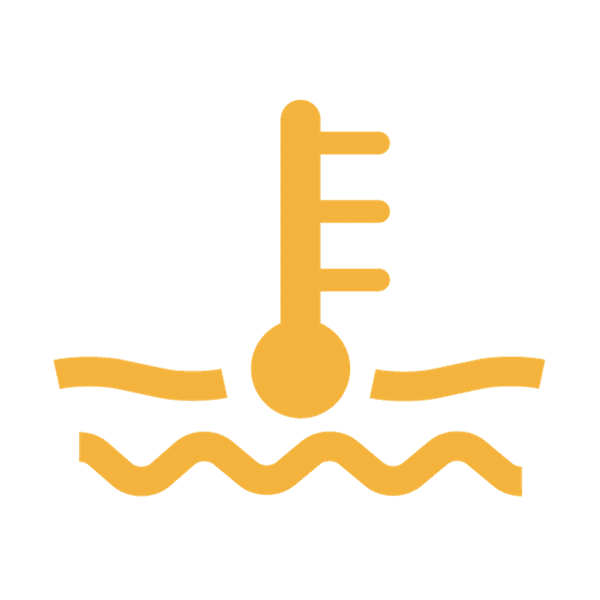
I knew that the road would ascend in steep turns after the town and so it did. But the cars in front of me were going extremely slow and I could not overtake due to oncoming traffic. The temperature display rose higher and higher…I noticed a sense of panic creeping up my spine. An overheated bike with a burst radiator hose would be a kind of game over scenario as this would require disassembling half the bike.
I was trapped after the last car…and I couldn’t pass it. Too low speed, too little headwind.When I finally could pass the car, the road went in steep turns….and then the temperature display reached the maximum and the display turned red. Nononononononoooooo!!! I was in the middle of a steep bend and could not stop here!!! I needed a safe spot to stop!
Finally I saw a lay-by next to the road where I entered and immediately switched off the bike. &§$%!!!!! This had never happened to me with the BMW! Was there a coolant problem? Not likely, I just had picked up the bike from the service. Or maybe a leak? What to do? I was trapped here. Well, it would take ages in this heat to get the bike cooled down. The whole motor block was a big hot piece of smelting iron. The only hope: let the bike roll down with shut-off motor to cool down a bit. So I did. I rolled down about two kilometers and saw the coolant temperature drop a bit. I waited until any cars passed by, switched on the motor and went up in a low-rev speed that would get me reasonable headwind. The yellow warning light was still on, but the temperature did not max out anymore. I rolled up the mountain, hoping for cooler temperatures. But even when I reached the top plateau, it was still 25° warm. I rolled to the radio tower that was worth 16010 points, parked the bike and took my picture.

Time for a short break. I entered the souvenir shop and passed the delicious looking cheese and sausages that were offered in too large quantities. I purchased a lot of water bottles and some snack. It was time to use the cooling vest under the jacket that needed to be filled with one litre of water. And there came Dave Winter, IBA veteran from Lancastershire, on this veteran FJR. We chatted a while and exchanged past itineraries. I rolled down the mountain again and enjoyed the views before the heat enshrouded me again. I would nervously watch the coolant temperature the whole day; even in the flat and with enough headwind, the temperature was quite elevated. But on the other hand, the air temperature leveled off at some cozy 41° for the rest of the afternoon.
During the break on the mountain, I did some replanning. I decided that it was impossible to do another loop to Badajoz, but I could pick up all the locations along the border. In the evening, I would have to decide what to do next, where I would spend the night. The next location was in the middle of nowhere, a church in white and blue, La Capela de Nossa Senhora dos Reméidos. Blistering heat.
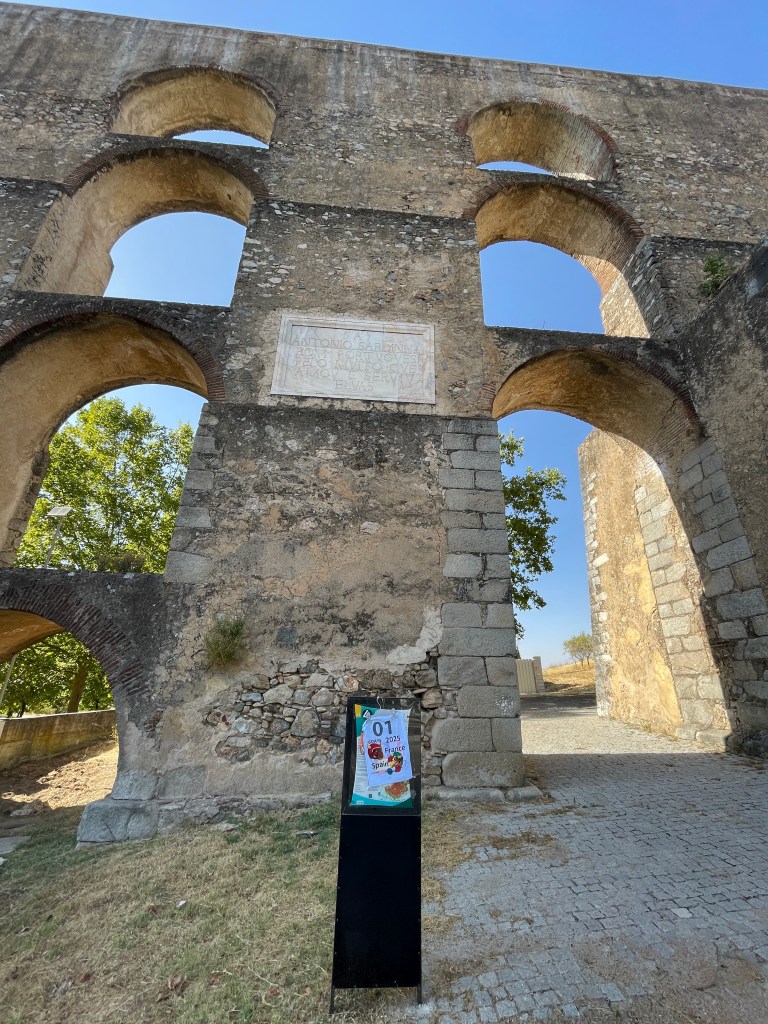
In Portalegre it was time to fill up the second time, a bit too early, but it would be enough for the rest of the day and petrol stations were not very abundant in this more remote part of the country. In Elvas I took a picture of the Amoreira Aqueduct, an impressive aqueduct from the 16th century that has a length of more than 7 km and 883 arches. I was riding in the Alentejo region with its soft rolling hills and plains, with conspicuous shrubs and the native cork oaks. Very relaxing, just the heat was a bit annoying, still around 40°. Luckily my cooling vest and the new Stadler suit with its many cooling openings kept me from overheating. I decided that after bagging the next high point location in Monsaraz, I would take a short evening break and plan the rest of the day.
When I arrived there, I had to take care of business first. With 90 min of daylight to spare, my plan had worked out so far. Check the rally book, get the flag, place it on the object, take picture, send picture, then take care of the other things. Like taking touristic pictures, snacking “dinner”, pondering over where to go next and where to sleep.
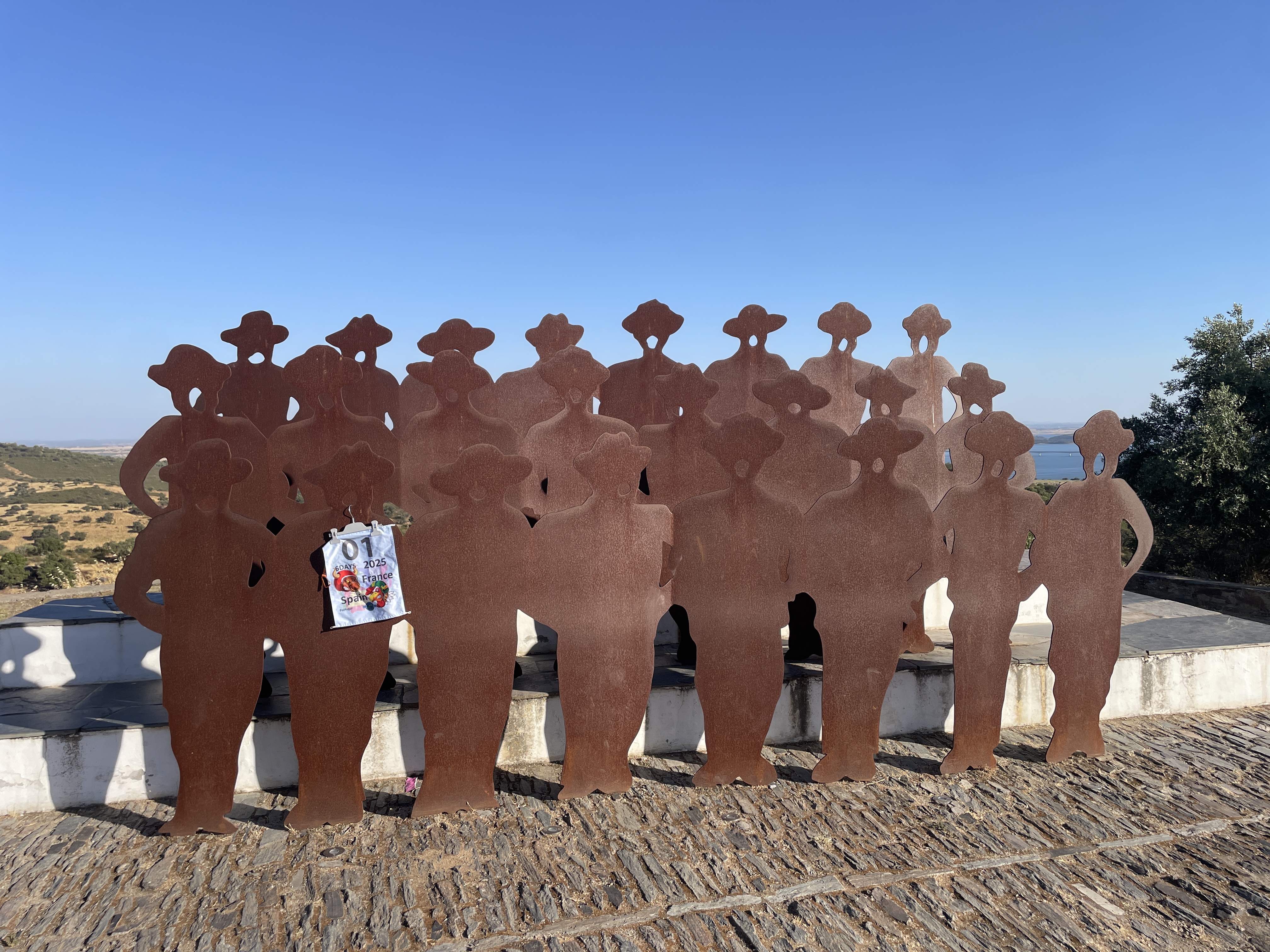
In the end I had a plan. I reserved a hotel near the BP location point in Lisbon that I would visit after another point on the way there. With a significant detour. A 242 km evening ride, with very little motorways. Let’s go and enjoy the evening light before riding in the night! Riding in the last rays of sunlight was nice and the landscape provided a perfect background. In the upcoming dusk, I reached the waypoint at Montargil, taking a picture of a milestone with a view over the Albufeira de Montargil. Some cheeky kids in a swimming pool were taunting me – I must have appeared like an alien in my black suit in this heat. For a split second I envied them.
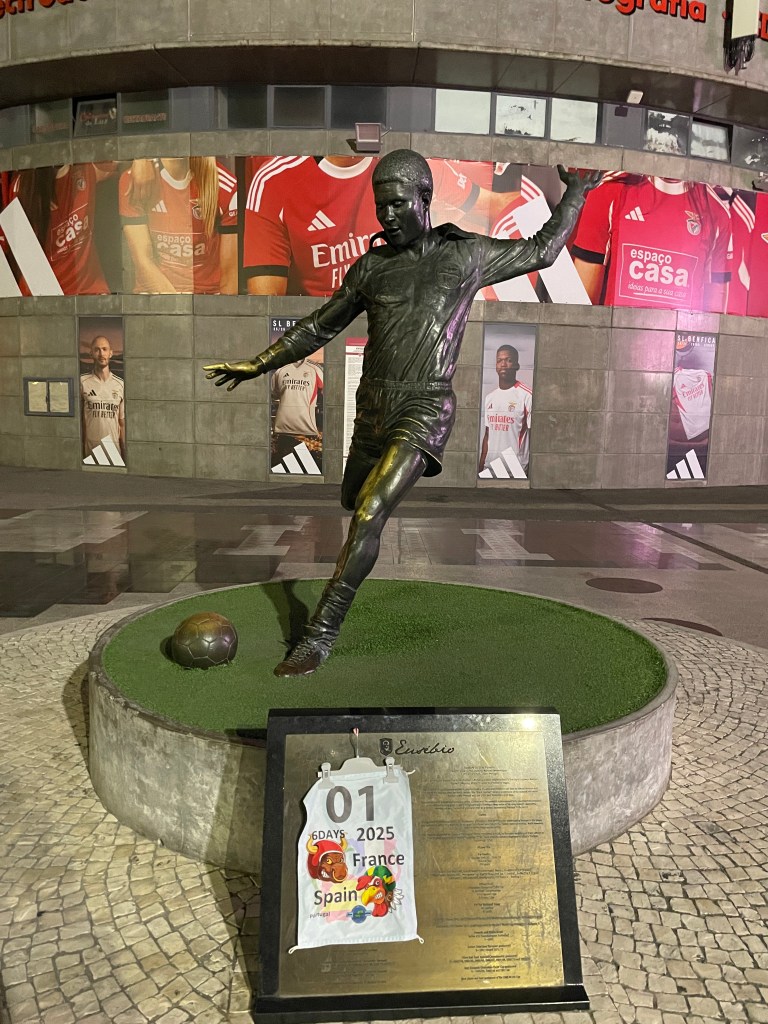
Onwards! It was getting dark now and the Erica lights came into play again. The BMW was floating through the night and I was glad to have the Waze app that saved me from some pesky speed cameras that were placed in a buccaneering way. Finally I reached the greater Lisbon area and rode across the Vasco da Gama bridge, the largest (17 km) bridge in the European Union. It was a memorable ride across the Mar de Palha Bay, in the dark, but illuminated by the bright lights of Lisbon. I quickly reached the stadium of Benfica Lisboa, parked the bike and walked to the statue of the legendary Portuguese football player Eusebio. Great, another 8500 pts, now for the rest break! First I had to pass the hotel on a motorway to get to a 24 h petrol station.
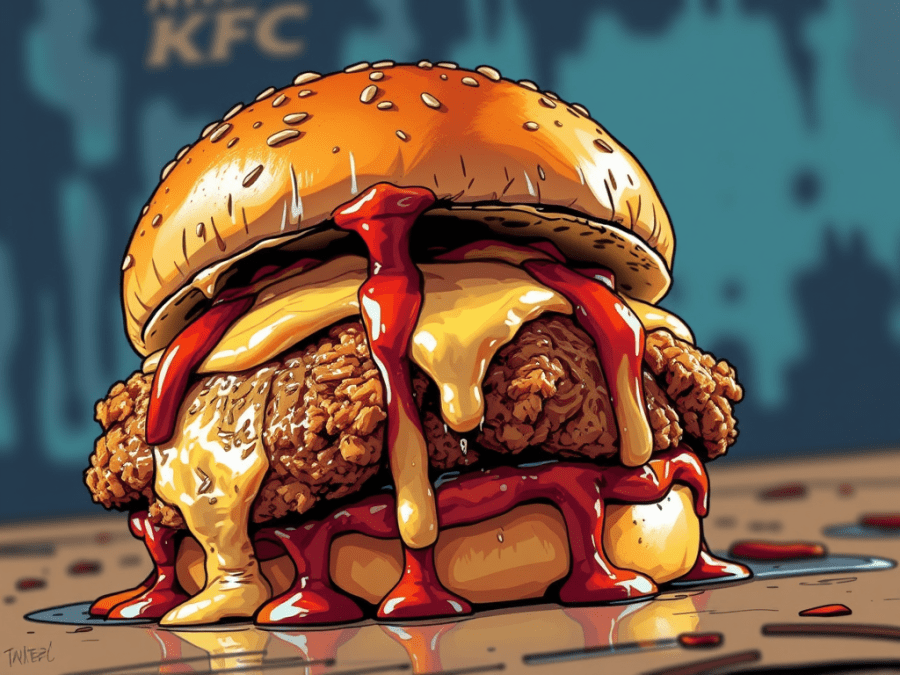
After I had my ticket, I rode back but stopped at another service station where I stopped at a KFC. I hadn’t had any warm food for three days, just some snacks. Kentucky Fried Chicken isn’t Mount Olympus of gastronomy, but at least it would be some warm food.
Picture to the left: after three days of cold junk food, finally some….er…warm junk food.
After this pitstop, I checked into the hotel. I had a very much needed shower and planned the next day, focussing even more on avoiding any transcription mistakes. I went through my sent pictures from the past days. I spotted that one e-mail subject line was missing a number for the last Pilgrim statue. I re-sent the picture with the correct number again – phew! This should have saved the Pilgrims Combo. For the next day, I still had to do a cunning move: go first north before going southwest and then east towards Granada. I was a tad tired, after all I had ridden 1497 km in 19 hours, mostly on secondary roads, at temperatures up to 41°. I decided that after this successful day, I deserved a longer break. Anyway, my first location was a daylight point and only 90 min away. At a sunrise at 6:40 a.m., there was no point to leave after five hours of rest break at 3 a.m. Luxury!
Day 4 (Lisbon – Granada)
The longer sleep was very much appreciated after the tough day, more than four hours! The temperature was rather cool when set off at the petrol station at 05:43. As I had planned to do all locations in Portugal, this was the time to make a cunning move to resolve the zig-zag jigsaw puzzle: I had to go north first before I would go south again! So off I went. Mostly on motorways until I reached the exit to Nazaré. Like many times, I was totally unaware where I was in that moment. It would only be later when I would realize. I rode close to a parking near the beach. The famous beach of Nazaré, the surfer paradise.

I spotted another rider that was already standing at the object to be photographed. I approached him and it was no other than…Arjen! What a surprise! He had sent me a message the day before telling me that he had forgotten to pick up the first Pilgrim Combo point and he needed to return later. Now he could tell me about it. We held each other’s flags and chatted a bit. The missed location was a bummer for him as he wanted to pick it up on the way back. I thought that this meant that he couldn’t do the same route as I had in mind…but you never know until the end. And he is good in planning competitive routes, so I knew that nothing was decided yet. And I could always mess something up, maybe I did already?
We set off together and would ride a while together before he would turn east and I south. I could see the difference at the toll booths when he rode through with his toll device, whereas I had to stop to put my payment ring against the card reader. This cost me 40 seconds per toll booth, but I still was convinced that I did not need such a device as on a 6 days rally, the extent of this advantage could be considered negligible. After a while we parted and I passed Lisbon again, this time going south. My targets were two locations along the Algarve. First, a weird statue in a very touristic town called Vila Nova de Montes where I also filled up. I had “only” done 400 km this morning yet, but there were not so many fuel stations around, it seemed. After another 120 km, I reached one of the highlights of this rally. The last Bratwurst before America. A German sausage grill at the south-west tip of Portugal near Sagres: “Letzte Bratwurst vor Amerika”. Worth a whopping 16050 points. It was only open in a small time window during the day. I followed the instructions: buying a sausage, receiving the certificate of purchase and taking a picture of the takeaway with the bike. Real stuff from Thuringia, the sausage was delicious.
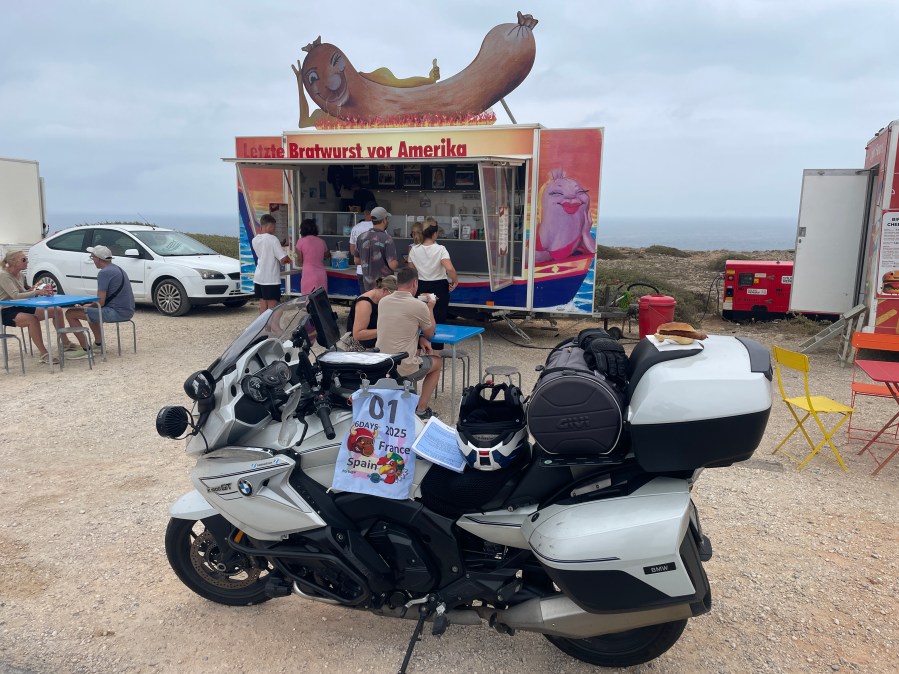
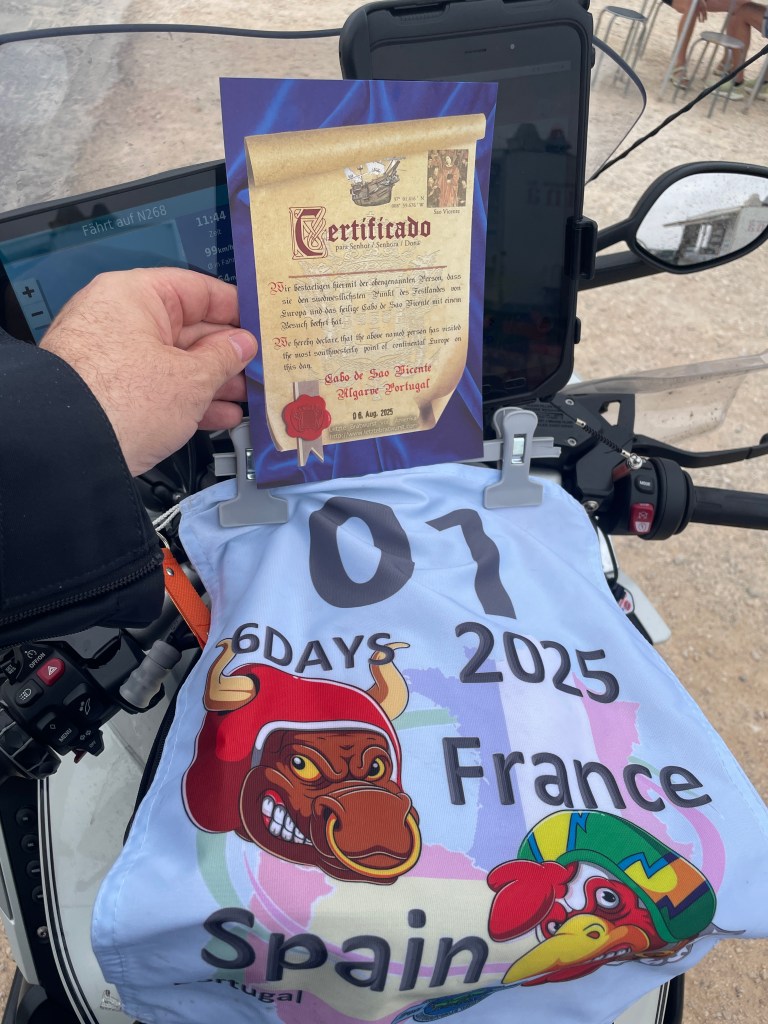

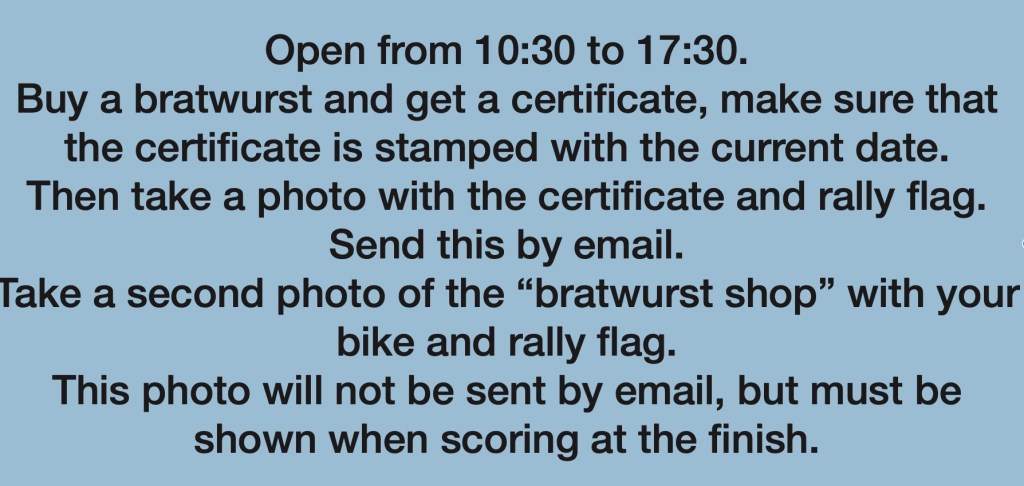
This was literally the turning point. The most distant location of the rally. Only very few people would make it here, if at all. Now it was time to turn north-east again. I had done it. I was going to visit the last location next, and then I had visited all Portuguese BPs!

Today it was very cool but I knew this was not going to last when I would enter Spain. The next point was in Loulé where I took a picture of a statue of a sitting poet António Aleixo. It was getting hot now (2 p.m.). My job in Portugal was done, no more locations left. My plan was to get to Granada tonight, with some luck I could still go up the Sierra Nevada before starting the rest break. So let’s go to Spain! After crossing the border, I left the motorway in Huelva and went north to a huge open pit mine. The next point was located in the expo area of Sevilla, a picture of an Ariane V rocket. It was bloody hot now, not like the day before, but still in the very high 30s.
Timewise, I made good progress, I visited the “museo del chocolate” in Estepa and another location in Antequera. When I filled up, I enjoyed a break in the air-conditioned fuel station, drinking a large bottle of water. My cooling vest was doing a great job again. I checked my plan again; was it possible to go up to the Sierra Nevada at daylight? If yes, I could save some time in the morning and leave early. My GPS told me I would have 30 min to spare before sunset; Let’s go! I passed Granada and started the ascent to the Sierra. In the evening light I reached the top at 2550 m sea level, la Hoya de la Mora. I had to take a picture of a hut and enjoyed for a short moment the views over the mountains, plains and ski lifts.
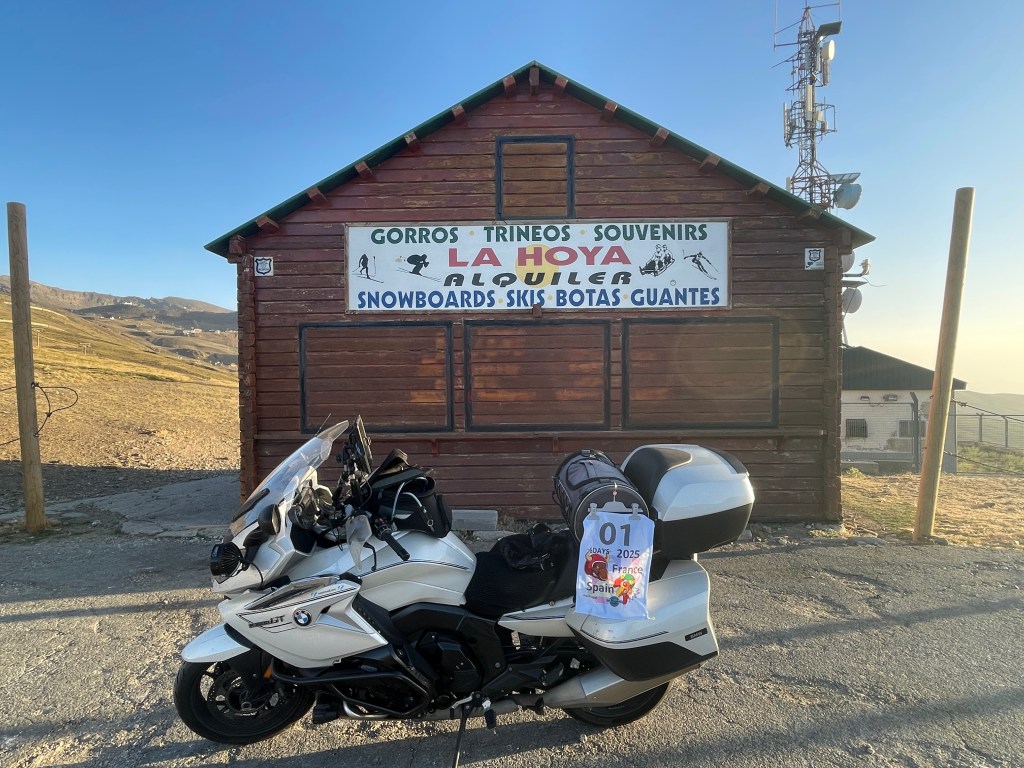
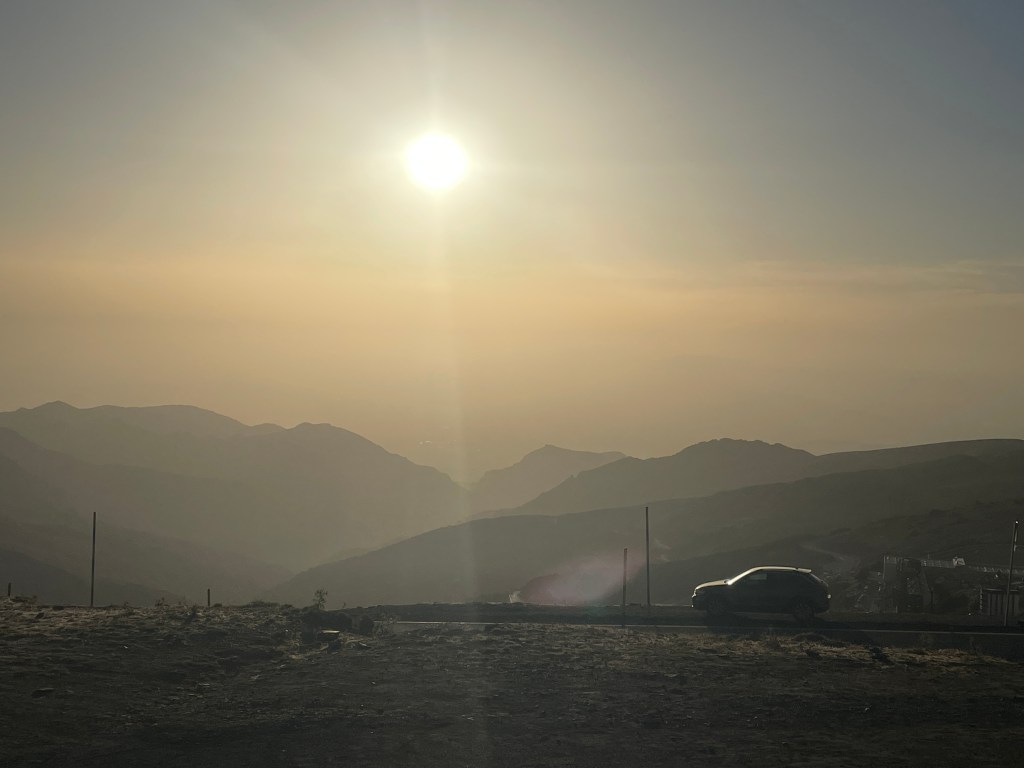
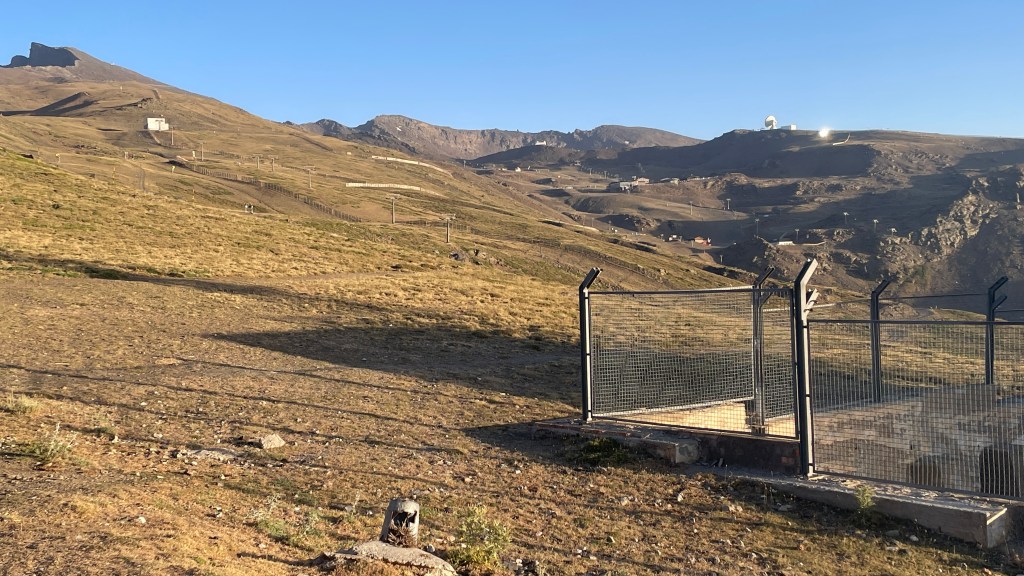
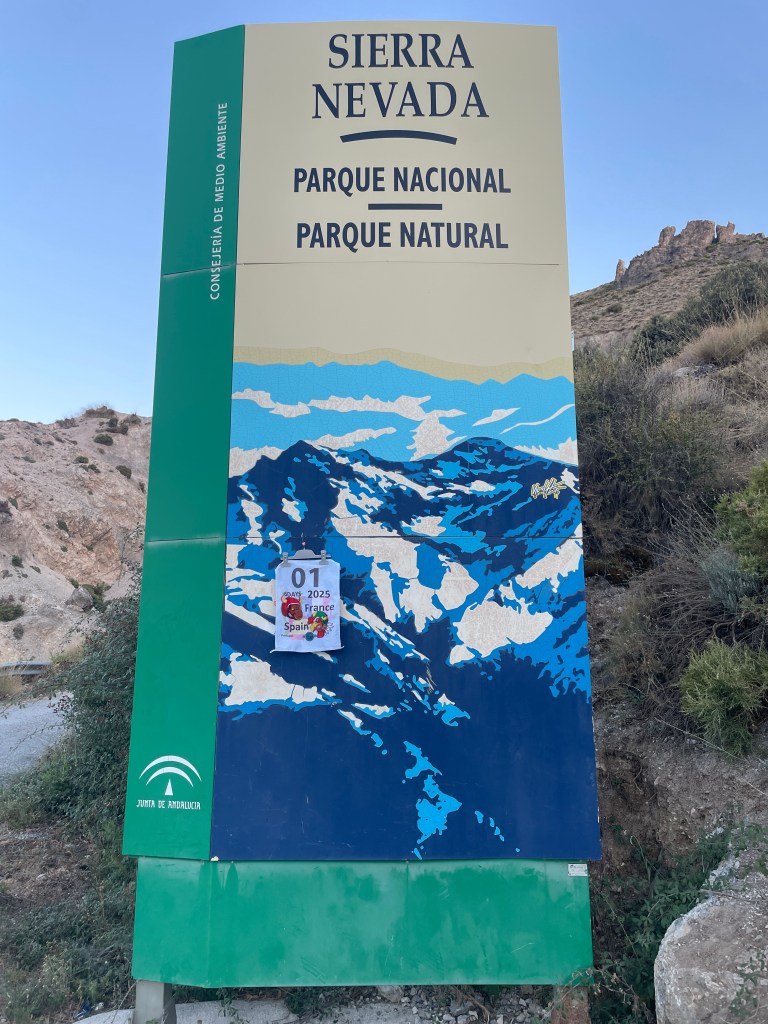
Another literal highlight of the day. I rolled down the mountain road and took a picture of a welcome sign of the national park for another 2750 points. Mission accomplished. I rode to a petrol station next to the hotel and got my rest break start ticket already at 21:28, the earliest in this rally. It was still very hot (35 degrees) and sweat was streaming when I locked my bike and walked to the reception.
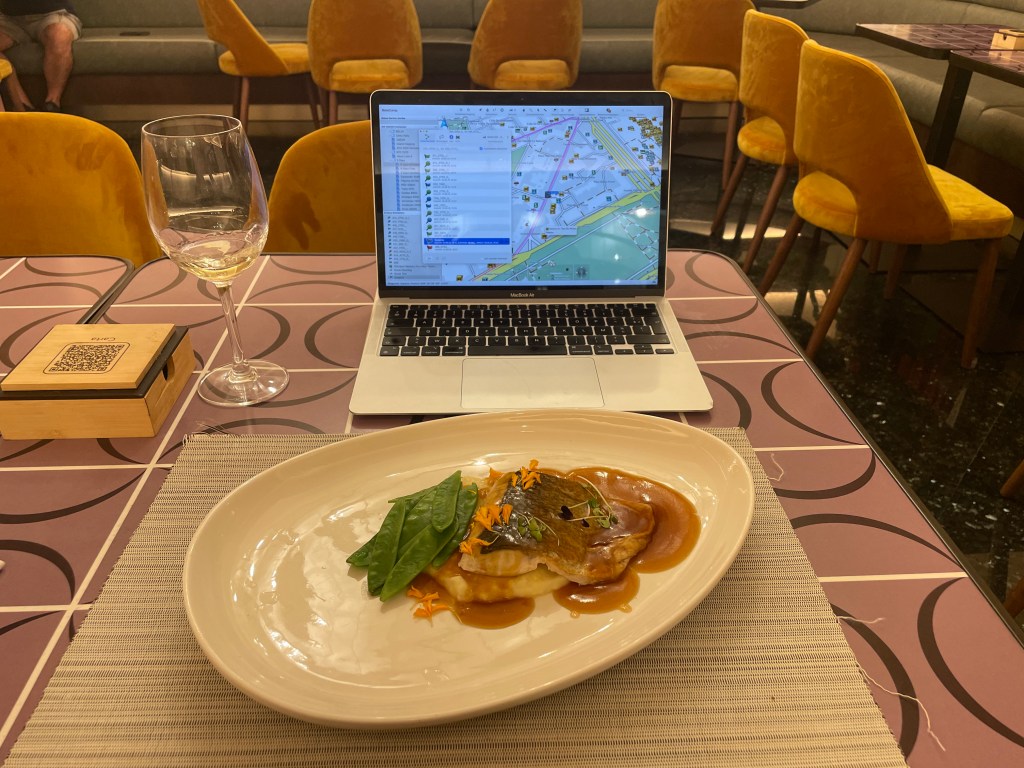
At the check-in of the plush hotel I asked if the restaurant was still open. Yes, until 23 h. Spanish time. Great! After a quick shower I sat down in the restaurant and ordered my dinner: some croquetas and fish with a glass of white wine. Finally not only warm, but even “proper” food. In parallel, I planned my route for the next day. I made progress as planned, but I knew that rallies are won at the end so designing the last 2.5 days were of importance.
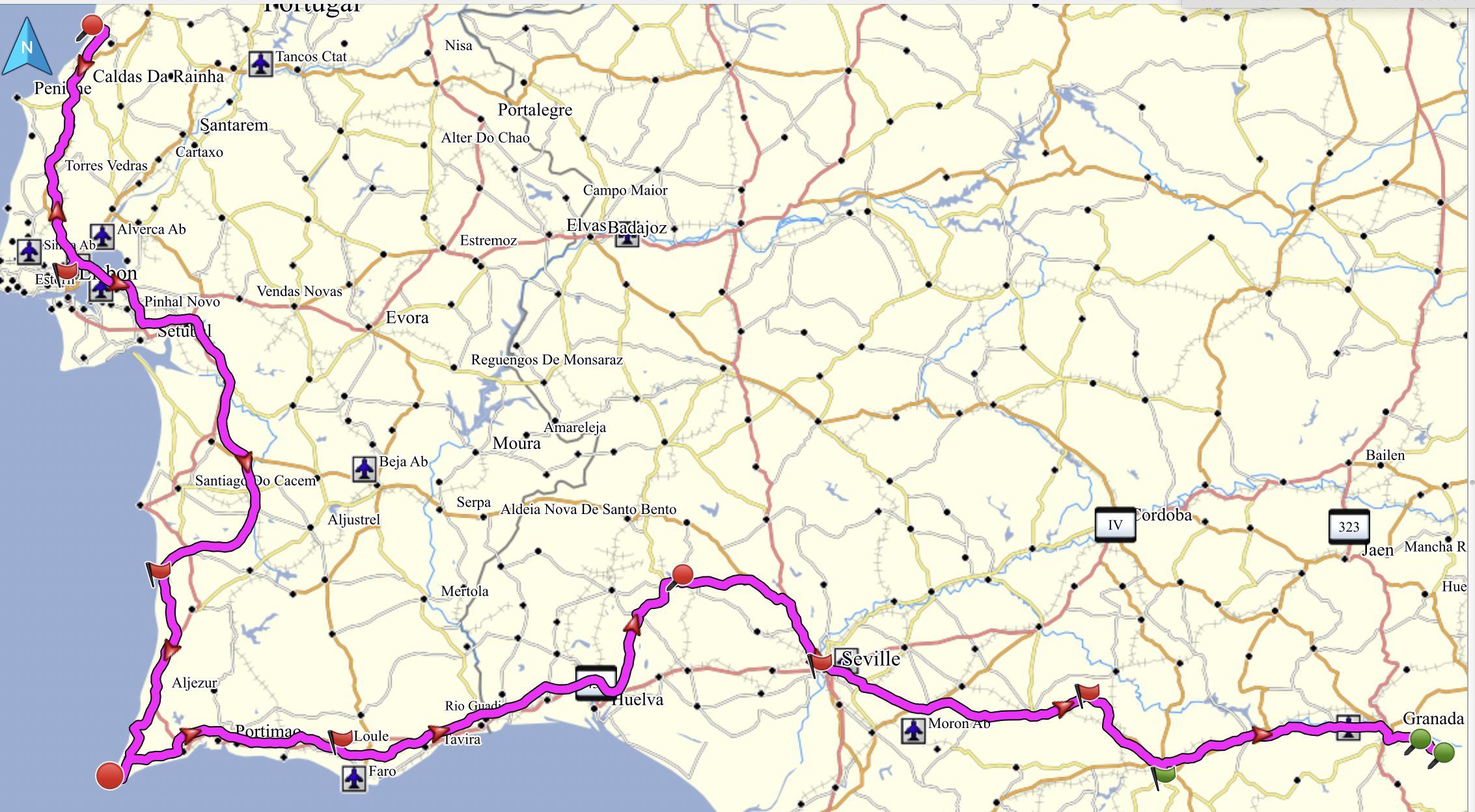
Today’s ride was “only” 1237 km in 15h 40 min. Late start and early end.
The next morning would be special, I would ride through the Alpujarras south of the Sierra Nevada, but due to some tricky daylight locations (the rallymaster’s twist!), I had to get east to the start of the Andalucia combo first before heading west and then north again. But a late daylight point meant that I could only leave late, this meant I would have another, now even 8 hour long rest break. Luxury!
Day 5 (Granada – Salou)
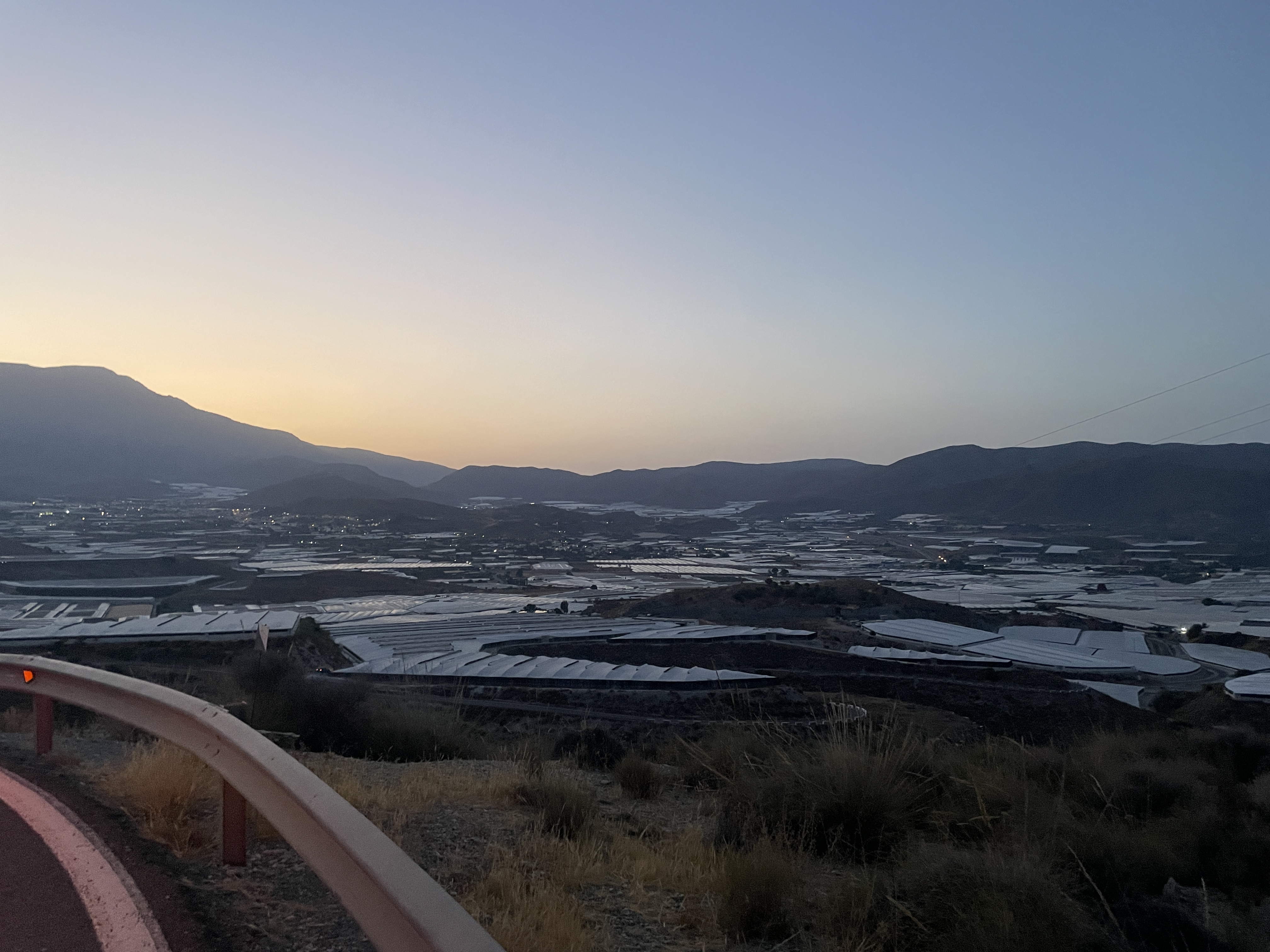
I enjoyed the late start and set off at 5:30 in the dark and rode onto the motorway towards Motríl and further on to Almería. I made good progress and after one hour I exited the A-7 in direction Berja. It was still dark but the black slowly turned into a dark blue. In Berja, I stopped at the central square to take a picture of a church. It was a Thursday morning before 7 a.m., but there were many young people on the streets, like looking for something. Weird. I rode on, towards the hills to the west. Before turning away from the valley, I looked back and was stunned. This view in the dusk of the coming day looked like from a different planet. I stopped and took a picture. What did I see here? Later, I realised what it was. As I was not far from El Ejido, I saw the extension of the massive greenhouse area that is even visible from space. Not comparable to the real thing next to El Ejido, but still unexpected. The young lads in Berja were day labourers looking for a job.
The next location, only 10 min away, was the first daylight point, a stele next to the road. I was riding through some of the typical white Andalusian villages in the arid landscape in the early morning. In Cádiar, I took a picture of another wine fountain. I was riding on larger roads now and made good progress. When my satnavs were disagreeing again, I stopped and had a closer look. I thought I was on my way back to Granada as I had collected already all points of the Andalucia combo. I spotted on the map that I had not listed a high 5650 points location. Another mistake duly corrected! I had to ride up to the village of Cañar on a winding road to take a graffiti picture….and ride down again.
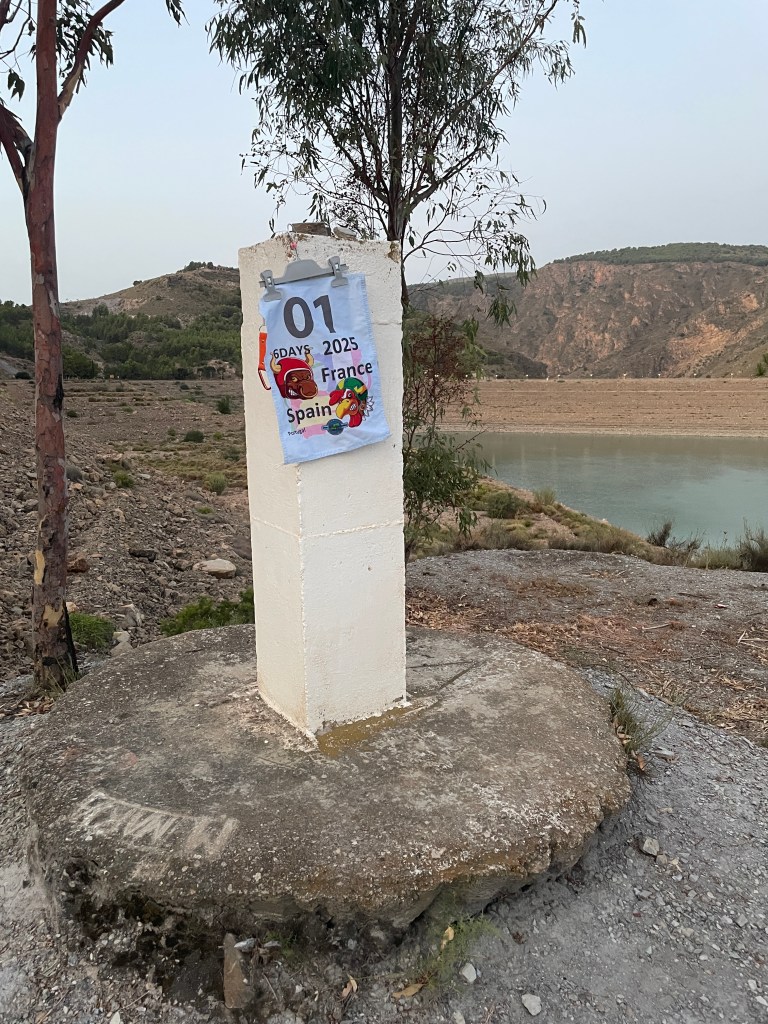

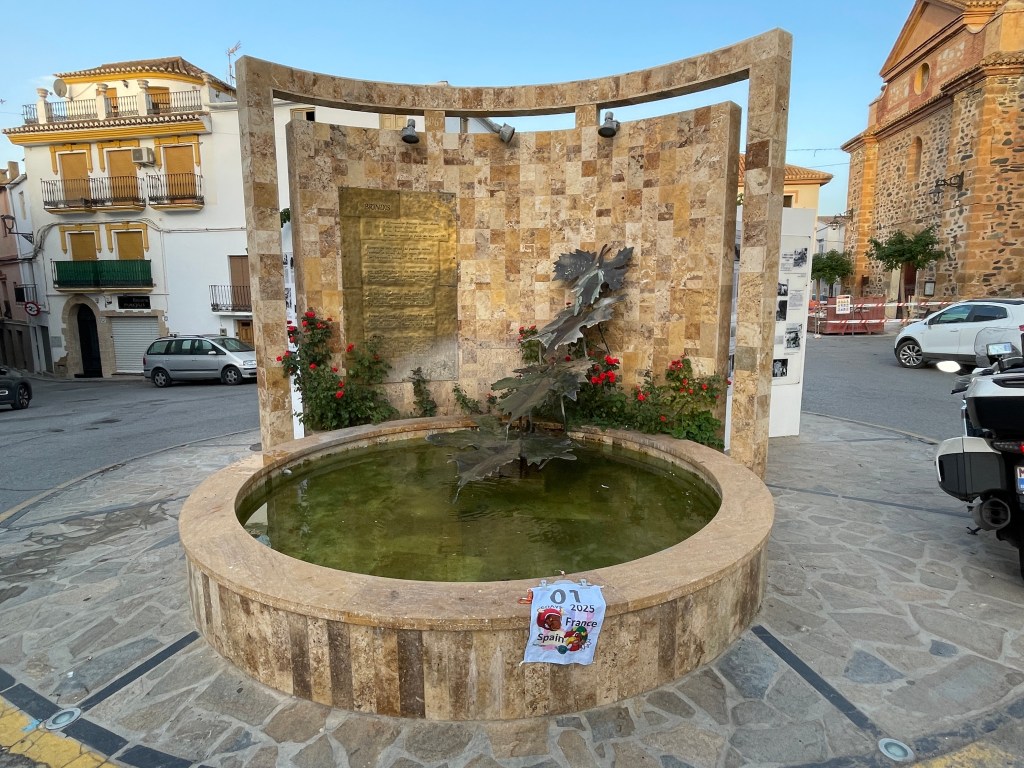
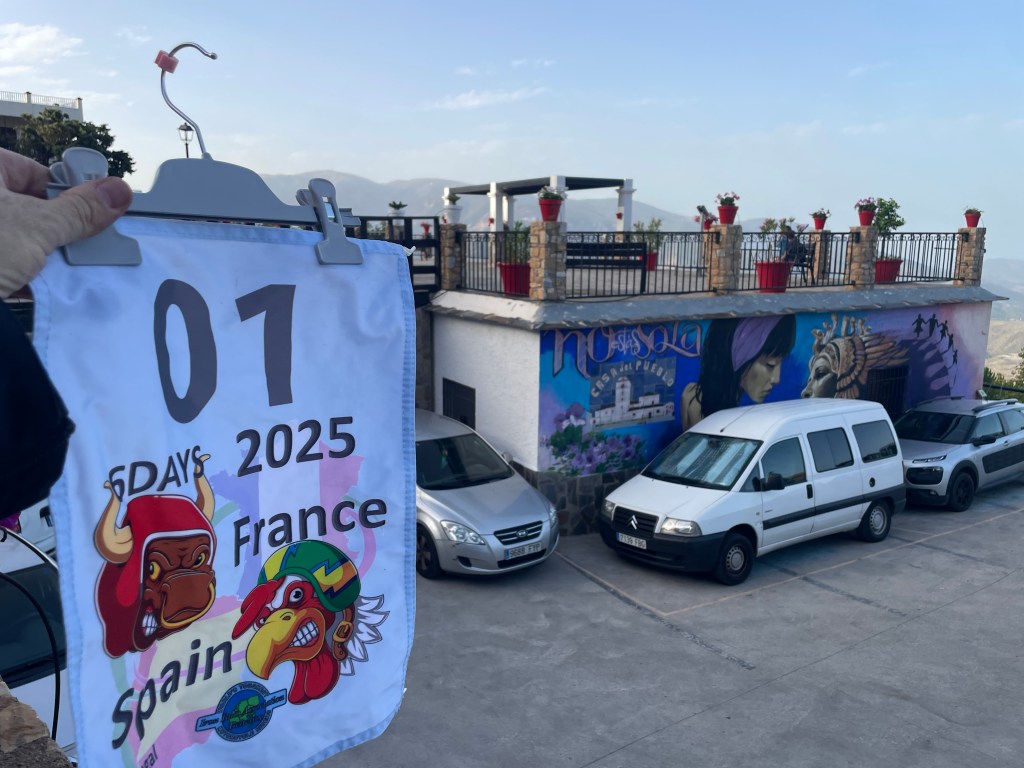
Now it was time to head north again, basically back to the finish in Metz….with some detours. A lot of detours. I passed Granada and exited the motorway to take a picture of one of the famous Osborne bulls. Back on the motorway, I rode north and after an hour, entered the town of Bailén to photograph a mural. Back to the motorway and further north. The next series of locations belonged to the “Cervantes” combo, worth some 8.000 points. The first bonus were the windmills near Consuegra, situated on a small ridge. The classic Don Quixote windmills. Then back to the south to Puerto Lapice where I visited another windmills on a hill. Down in the town I had to take a selfie with Señor Cervantes himself. It was time to fill up for the first time today and I decided to have snack lunch break in the cool petrol station. I needed to plan/check the rest of the day. My next destination was Valencia where I had planned to make a family visit. From there, I would head north towards Barcelona. But first, I had a few more locations to visit.
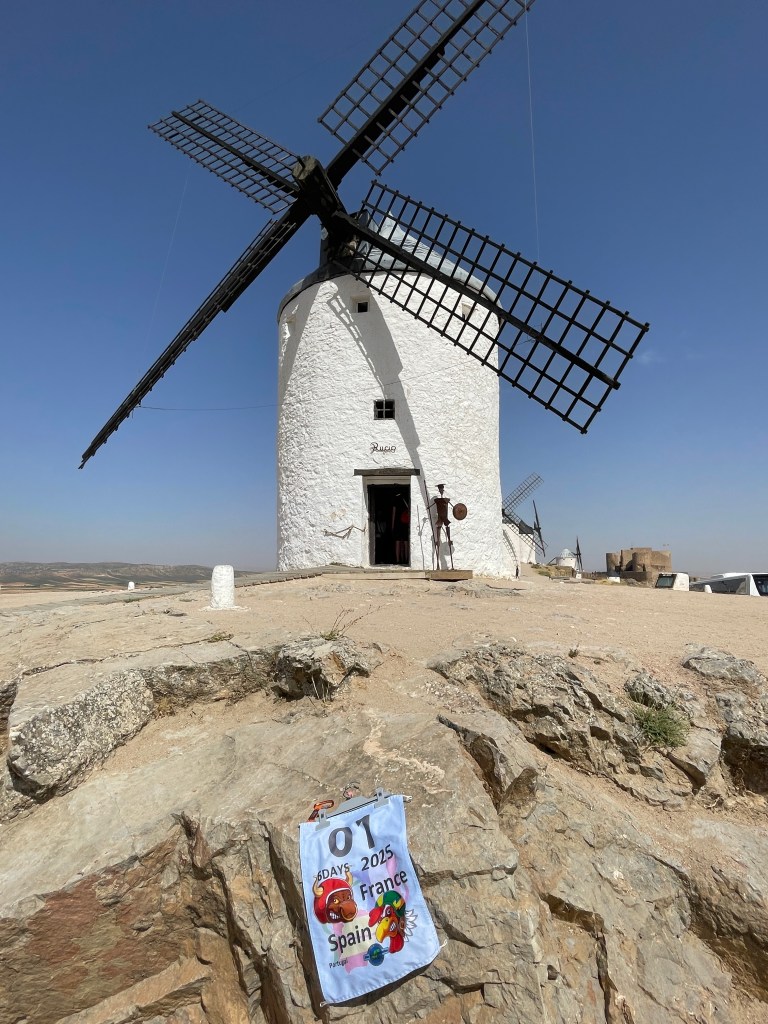
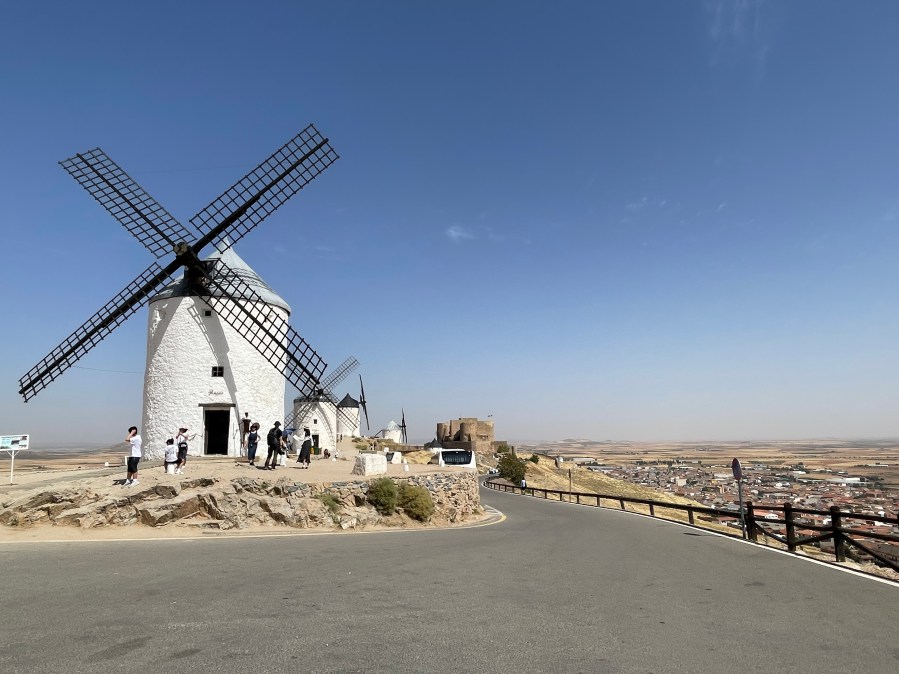


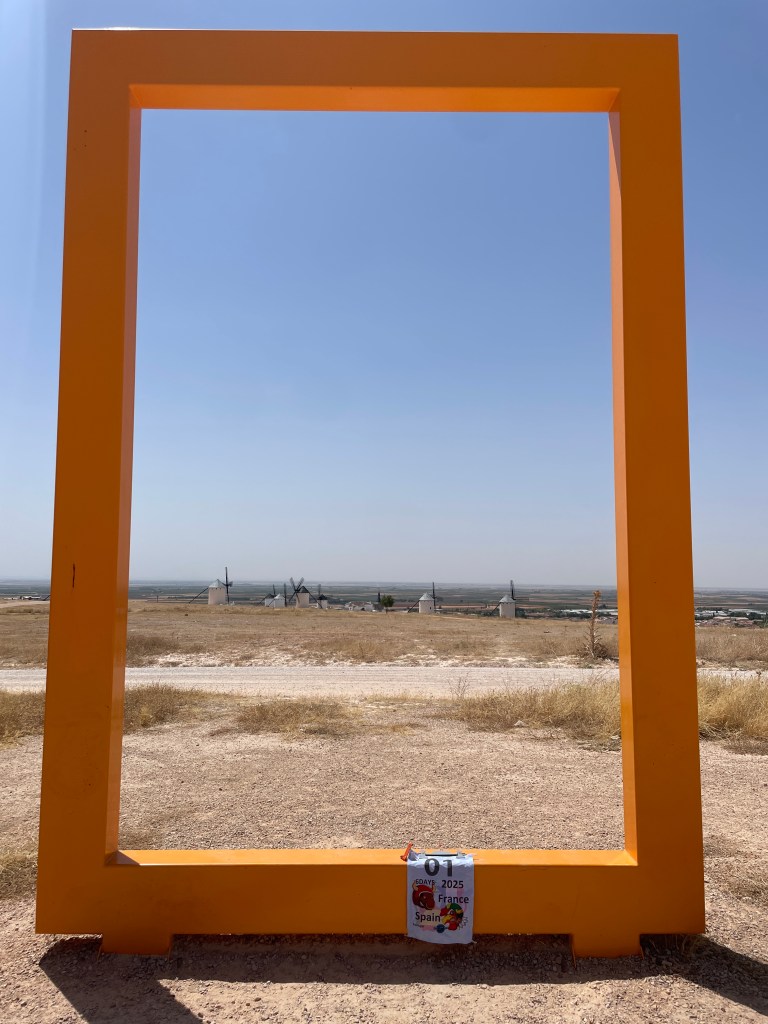
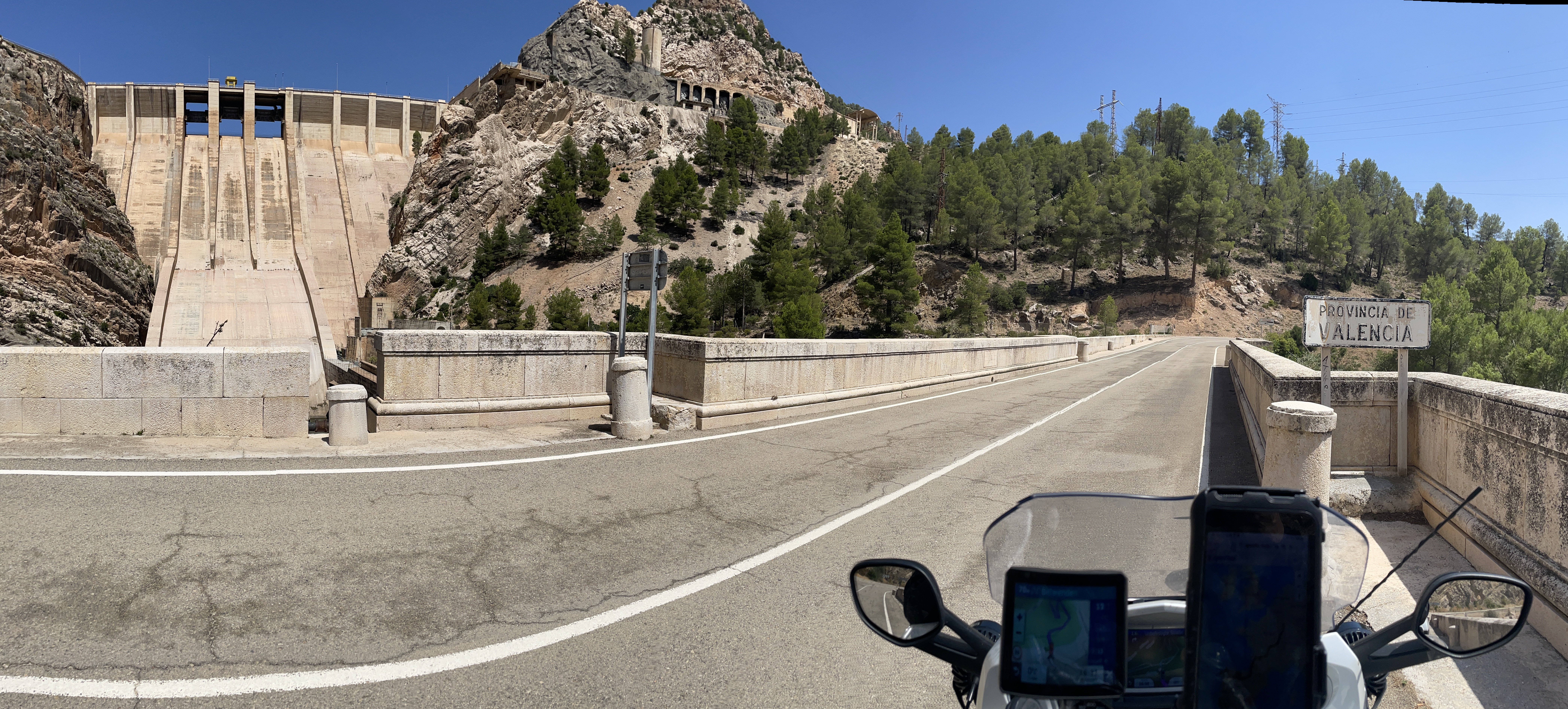
My next bonus were more windmills, but in the picture, they had to bet inside a frame that is situated in the middle of the arid landscape. This meant I could could claim the Cervantes combo, the second combo of the day. I went east to the A3, the motorway leading to Valencia. Before entering, I visited Castillo de Garcimuñoz, where I photographed the…Castillo de Garcimuñoz! Onwards. About an hour later, I exited the motorway and rode down a neglected side road at a dam lake to take a picture of the concrete dam. The bridge marked the border to the Valencia autonomous region.
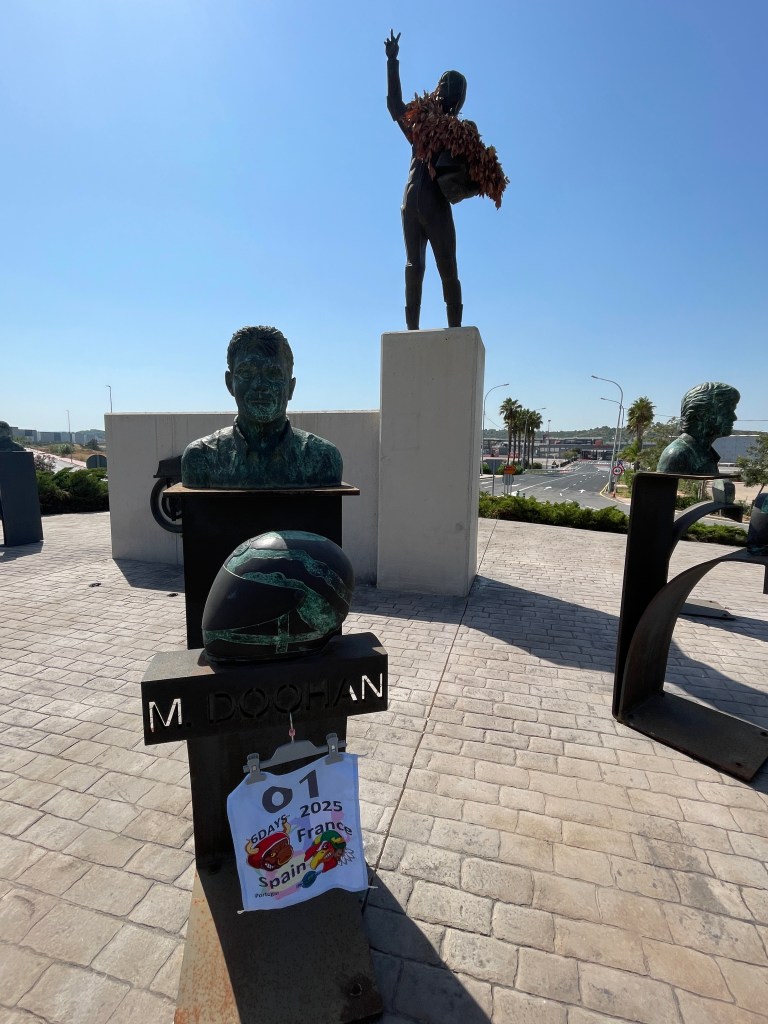
Although the temperature was dropping from the 40s to mid-30s, the effect was compensated by an increase of humidity at the Mediterranean. Down in the plain, I visited the Circuit of Valencia (just like in 2014) and took a picture of the bust of Michael Doohan at the roundabout to the circuit where several motorbike racers are revered. From here, I had to enter Valencia and to do two detours. First, for a fistful of dollars….er, I mean, for 10.000 extra points I had to do this: “JOKER 1 – Make a selfie, before the end of the Rally, with a scoop ice cream in an exclusive ice cream shop AND make a photo of your own bike with Rally Flag in front of the same ice cream shop with name of the shop in the picture, to show this photo to the Rally Master on Saturday.”
During the lunch break, I had identified an ice cream shop on my route that seemed to fulfill these specifications. The term “exclusive ice cream shop” was the challenge here. The high point value made it advisable to plan the visit properly and not to put faith in simply good luck. But I had done this well, took also a picture outside. People in the shop looked at me with certain disbelief – in this humid heat, why would anyone wear a massive black motorbike gear?? Must be a typical “guiri“. The second detour was a family visit to my in-laws, an important recess from rally business. An hour later, I rode to the only location situated in Valencia; the sculpture “La Pamela” for some high 5.720 points. It was 18:10 p.m. now. Let’s go north!

An hour north of Valencia, I visited a modern sculpture at the beach of Castellón. I remembered how during the European Tour 2014, my BMW gearbox atomised at night in an orange grove in the vicinity of Castellón. I hoped for a different outcome this time. The next location would be in the Delta of the Ebro river. At 20:40 p.m., I took my last picture for the day.
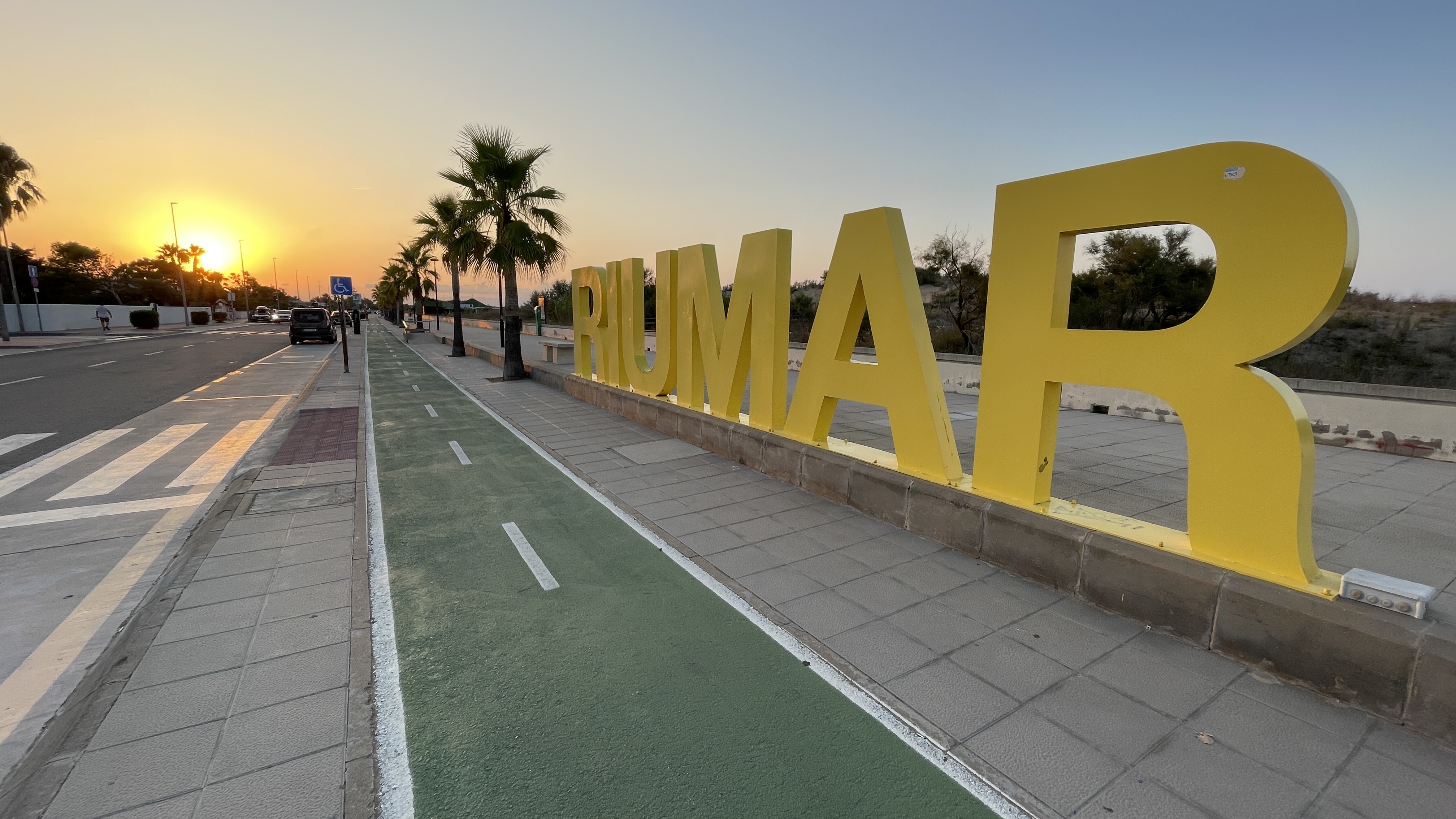
Right, how far do I want to go today? I could push through to get to Barcelona in less than two hours, there’s plenty of accommodation. But why hurry, I had started to like these “let’s finish early” days. Maybe I could even have some dinner. So I selected Tarragona and was looking for hotels….but the combination of a hotel not too far away from the motorway and an open fuel station nearby was difficult to figure out. So I changed the plan and selected Salou as stopover point. Salou is a touristic town at the Costa Daurada with plenty of hotels. So I made my reservation there. The hotel was a bit far from the fuel station next to the motorway, but at least I had a plan. At 21:37, I received my rest break ticket, again a very early rest. I spotted a trucker restaurant next to the petrol station and peeked inside.
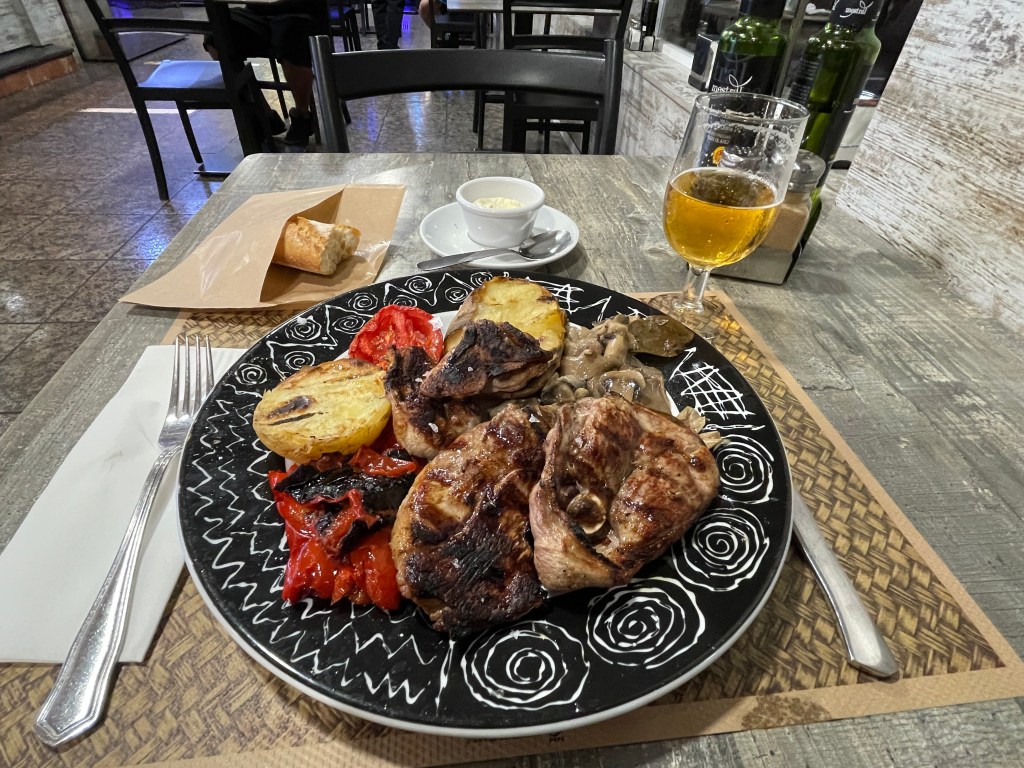
A typical Spanish/Catalan grill restaurant with mountains of meat in the showcase, steaks, chuletones, butifarras, all in enormous sizes! Too good to be missed, it can’t get more authentic than this. I parked the bike and studied the menu….I should not eat mountains of meat now, better take something “light”. So I ordered some lamb chops, crema catalana and a cortado. Delicious. Simple, but good. This indulgence was worth it.
I rode to Salou and the hotel. I entered the lobby and was flabbergasted to see about 40 tourists in front of the reception. I had no other option than to wait until it was my turn. After check-in, I parked the bike in the underground parking lot. The usual routine: strip the smelly clothes, take a shower, sit down and plan the route for the next day, transcribe the plan on my daily list and go to bed.
Day 6 (Salou – Lyon)
It was more than an 8 hour break again. I had made good progress and although the first locations were not daylight bonus points, I set off late at a quarter to 6 a.m. I felt quite confident that my performance so far was quite good and there was no need to push to the max. I felt that despite the rather long rest breaks, I had ramped up a lot of points. It was the same strategy like 2023 in the Iron Butt Rally and the 12 Days Rally: longer breaks, more rest, keeping a continuous flow with the right amount of indulgence.
My first stop was soon in Tarragona; at the end of the new Rambla, I took a picture of a statue of Roger de Lauria. I followed the Costa Daurada into the dawning day. In Vilanova i la Geltrú, I rode to the beach and realised that I had to park the bike and walk across the beach to a sculpture. It turned out it was worth it. This is what I saw:
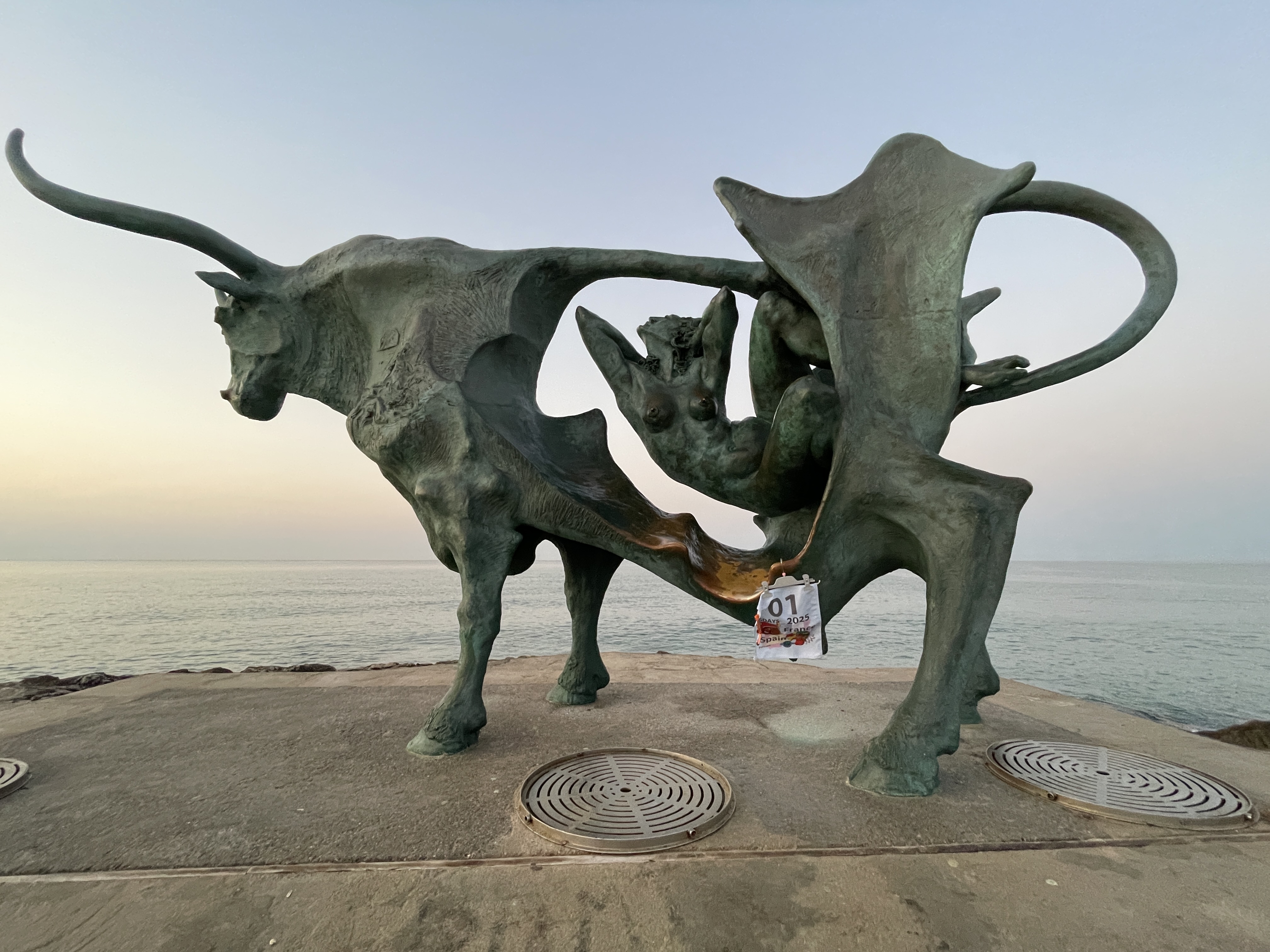
Weird and beautiful. But it gets even weirder when you know the backstory of this sculpture. It is entitled “Pasífae” und is based on the person of Pasiphaë in Greek mythology.
Pasiphaë was the daughter of god of the Sun, Helios. Pasiphaë was given in marriage to King Minos of Crete. Minos was required to sacrifice “the fairest bull born in its herd” to Poseidon each year. One year, Minos refused to sacrifice the animal, and sacrificed another, inferior bull instead. As punishment, Poseidon cursed Pasiphaë to experience lust for the Cretan bull. Ultimately, Pasiphaë went to Daedalus and asked him to help her mate with the bull. Daedalus then created a hollow wooden cow covered with real cow-skin, so realistic that it fooled the bull. Pasiphaë climbed into the structure, allowing the bull to mate with her. Pasiphaë fell pregnant and gave birth to a half-human half-bull creature that fed solely on human flesh. The child was named Asterius, after the previous king, but was commonly called the Minotaur.
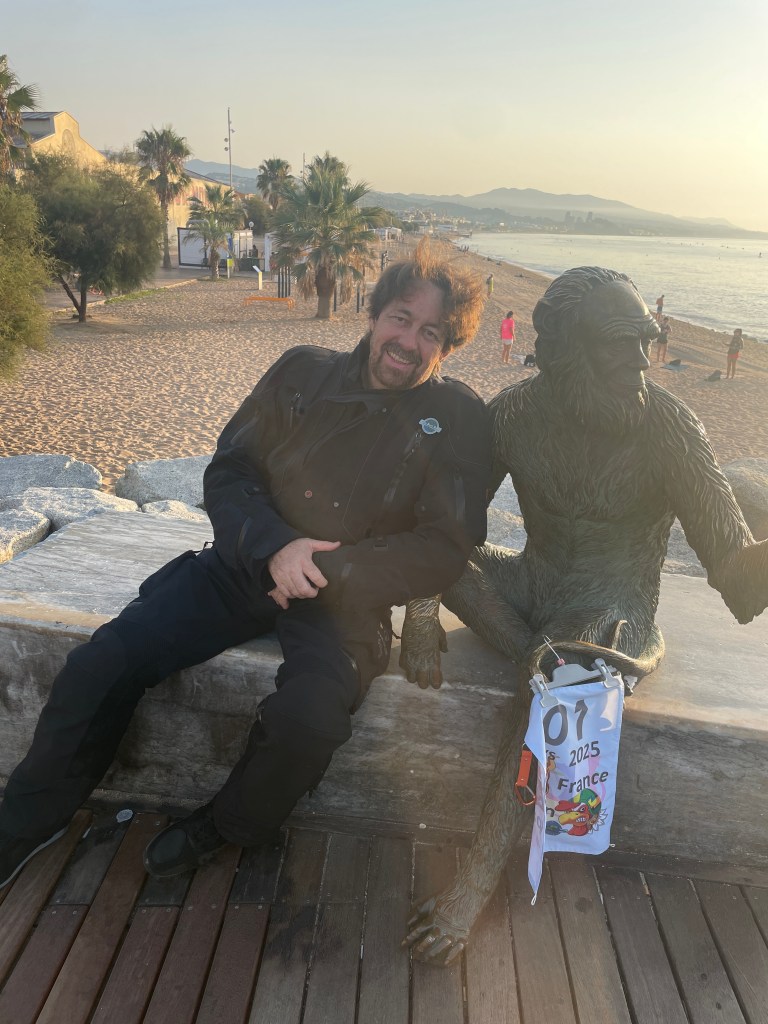
Onwards! I followed the motorway along the coast, passing Sitges, Castelldefels, entering Barcelona at 7:30 a.m. I rode on the Ronda Litoral between the Montjuíc and the harbour. I wondered if I ever rode at this time of the day here when I was living in Barcelona…probably not….I passed the Columbus monument…in Badalona, I rode again to the beach. I had to do a selfie with the bronze mascot of the “Anís de Mono“, a popular Anisette brand. While dealing with my phone, I realised that I hadn’t sent my rest break start receipt of last night! I did it right away. Phew! Again a near miss! This would have cost me the Sleep Bonus Combo of 25.000 points! Aaaaargh! Watch out! Back to the motorway and along the Littoral north of Barcelona…Mataró, Arenys, Calella…a nice sight in the sunny morning light.
I exited the motorway at Blanes and was looking forward to one of the riding highlights of the rally: the Costa Brava coastal road. But first I had to get to the harbour in Blanes through the morning traffic; I took a picture of a steel sculpture of musicians. The road from Blanes to Tossa de Mar via Lloret de Mar is always very crowded and slow. But then I was ready to ride my favorite road in Spain: the coastal road between Tossa and San Feliu de Guíxols. 20 km of pure pleasure. Excellent tarmac (most of the time), one bend after the other, up and down, perfect radiuses, and if you find the time, gorgeous views on the Mediterranean Sea. I haven’t managed to make a video on my own yet, but this on-board video gives you a good idea. Pure motorbiking heaven.


You can understand my surprise and frustration when I found the road covered in tons of liquid asphalt covering small cracks. This was absolute madness and super dangerous for motorbikers, even in this bone-dry conditions. It totally ruined this riding highlight. I suspected it was done on purpose to reduce the heavy motorbike traffic, and indeed, almost no motorbikes were to be seen, very uncommon in August. Yes, there were many small cracks, but there were not affecting the road surface. And unlike in a more northern climate, no freezing water in the cracks in winter does damage the tarmac. Overkill. When I look at the Google Maps pictures from April 2025, just four months earlier, nothing was to be seen. Luckily this madness stopped at the communal border between Tossa and San Feliu at the Cala de Salionç, where the cracks were not filled. At least 15 km saved from this barbarism (well shown here).
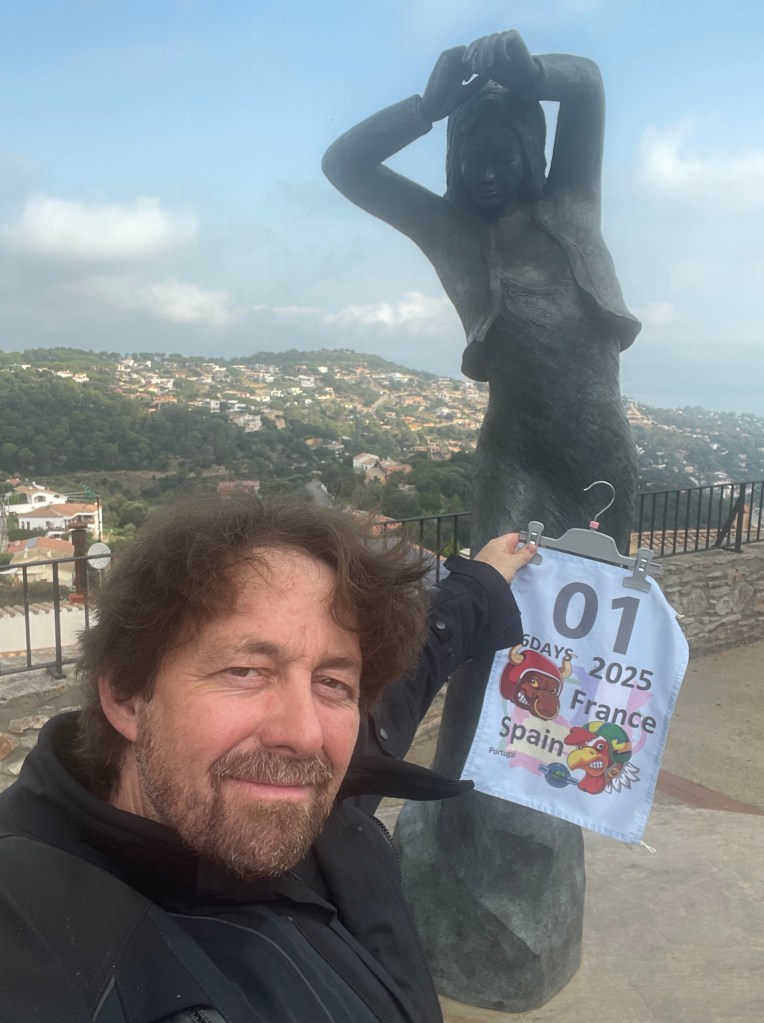
At the Urbanización Rosamar, I had to take a picture of a small boat, this was the reason my the rally master had forced the route through this road. “Only” 2880 points, but why not, I had plenty of time at my hands (27 hours for a remaining shortest distance of 1100 km); In San Feliu the glory was over and I had to ride on the main road along the coast without making these little detours to these beautiful coastal villages such as Llafranc, Palamós, Pals…but I was not here for tourism, but an a schedule. The last location in Spain led me to Begur with its famous castle. Close to it, I had to take a selfie with the statue of Carmen Amaya, an internationally famous Flamenco dancer of the last century who died in Begur.
There was nothing more to do for me in Spain, but there was another big joker bonus that I should take care of: “You will receive an additional 10,000 points if you successfully complete the #500 bonus point (High Noon)…BP500: 12:00 Noon – find a clock on a public building (e.g. train station, town hall) and take a photo at exactly 12 noon.” So in total a whooping 15.000 points.
I had not the time to take care of it so far and I did not want to postpone it to the very last moment in Metz. So while riding, I tried to figure out where I could find a public clock at the border or beyond. I concluded it would be too risky to try to find something in the village of Le Perthuis. The tablet indicated some traffic jam across the border between the border and the toll booth in Le Boulou. So I selected a church tower in a village….but despite all the pesky traffic up to the motorway near Figueres, I was a bit faster than expected. I crossed into France at 11:05, so I changed my plan to the railway station of Perpignan. I arrived at the station with 20 minutes to spare, perfect timing. I purchased a sandwich for lunch and spotted a suitable clock where I took the picture at noon. Ka-ching!
My progress went well so I could unfold my plan for the afternoon: collecting the Cevennes Combo for some 6.750 extra points (15.400 points in total). But I would be a lot of work. Before that, I had to visit two locations near the Étang de Leucate, the large pond north of Perpignan. The first one was next to the motorway and a landmark that I always notice when riding by: the Porta dels Països Catalans, the Gate to the Catalan Countries. But I had to park the BMW at the bottom of the hill and walk 5 min up to the monument. I was cloudy and temperatures did not reach the 40s as in the past days, but it was enough to be completely soaked when I reached the sculpture.

After that, I went around the Étang and walked (again!) to the end of a pier in Port Leucate. From here, it was more than two hours two the next bonus point in the National Park of Grands Causses. Near Narbonne, I rode through a stretch where the forest left and right of the motorway was burnt. Some days ago, we had been warned by the rally team that wild fires were raging here! Only a week later, Spain, especially Galicia would be terribly engulfed in flames again.

Soon I was riding in sunshine again, but without the blistering heat of the last days. In Saint Rome de Cernon, I slammed on the brakes when I rode past the town sign…I hadn’t hoped to find this one, but here it was…”503: take a picture of an upside down town sign (2750 points)”. I turned around and took a picture of the road sign. After a few metres riding, it dawned on me that the BMW had to be in the picture? Check!…Yes! Aaaargh! Turn around and take a picture WITH the bike.
Motorists in rural France have recently been astonished to see thousands of road signs at entrances to towns and villages turned upside-down. The name-bearing roadside plaques have been unscrewed, flipped, then meticulously screwed back on. It was campaign by farmers to draw attention to what they say is their increasingly precarious way of life.
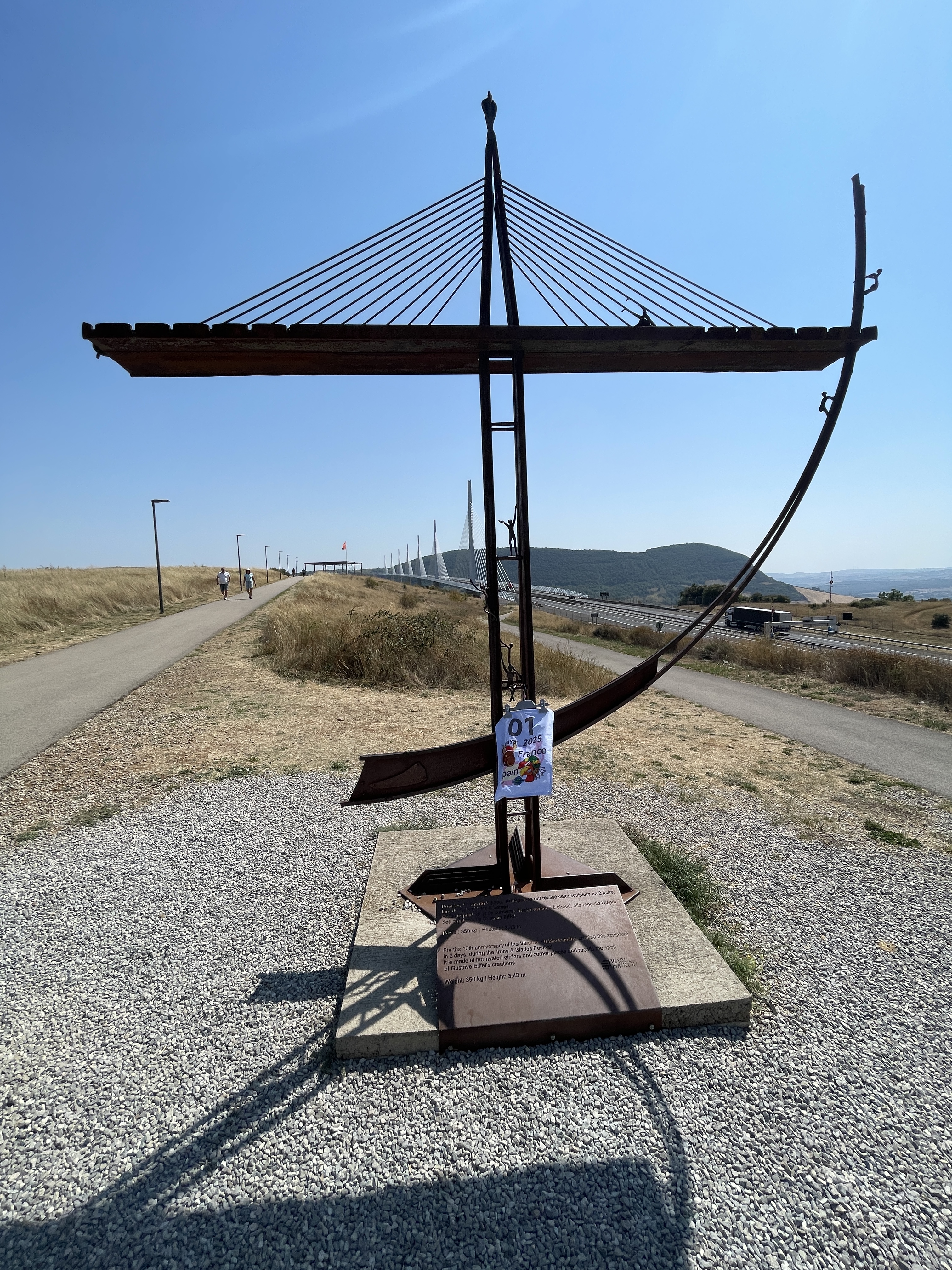
Not far away I took a picture of a small Liberty statue in Saint Affrique (sic) on the Place de la Liberté. It was a replacement for the 1889 miniature copy of the American original that was smelted in 1942. The next location and the first of the Cevennes Combo, was not far away and supposed to be situated next to the famous Millau bridge. So I had to cross it, pay road toll and exit. But apparently, I was in the wrong lane and could not exit there. I had to continue to the next exit and turn around. Aaargh! Finally, I reached the parking next to the valley where I parked the bike and had to walk (again!) uphill to the sculpure. I understood why it was another “T” (touch) point: you really had to walk up there, so nobody was tempted to stop on the motorway and take a picture from there. However, it meant that I was drenched in sweat…again.
I had to ride a large detour to actually get to Millau under the bridge from where I started the long haul across the Cevennes. For the next four hours, I rode on a mixture of lovely, winding country roads or very bumpy narrow, almost single-track roads, all depending whether I was going in an west-east or south-north direction. The next point seemed to be a bust of a man or so I thought. Next to the Grotte de Dargilan. Parked the bike at the parking lot and scuffled down the road to the tourist centre. There was a visitor centre, but I couldn’t see the bust.
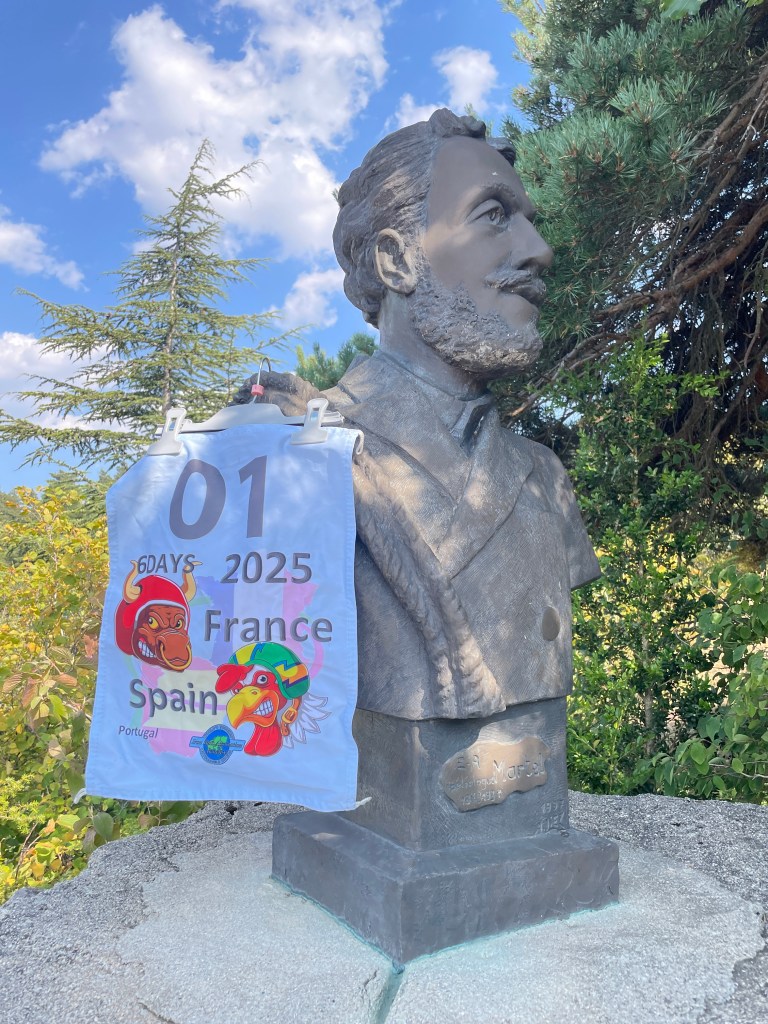
So I entered the centre and asked a girl behind a bar where I could find it. She told me to walk down a path. So I did. When I reached the end of the little road, I had to turn around and walk back. Nothing here. I took another route and reached again a dead end without spotting the bust. Angrily, I had to walk up again, drenched in sweat. I visited the girl again and told her that the bust was nowhere to be found. In the end she walked with me down the second road, but turned suddenly to a small gravel path, walking behind a rock – and there was the bust. Definitely impossible to find without the help as the GPS point was the parking lot. All locations visited during the rally were of excellent quality and spot on, but this one was the only outlier.
It was 5 p.m. now and I had to make up my mind where I would stay for the night. I was 30 min behind my daily plan. I HAD to do the remaining six locations before sunset and only 180 km to go. Should be easy, no? Not so fast! The plan also told me that I had to ride at least 3 hours. At least I had enough petrol in the tanks. It soon was revealed where the estimated arrival time came from. These roads were slow. Sloooow. And bumpy. Bumpybumpybumpy. Although the road layout was nice and the views scenic, these sunny evening hours were tough. With mixed feelings, I remembered my accident 23 years ago, with a separated shoulder and subsequent operation in the hospital of Mende, not far from this area.
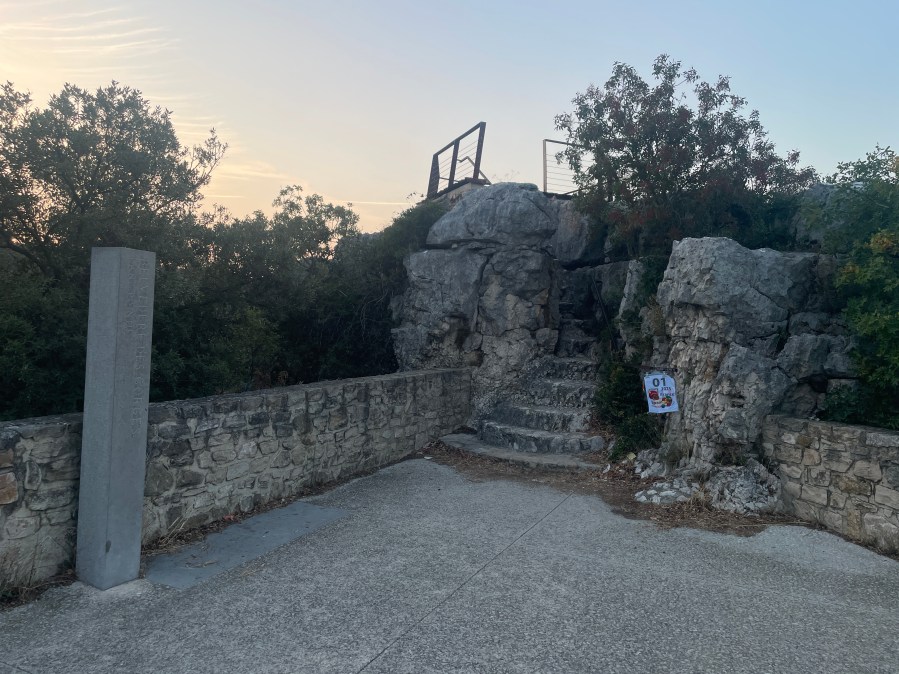
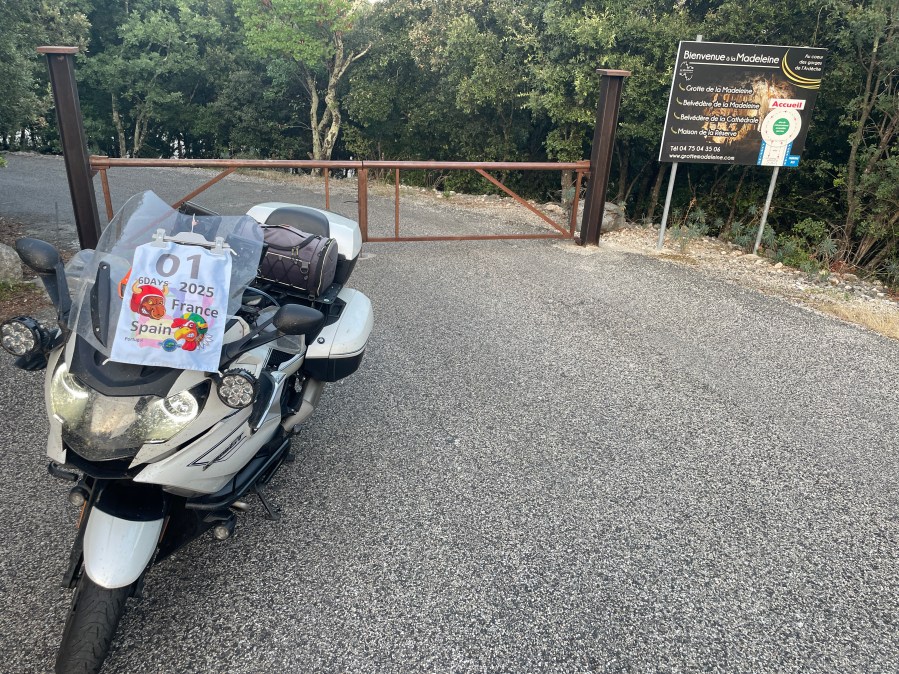
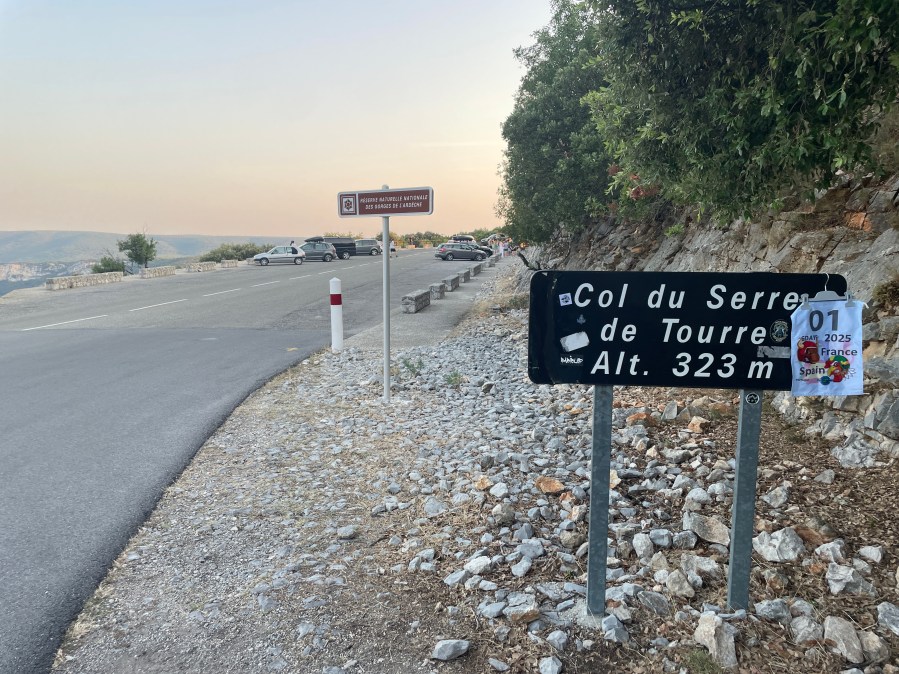

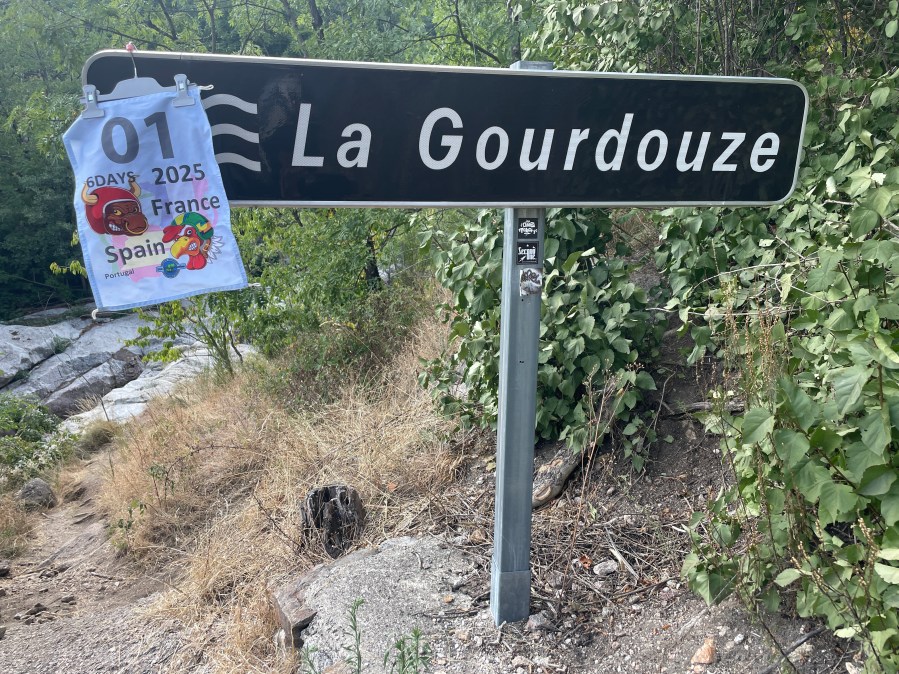
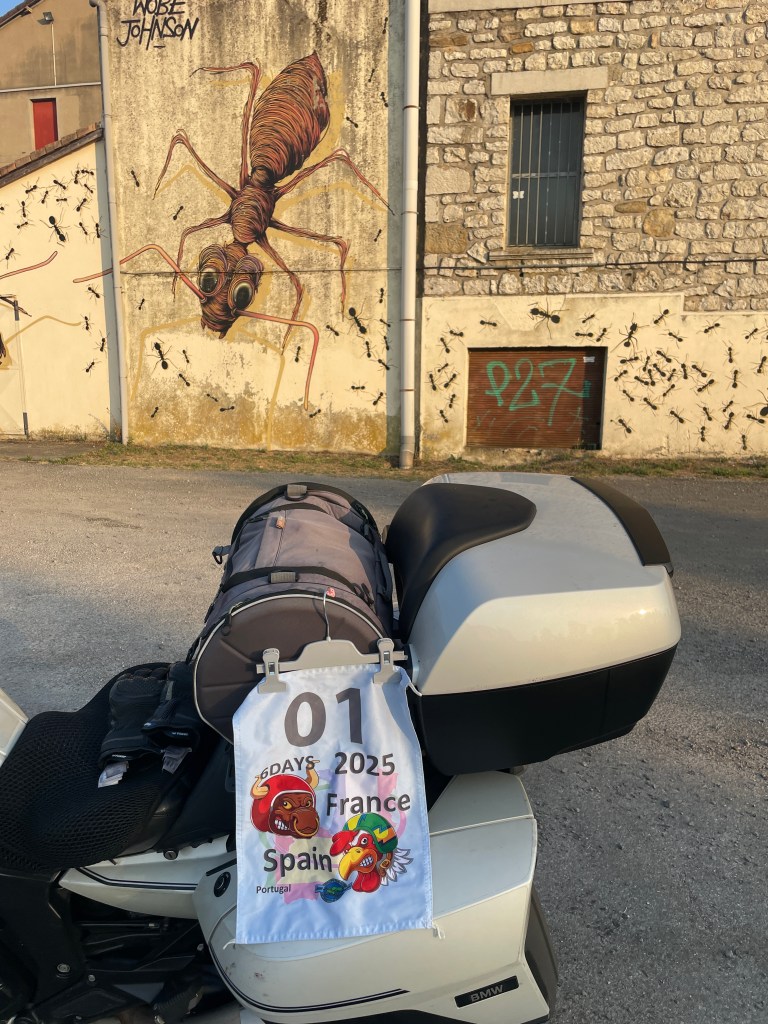
At 8 p.m., I reached the Ardèche Valley, normally crowded with tourists. But now, I could do some “canyon surfing”, enjoying the beautiful views, such as the iconic Pont d’Arc. The locations in the valley were quickly bagged and at the last point I had collected all the points of the Cevennes Combo. I made a little break, had some snack and chatted a bit with a funny couple that was enjoying the sunset with a little dance around their camper van. I had ridden the plan of the day. Now I had to get to the motorway and ride to Lyon where I had one last location before I would ride to the hotel that was situated in the centre of the city.
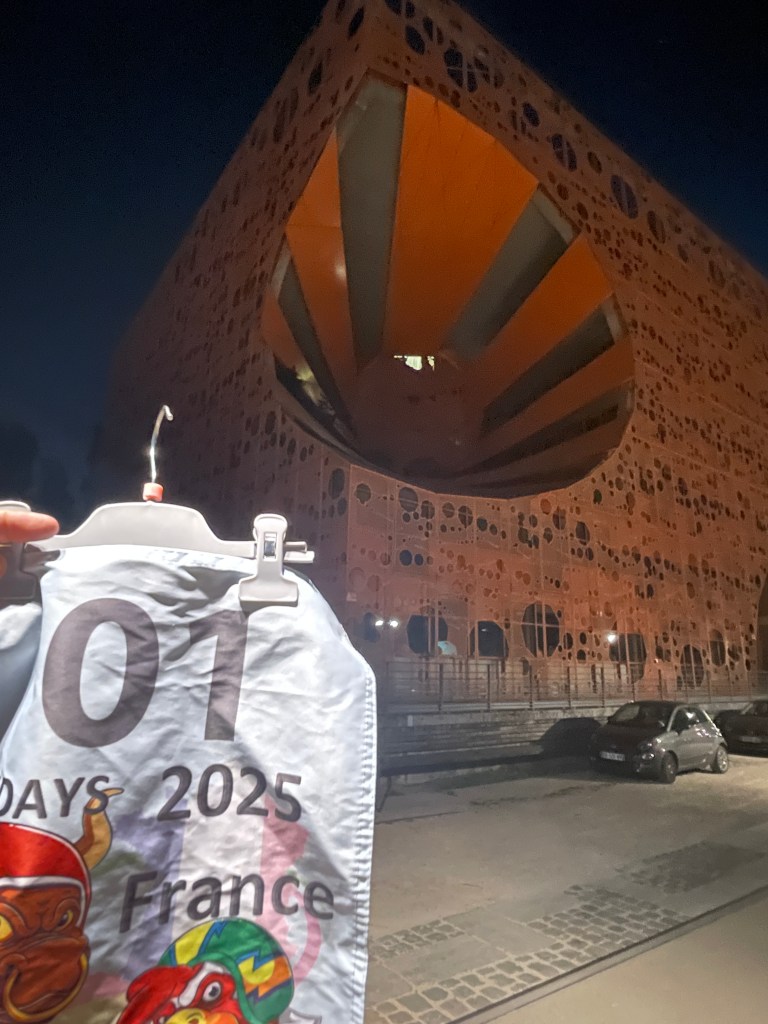
Two hours later I arrived in Lyon and went to the last point for this day – Le Cube Orange. I tried to find the right perspective in the dark and was happy that my phone could cope well with this lowlight conditions. A funny building.
I still had to cross the city centre that cost quite some time, but I wanted to have a petrol station close to the hotel. I got lost a bit but finally found the petrol station that was next to the hotel. To my disappointment, there was no shop where I could buy some dinner or breakfast for the next morning. I was quite tired, sweaty and without food. And this happened in the Gastronomic Capital of France??? Fun fact: yes, it’s Lyon, not Paris!
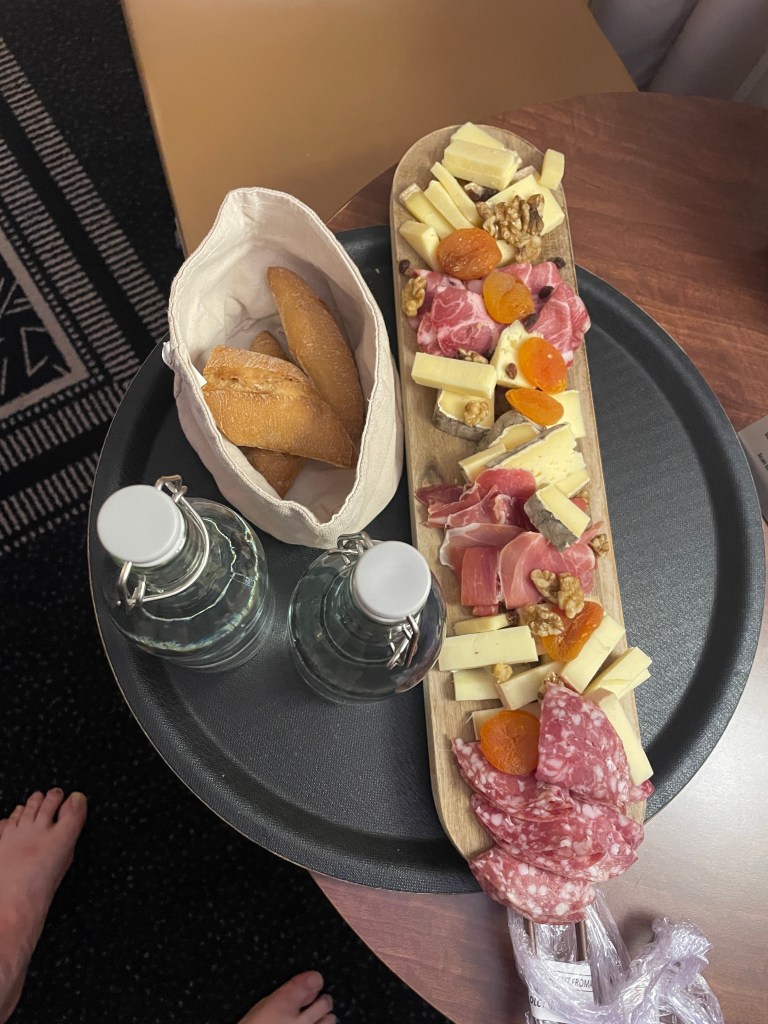
After the check-in to my room, I descended again to the hotel reception that was deserted. In principle, there was food, but the restaurant had already closed and so did the bar. But I spotted a showcase with some food platter… cold cuts and cheeses….hmmm, this was a lot. I heard the receptionist approach. Yes, this was the only food that was left, together with some tasty-looking bread rolls. Expensive and much too much, but what was the alternative? Right, when rallying, think big! I returned with the platter to my room. I was delicious! I devoured the first food since the stop in Perpignan. Of course I couldn’t finish it, but needed some breakfast for the next morning.
I still had to plan the grand finale, i.e. the remaining half day between Lyon and Metz. There were not many points left and I would have an easy ride. Although… I was still in competitive mode…the was one high-value point north-west of Verdun. But with some detour that would make the arrival a nail-biter. But finally, after 7900 km, after six days of pushing from dawn til dusk, after having collected at least 300.000, maybe even 400.000 points, after all of this, did I really need to push until the very end and risk a DNF?? And suddenly, the very shy voice of reason cleared its throat and asked to consider that it was enough. Enough, enough, enough, enough. I had done enough. Everything went quite well, there was no reason to take unnecessary risks.
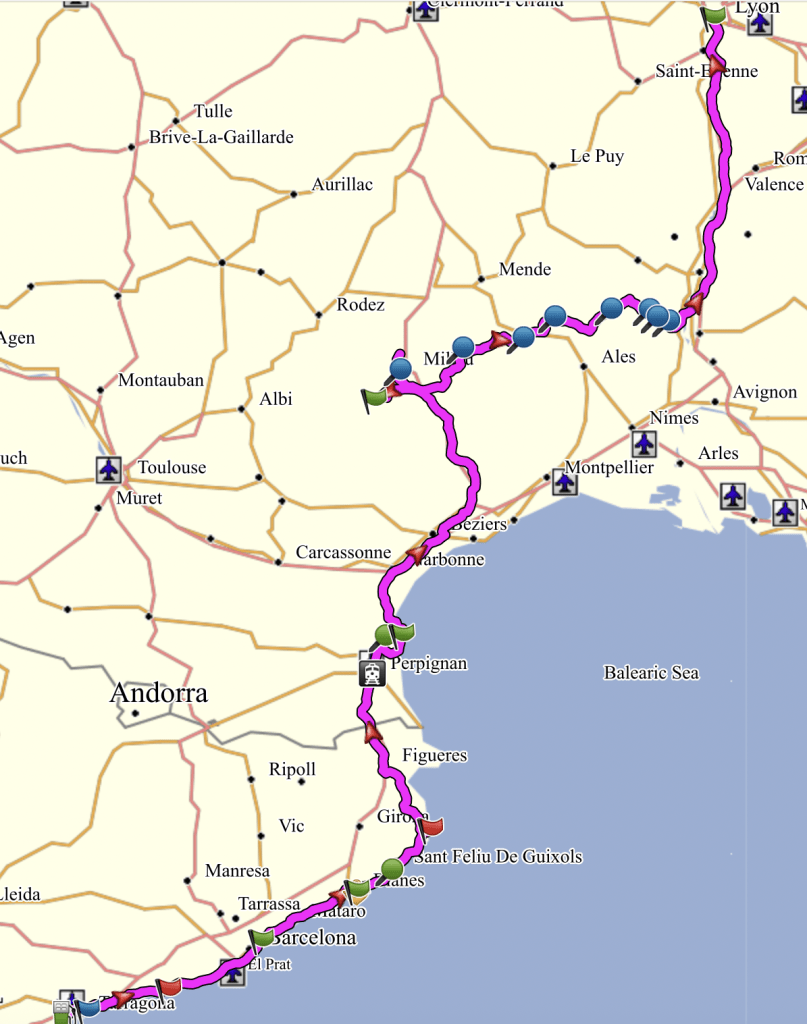
If there would be with a better route and performance, so be it. Well deserved. Congratulations. But I decided not to risk a DNF for the last 1 %. 99 % are ok as well. Write the short list, prepare everything, good night.
Day 7 (Lyon – Metz)
Wait a minute. A 6 Days rally and there is a day 7? Well, yes, there was a seventh day, or rather half day. We had started at 8 a.m. on Sunday morning and had to return before Saturday 2 p.m. So actually it is a 6.25 Day rally.
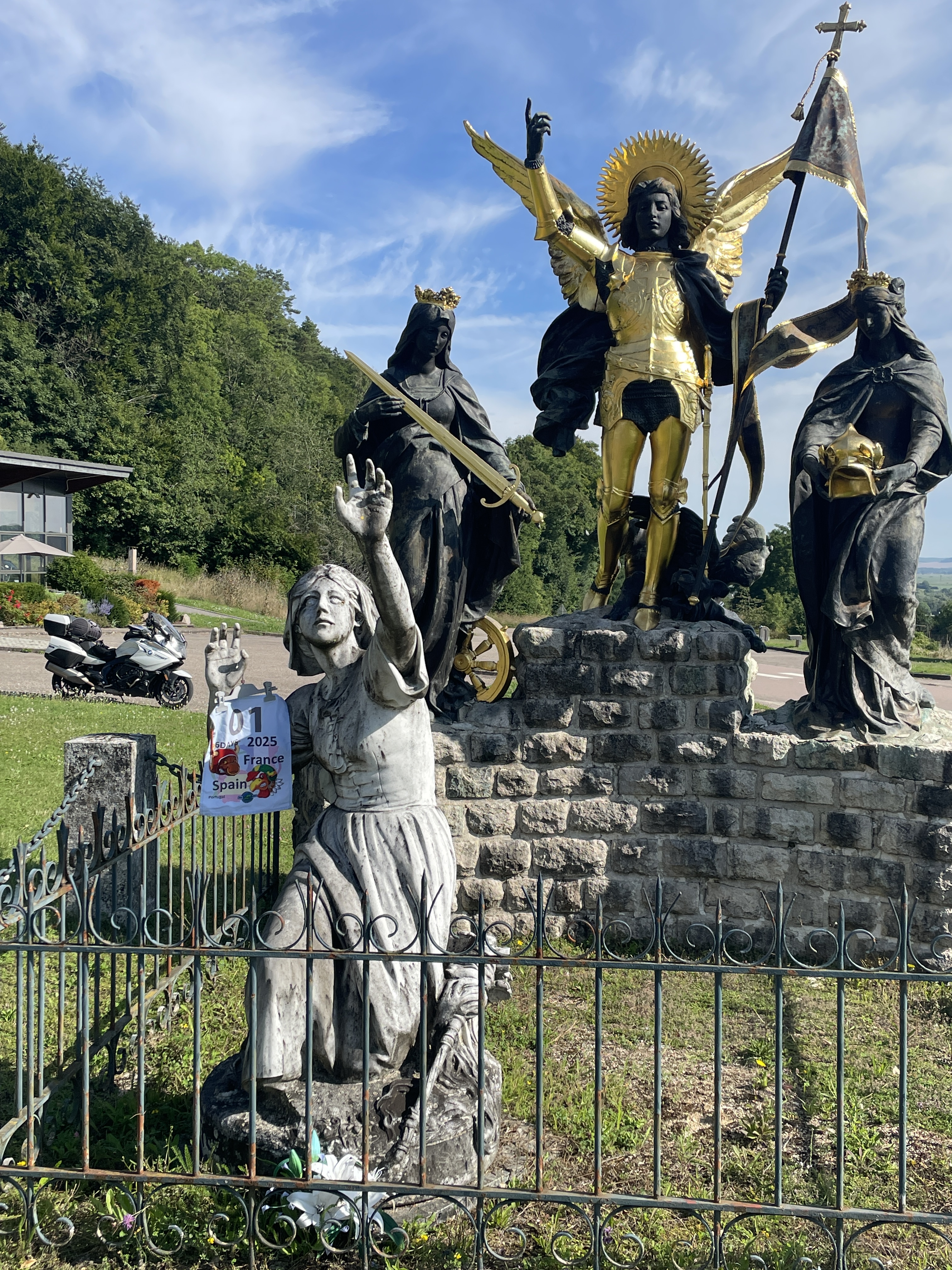
I finished the rest of the platter and set off from the petrol station at a quarter to 6 a.m. It was still dark, but traffic was absent and I quickly could leave Lyon behind me. It was a relaxing motorway ride on a sunny morning. After two hours, I entered the empty centre of Dijon (Saturday morning!) and walked across the pedestrian zone to a gate to take my picture. The next location was one hour to the north. I had to park the bike in a parking lot in the fields and walk through a small forest to a little stone arch that marks the source of the Marne river. Another 90 min to the north, I stopped at a church with some kind of statue next to it. Actually, it was the Basilique du Bois-Chenu and the statue was about Jeanne d’Arc. The bike had to be in the picture (!) but I managed this. The village nearby was Domrémy-la-Pucelle, the birthplace of Jeanne d’Arc, as a memorial stone revealed clearly.

This was the last bonus point location of the rally. The location west of Verdun was definitively out of question now so I had quite some time on my hands. I stopped at a rest area between Nancy and Metz with two hours to spare and 30 km to go. I needed to sit down, have a snack, relax and run through all the sent pictures. I checked every photo whether the subject line of the picture was correct. The picture in Tarragona had the wrong BP number so I sent it again. This was the only glitch I could detect.
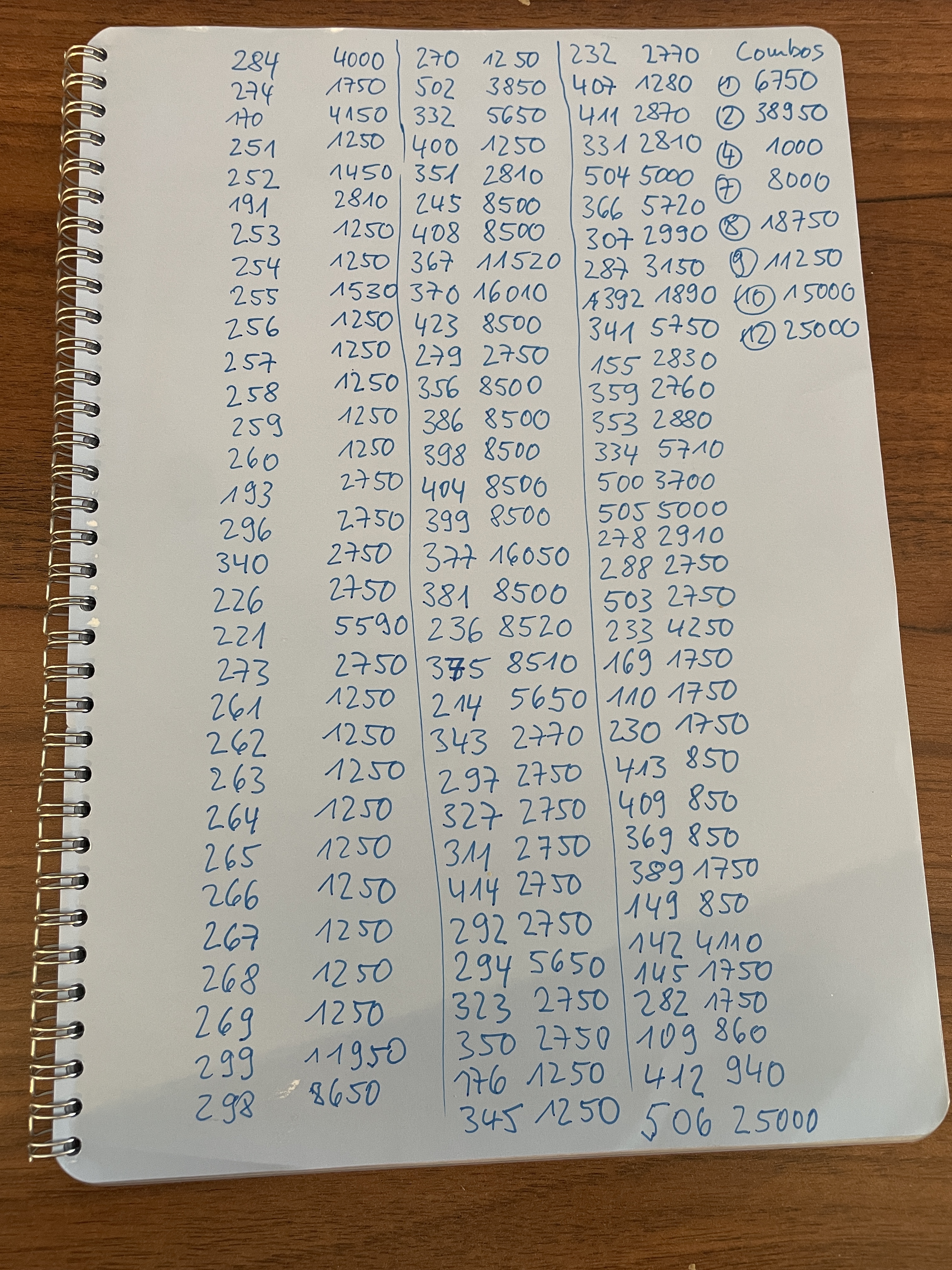
Then I decided to calculate my expected points….meticulously. When I did sum up all the points, I was genuinely surprised: more than 518.000 points! Wow! This seemed a lot. But how much would I lose at the scoring table? Actually, there was one more, very last point:
506 25.000 pts Best Western Plus Metz: take a photo of a specific member of the Rally Team (tba) holding your rally flag. This bonus point is available on Saturday, August 9, 2025, from 12:00 to 13:45. The photo must be taken not later than 13:44. If you arrive late and/or the queue is too long to take the photo in time, then it’s your bad luck. No exceptions, take it easy. First the photo, then stop the clock.
At 12:50 p.m., I rolled onto the parking lot of the finish hotel, picked my flag and had the very last selfie made with Giel and Michiel the President.

With more than one hour to spare, I stopped the clock. I was glad to have taken the last half day quite easy. When all is over, you really feel what you have been going through. The first six days had been quite a long, hard slog. I was pushing from mornings to late evenings. Had there not been the need to adjust the route and the timing to daylight points, I would have had shorter rest breaks, barely over the minimum of five hours. I didn’t indulge in any breaks during the day and outside rest breaks with the exception of one hour of family visit in Valencia and I had twice a “proper dinner” during rest breaks in Spain. This was the only downtime when I was not riding, planning or sleeping although I also planned while eating, as usual.
So this meant that during these 150 hours, I had no time to relax, except the two to five hours, on average four hours of sleep every night. This doesn’t sound a lot of sleep, but actually it is not bad for multi-day rallies. With a mandatory rest break time of five hours, I would normally have less than three hours of sleep, given my rallying style of staying in comfortable hotels that require some more time to check in and out, but offers a more relaxing rest than the “Iron Butt Motel”, i.e. sleeping anywhere, in the ditch.
Considering all of this, it was no surprise that I was very tired now. At least I had done all my checks yet, so I could proceed to scoring soon.
The Scoring
When I entered the scoring room, I was greeted by the scoring triumvirate composed of Michiel the President, Gerhard the Rally Master and Bob the software engineer and operator of the Scoremaster software program to where we all had to send our e-mails with photographic proofs. They presented me the printout of the calculation of the software with a total points value of about 440.000 points on it. Wait, what?? That was almost 80.000 points less what I had calculated! This could not be! Well, have a look at bonus point location 262….I opened the rally book and looked at my picture that I sent:
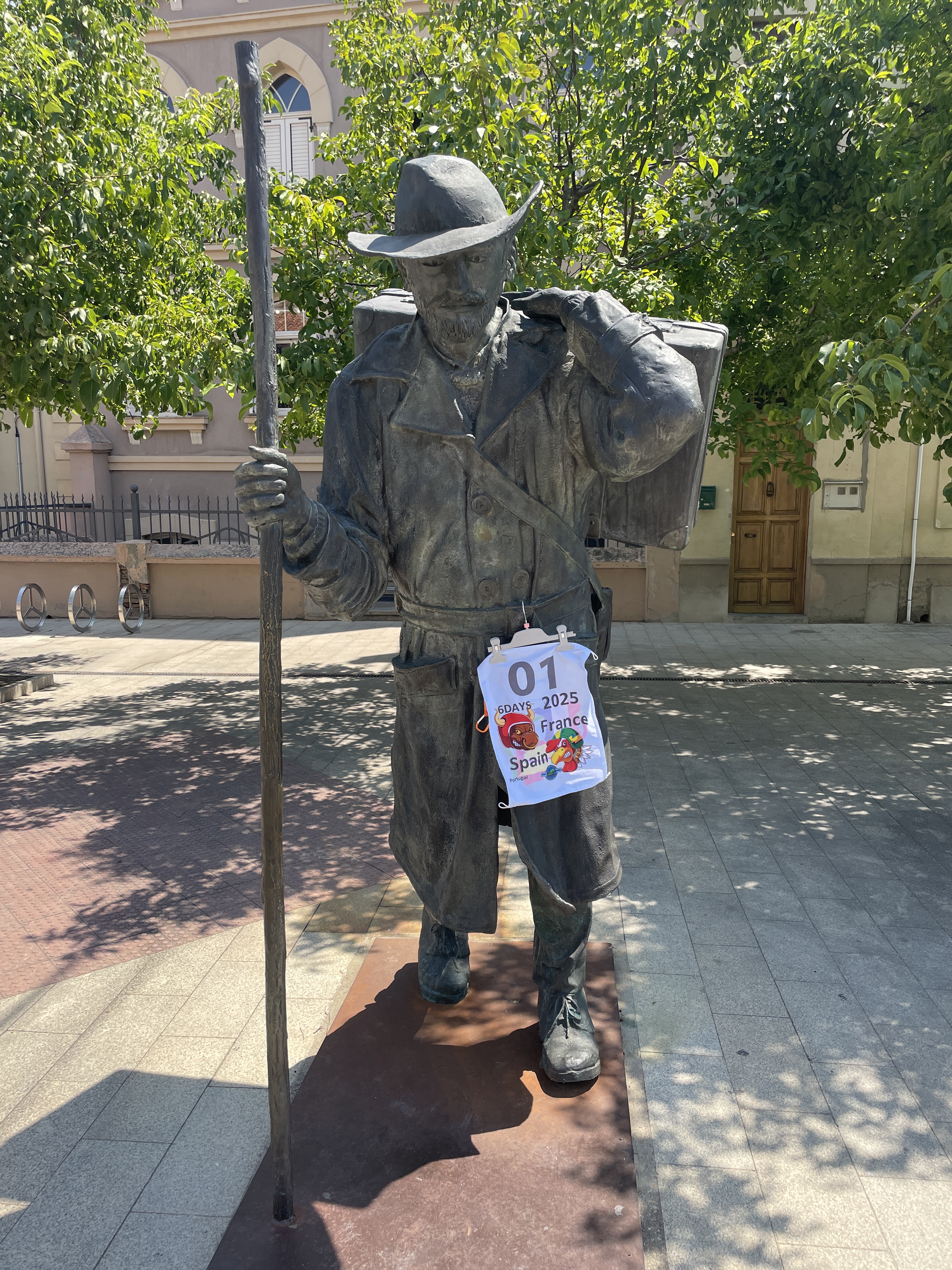

Well, that’s the right picture….the flag is in the picture….oh, wait…..what’s this? The logo for “selfie”? This was supposed to be a selfie picture? Oh no! I immediately realised what the consequence was: as this was a location of the “Pilgrims” combo, I would not get the combo….and lose 38.950 points plus the 1.250 points for the location, in total 40.200 points less…this was massive! I had started my rigorous double-checking with the rally book after this point, so this one had slipped through. &%@?%!!£*#!!! Ok, I kept my cool. “OK, fair enough, my bad. But I’m still missing 36.000 points“.
What followed next was a demonstration how a good preparation can save a lot of points. I took the score sheet, put it next to my list and went one by one line. Every now and then, there was a claim missing on the scoring sheet. For every single one of them, I could prove that I had sent the correct picture. And for every single one of them, Bob had to admit that the picture had been received correctly, but had not been checked for evaluation. I could keep all my other points, including some combos. I had always been very critical about electronic scoring. This showed that the calculations may be right, but the human factor might still be the weak link if not all data are considered correctly.
In a way, this was not a bad result. After all the hiccups and near-misses, after all the mistakes I had spotted in time, there was only one tiny, single mistake among 97 claims! But it was a massive one, costing me the biggest chunk of points you could earn in a rally. In the Iron Butt Rally, this would mean that you’d lose many positions in the ranking. But would the remaining points still be enough for a top-tier result? In a few hours we would know more…
As usual, there was a lot of talk and banter in the lounge, all riders had a lot to tell. Anecdotes, mishaps and funny stories are shared and it just goes to show that riders had enjoyed this week very much. I heard from Arjen that despite all his efforts to save the Pilgrims combo, he missed one location and didn’t get the extra points either. We went “all-in” and we failed both to get this one right. But we knew it was a high-risk challenge without alternative. I checked into my room, had a shower and relaxed a bit.
Later, we gathered again for the ceremony and the subsequent dinner. After some summarising words, the ranking was revealed and riders received their certificates in ascending order. In the end, there were only three riders not called yet: Arjen, Marcus and I. So the podium looked like this:

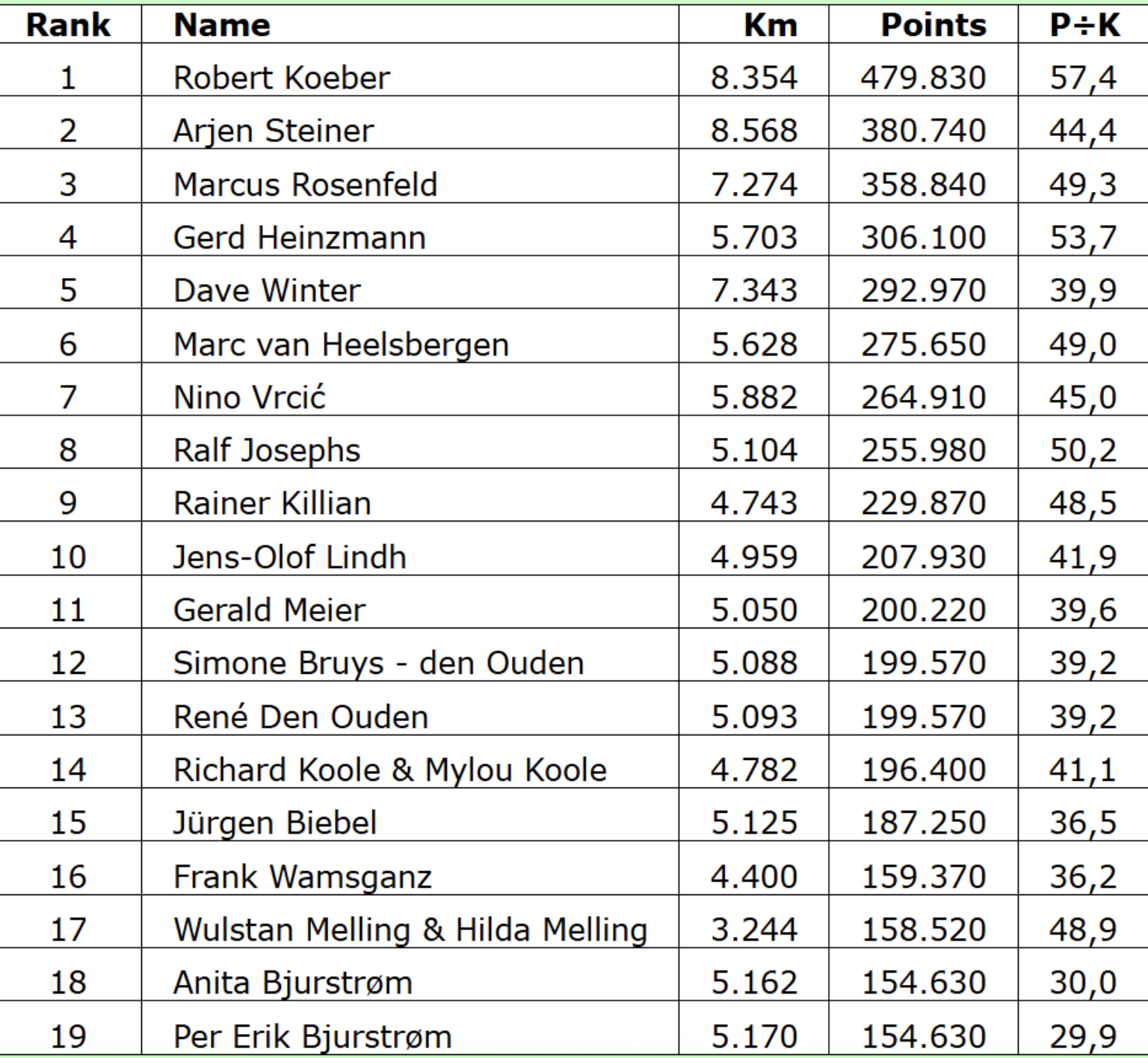
I was flabbergasted as I had genuinely not expected such a clear WOW! outcome. First place with a staggering result. We quickly moved to the restaurant where we continued sharing our tales, and there were many. What a great crowd.
Conclusion
The next day, I had a relaxed day riding home and had a few hours to muse about this rally. In my short speech at the ceremony, I had already summarised my first impressions. In essence, it was a fantastic rally, carefully crafted, with a clear concept. The mandatory minimum combo made it not too easy, so riders had quite a challenge to overcome. More than six days, many in southern heat was also a factor that could rival the conditions of an Iron Butt Rally. Comparing these two rallies seems somewhat implausible to do; a 6 Days rally here and a 11 Days rally there. BUT, it’s not just about the lengths and distances. Yes, the IBR may set the standard here, but rallying in Europe is so different from rallying in North America. Especially in this rally, a lot of locations were in remote places and roads are small and slow. IMHO, this makes riding so much more exhausting than in the IBR.
I had said it in the ceremony: I don’t know if this was the “best” rally ever, but it was definitely the most beautiful rally I have ever ridden. The locations were (almost all) spot on in terms of correct coordinates, a lot of special places in stunning locations and many motorcycling highlights had to be visited. This was not by accident, Gerhard the rally master and the rally team had carefully selected the best of the best. They also set a few snares, mostly in the form of daylight points that made planning more spicy. Brilliant work.
I have the impression that I never could keep the tension so high over so many days than in this rally. This was probably my best rally performance ever. I had a big plan and I could put it into practice, but also showing the flexibility to react adequately on the fly. I resisted adverse situations and remained cool, even when my BMW was close to a meltdown. What helped to motivate me was the knowledge that I could not linger about. Fellow rider Arjen has developed into a strong competitor over the last years. Knowing that he can perform very strongly made me show me my best performance. Competition is good for business.

 Hutzlmandl On Tour